 Bellingham
 Birch Bay sits right on the water, and that changes what a deck has to survive. Homes here deal with salt-laden air blowing off the bay, wind-driven rain that gets up under railings and ledger boards, and a moss season that can run most of the year in the shade of Whatcom County's tree cover. A deck built to a generic spec — the kind you'd get from a crew that mostly works inland — tends to show its age fast out here: soft spots at the ledger, corroded fasteners, slick green boards by December. A deck built for Birch Bay's actual conditions holds up. That's the difference we aim for on every replacement.
Why Birch Bay Decks Wear Out Faster Than Inland Decks
If your deck is 15-25 years old and starting to feel soft, spongy, or discolored, it's not just age — it's the environment. A few things are working against wood and hardware near the bay that don't apply the same way a few miles inland:
- Salt air accelerates corrosion. Standard fasteners, joist hangers, and hidden clips rust faster near saltwater, and once a fastener weakens, the connection it's holding — often a structural one — weakens with it.
- Driving rain finds every gap. Wind off the water doesn't just fall straight down; it pushes moisture sideways, under rail caps, behind fascia boards, and into ledger connections that were never flashed correctly to begin with.
- Shade and moisture grow moss and algae. Bellingham's long wet season plus tree cover on many Birch Bay lots means decking surfaces stay damp longer, which feeds moss growth and turns boards slick — a real fall hazard on stairs and landings.
- Freeze-thaw cycling opens up small cracks. Whatcom County doesn't get brutal winters, but repeated freeze-thaw on already-moisture-saturated wood widens hairline cracks year over year.
None of this means a deck can't last in Birch Bay — it means it has to be built and detailed for these conditions from the start, not treated as an afterthought.
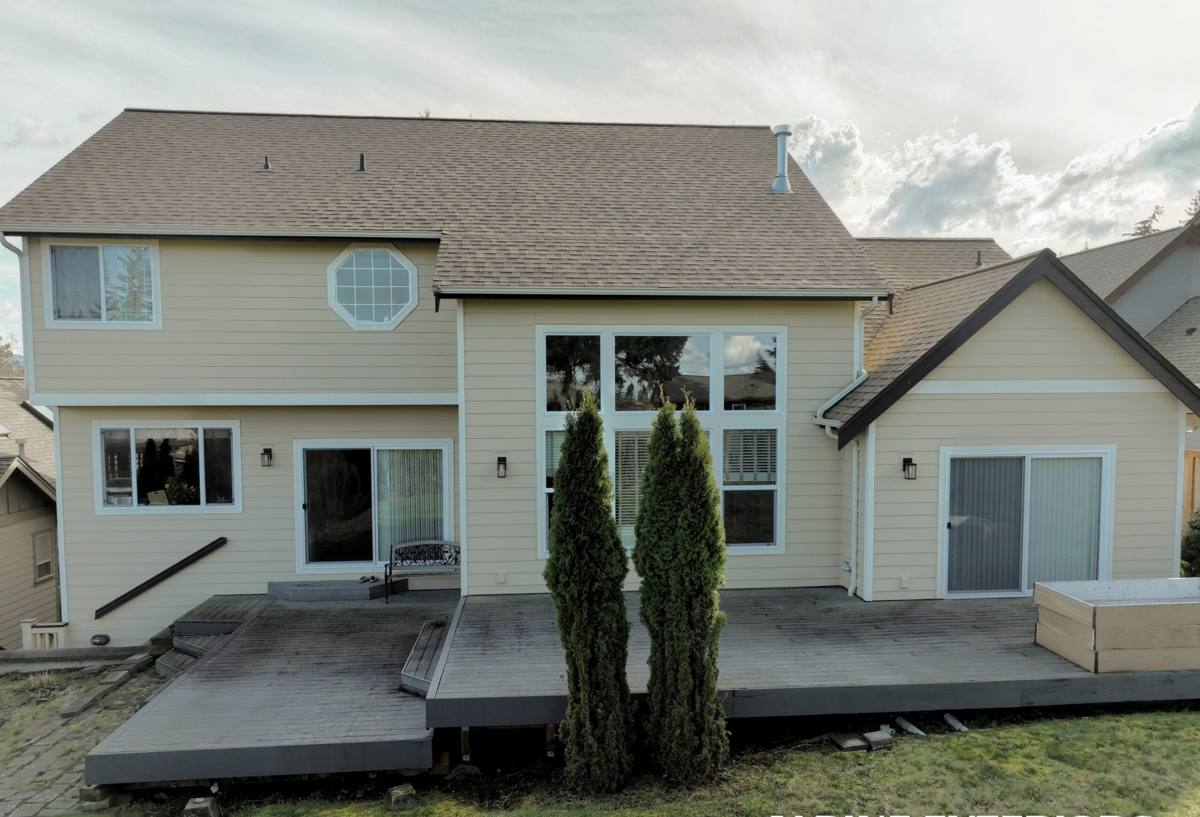
Signs Your Deck Needs Replacing, Not Just Repairing
Not every issue means a full tear-out. But there's a point where patching individual boards costs more over time than doing the job right once. Here's how we tell homeowners to think about it:
| Condition | Repair Likely Enough | Full Replacement Usually Needed |
|---|---|---|
| A few soft or cupped boards | Yes, if the frame underneath is sound | No |
| Soft or spongy spots at the ledger board | No | Yes — this is often a structural moisture problem |
| Rusted or corroded joist hangers/fasteners | Sometimes, if isolated | Yes, if widespread — corrosion doesn't stay contained |
| Persistent moss even after cleaning | Yes, cleaning and sealing may help | No, unless boards are also degraded underneath |
| Railing that flexes or feels loose | Sometimes | Yes, if posts are rotted at the base |
| Deck is 20+ years old with multiple issues | Rarely worth it | Yes — replacement cost per year of remaining life is usually better |
We'll always tell you honestly if repair makes more sense than replacement. A full replacement is a bigger investment, and we don't recommend it unless the structure or the pattern of damage actually calls for it.
The Ledger Board Is the Part We Check First
The ledger board — where the deck attaches to your house — is the single most common failure point on older decks near the water, and it's also the least visible from a casual look. Water that gets behind improperly flashed ledger connections doesn't just rot the ledger; it can work its way into the house's rim joist and wall framing. On a replacement, correcting ledger flashing is non-negotiable, not an upsell.
What a Correct Deck Replacement Involves
A deck replacement is more than swapping old boards for new ones. Done right, it's a full rebuild of everything that keeps water out and the structure sound:
- Full tear-out and inspection. We remove the old decking and structure down to the point where we can see the actual condition of ledger, posts, and any framing the deck ties into.
- Proper ledger flashing. Correct flashing detail — not caulk alone — is what keeps water from tracking behind the ledger and into the house.
- Corrosion-resistant hardware throughout. Given the salt air here, we use fasteners, joist hangers, and structural connectors rated for coastal exposure, not standard interior-grade hardware.
- Footings and posts sized and set correctly. Undersized or improperly set footings are a common shortcut on older decks and a common cause of movement over time.
- Decking material matched to how you'll actually use the space. Covered in the next section.
- Drainage and airflow underneath. Decks that trap moisture underneath — poor grading, no ventilation — stay damp longer and rot faster, moss or not.
- Permitting and inspection where required. Structural deck work in Whatcom County typically requires a permit; we handle that so you're not left holding an unpermitted structure at resale.
Decking Material Options for a Bay-Exposed Deck
There's no single "best" decking material — it depends on your budget, how much upkeep you're willing to do, and how much direct salt/wind exposure your specific lot gets. Here's how we walk homeowners through it:
| Material | Upfront Cost | Maintenance | How It Handles Birch Bay Conditions |
|---|---|---|---|
| Pressure-treated wood | Lowest | Needs regular sealing/staining, especially near salt air | Workable if maintained consistently; falls behind fast if neglected |
| Cedar | Moderate | Regular sealing to maintain color and resist moisture | Naturally moisture-resistant but still needs upkeep in wet, salty air |
| Composite decking | Higher | Low — occasional cleaning, no staining/sealing | Very strong choice here; resists moisture absorption and doesn't feed moss growth the way bare wood can |
| PVC decking | Highest | Lowest — cleaning only | Excellent moisture and salt resistance; best long-term option for heavy exposure areas |
For most Birch Bay homes we work on, composite or PVC decking earns its higher upfront cost back in reduced maintenance over the years — especially for decks that get direct wind off the water or sit in shaded, damp spots where wood would need constant attention. That said, some homeowners want the look and feel of real wood and are willing to keep up with sealing; we'll install that correctly too. It's a real trade-off, not a right-or-wrong choice, and we'll lay out the honest maintenance expectations either way rather than pushing whatever's easiest for us to install.
Railings and Fasteners Matter as Much as the Decking
A homeowner who upgrades to composite decking but keeps standard fasteners and a wood railing system hasn't solved the coastal-exposure problem — they've just moved it. We match hardware and railing materials to the same exposure standard as the decking itself, since a mismatched system just fails at a different point a few years later.
Our Deck Replacement Process
- On-site assessment. We inspect the existing deck, ledger, footings, and framing, and check for moisture damage that isn't visible from the surface.
- Honest scope and estimate. You get a clear breakdown of what needs replacing structurally versus what's cosmetic, and material options with real cost and maintenance trade-offs.
- Permitting. We pull the required permits before work starts, so the finished deck is documented and won't cause issues at resale or refinance.
- Tear-out. Old decking, railing, and any compromised structure comes out, with the framing exposed for inspection.
- Structural rebuild. Footings, posts, joists, and ledger flashing are corrected or rebuilt to current code and to coastal-exposure hardware standards.
- Decking and railing installation. Installed per manufacturer spec for whichever material you've chosen, with attention to proper spacing and fastening for wet-climate movement.
- Final walkthrough and inspection sign-off. We review the finished deck with you and make sure any required inspections are closed out.
Maintenance That Actually Matters Near the Bay
Whatever material you choose, a few habits make a real difference to how long a Birch Bay deck stays solid and safe:
- Sweep off standing debris and organic matter regularly — it's what feeds moss and algae growth in our wet season.
- Rinse salt residue off railings and hardware periodically if your lot has direct bay exposure.
- Check for slick, mossy spots on stairs and high-traffic areas going into fall and winter, and clean them before they become a fall hazard.
- For wood decking, keep to a real sealing schedule — skipping a year near the water costs more than it would inland.
- Have fastener and connection points glanced at every couple of years, since corrosion at hidden hardware is the failure mode you're least likely to notice on your own.
Why Hire a Crew That Already Works Birch Bay
Deck construction basics don't change from town to town, but the details that make a deck actually last do. A crew that regularly works Birch Bay and the surrounding Bellingham waterfront knows to flash ledgers for driving rain instead of standard rainfall, to spec hardware for salt exposure instead of general use, and to plan drainage for a climate where things don't fully dry out for months at a time. That's not something you can substitute with a generic install — it's the difference between a deck that needs major work again in eight years and one that holds up for decades.
We're a local Bellingham Siding crew, and Birch Bay is part of our regular service area — not a special trip. If your deck is showing its age, we're happy to come take a look, tell you honestly whether you're looking at repair or replacement, and walk you through material options that make sense for your lot's exposure. There's no pressure and no obligation — just use the form below to request a free estimate.