 Bellingham
 Exterior Work Built for Columbia's Climate
Columbia is one of Bellingham's older, established neighborhoods, and that means a lot of the homes here were built well before anyone was thinking hard about moisture management, rain screens, or how a wall assembly actually breathes. Whatcom County's marine climate is not gentle on exteriors. Homes in Columbia deal with salt-tinged air moving in off Bellingham Bay, long stretches of driving rain that comes in sideways during winter storms, and a moss season that can run most of the year on north-facing walls and anything shaded by mature trees. We've worked on enough houses in this part of Bellingham to know what holds up here and what doesn't.
This page covers how siding, roofing, windows, and decks perform in this specific environment, and why we've standardized our siding installs on one product line rather than offering a menu of options that all age differently.
What Bellingham's Climate Actually Does to a House
Moisture Load, Not Just Rainfall Totals
The number that matters isn't just annual rainfall — it's how long a wall surface stays wet. Bellingham gets long, low-intensity rain events rather than short downpours, and that means siding, trim, and flashing details stay damp for days at a stretch during fall and winter. Wood-based products swell and dry repeatedly through that cycle, and every cycle is a small opportunity for paint to crack, seams to open, or fasteners to loosen.
Salt Air Corrosion
Being close to Bellingham Bay means airborne salt reaches painted and metal surfaces on homes throughout the city, including inland neighborhoods like Columbia when wind direction cooperates. Salt accelerates corrosion on fasteners, flashing, and any exposed metal trim, and it can also affect how long a paint film holds its bond to certain substrates.
Moss, Algae, and North-Facing Walls
Shade, moisture, and mild temperatures are exactly what moss and algae need to establish themselves, and Whatcom County offers all three for most of the year. North-facing siding, roof valleys, and anything under tree cover will show green growth faster here than almost anywhere else in the state. That growth holds moisture against the surface underneath it, which is the real problem — the discoloration is cosmetic, but the trapped moisture is not.
Siding: Why We Only Install James Hardie
We get asked regularly why we don't offer vinyl, LP SmartSide, cedar, primed spruce, or fiber cement alternatives like Cemplank or Allura. It's a fair question, and the honest answer is that we made a standard for ourselves based on what we've seen perform, and what we've seen fail, on homes in this exact climate.
Wood and Wood-Composite Siding
Cedar and primed spruce look good on day one. The problem is what happens over the following ten to fifteen years in a climate that stays wet as long as ours does. Wood siding needs consistent repainting and caulk maintenance to keep water out of end grain and joints, and if that maintenance schedule slips even once, rot can start in places you can't see until the damage is significant. LP SmartSide improved on solid wood with an engineered strand product and factory treatment, and it performs reasonably well when installed and maintained correctly — but it's still a wood-based substrate, and wood-based substrates are the ones most sensitive to the wet-dry cycling this region puts them through.
Vinyl Siding
Vinyl is inexpensive and low-maintenance in the sense that it doesn't need paint, but it has real limitations in a coastal-adjacent climate. It expands and contracts significantly with temperature swings, which stresses seams and fasteners over time, and it's a poor insulator on its own. It also isn't fire-resistant and can deform under heat exposure. For a house that's going to sit in Bellingham's damp air for decades, we don't think it's the strongest long-term choice.
Other Fiber Cement Brands
Cemplank and Allura are legitimate fiber cement products, and fiber cement as a category is the right general direction — it's dimensionally stable, doesn't rot, and resists pests. Where we've landed on James Hardie specifically is the factory-applied ColorPlus finish, the HZ product engineering built around regional climate zones, and a warranty structure we're comfortable standing behind on every job. We'd rather install one product exceptionally well than offer four products at varying levels of confidence.
James Hardie Product Lines for This Climate
Hardie's HZ5 product line is engineered for climates like ours — colder, wetter regions where moisture cycling and freeze-thaw stress matter more than pure heat exposure. Fiber cement itself is non-combustible, doesn't absorb moisture the way wood does, and holds paint and factory finish far longer than wood-based sidings because the substrate itself isn't moving with humidity changes the way wood fibers do.
ColorPlus Factory Finish
ColorPlus is baked on at the factory under controlled conditions, which gives a more even, durable finish than field-applied paint and comes with its own finish warranty. For a neighborhood with moss growth and salt air working against painted surfaces year-round, starting with a finish that's tougher than typical field paint matters.
Panel and Plank Options
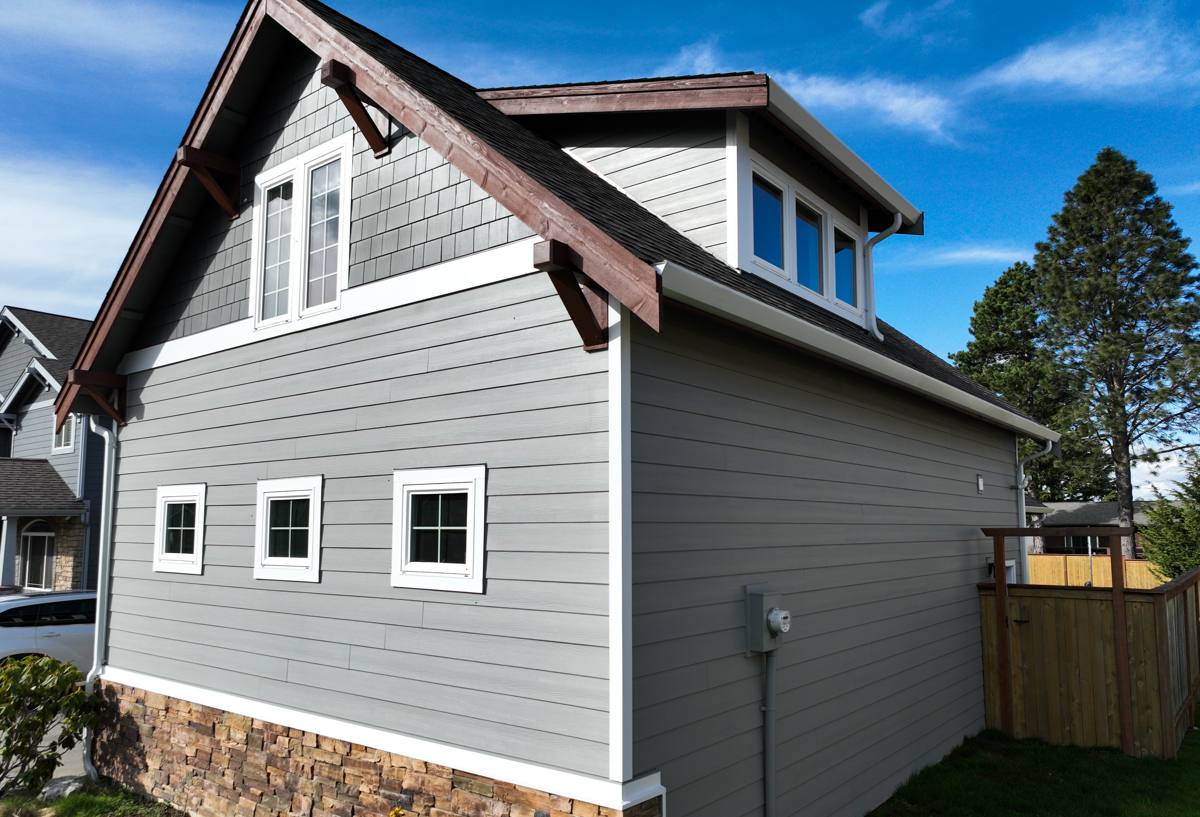
Lap siding, board-and-batten panels, and shingle-style panels are all available in the Hardie lineup, which gives Columbia's mix of older craftsman-style homes and newer builds a way to match existing architectural character rather than forcing every house into the same look.
| Siding Option | Moisture Resistance | Maintenance | Fire Resistance | Typical Lifespan |
|---|---|---|---|---|
| James Hardie Fiber Cement | Excellent | Low | Non-combustible | 30-50+ years |
| Cedar / Primed Spruce | Fair (maintenance-dependent) | High | Combustible | 15-25 years |
| LP SmartSide | Good (with intact treatment) | Moderate | Combustible | 20-30 years |
| Vinyl | Good (seams are weak points) | Low | Combustible/deforms | 15-25 years |
Roofing That Matches the Siding's Job
Siding and roofing work as one system, not two separate decisions. A roof with poor drainage or aging flashing will send water directly down onto siding and trim, which undermines even the best siding installation. In Columbia's tree-shaded lots, roof valleys and north slopes tend to hold moss longest, and moss on a roof does the same thing it does on a wall — it traps water against the surface underneath. We check roof condition, flashing, and gutter function as part of any siding project, because replacing siding underneath a roof that's still funneling water into the wall assembly doesn't solve the actual problem.
Windows: The Detail That Makes or Breaks a Siding Job
Most siding failures we see aren't failures of the siding material itself — they're failures at window and door openings, where flashing, house wrap integration, and caulking all have to work together to keep water out. Old or poorly flashed windows are one of the most common hidden moisture sources in older Bellingham homes. When we're already opening up a wall for siding replacement, it's the right time to address window flashing details properly, and often to talk about window replacement if the existing units are original to the house and showing seal failure or rot at the frames.
Decks: The Same Moisture Rules Apply
Decks in Columbia face the same driving rain and moss exposure as siding, but with the added stress of standing water on horizontal surfaces and direct foot traffic. Ledger board attachment, joist protection, and proper drainage away from the house are the details that determine whether a deck lasts one decade or three. A deck built or resurfaced without attention to those details will show rot at the ledger and support posts well before the decking boards themselves wear out.
How a Siding Project Works, Start to Finish
- On-site assessment of existing siding, moisture damage, window flashing, and roof drainage
- Removal of old siding and inspection of the sheathing underneath for rot or hidden damage
- Repair of any compromised sheathing or framing before new material goes up
- Installation of proper house wrap and flashing at every window, door, and penetration
- James Hardie siding installation to manufacturer spec, including correct fastening and clearances
- Final trim, caulking, and touch-up work at seams and corners
- Walkthrough with the homeowner before the job is closed out
What to Check Before You Hire Anyone
- Washington State contractor license and current liability insurance
- Experience specifically with fiber cement installation, not just general siding work
- Willingness to inspect sheathing before quoting a final price, not just the visible surface
- A written scope that specifies flashing and house wrap details, not just "install siding"
- References or completed work in Whatcom County, where the climate demands are the same you're facing
- A clear explanation of manufacturer warranty terms and what voids them
Why a Local Crew Matters Here
Installation quality is what determines whether any siding product performs for thirty years or fails in ten. Fiber cement in particular is sensitive to installation details — clearance from grade, fastener placement, joint treatment, and flashing integration all have to be done to spec or the material's real-world durability drops well below its potential. A crew that works in Whatcom County regularly understands how much moisture load these details need to handle, because we see the failures that come from cutting corners on other people's past work. That local, repeated exposure to this specific climate is worth more than a general contractor's siding experience from a drier region.
If you're weighing your options for a home in Columbia, we're happy to take a look and give you a straight, no-pressure estimate on siding, roofing, windows, or decks — whatever the house actually needs.