 Bellingham
 Siding Built for Lynden's Corner of Whatcom County
Lynden sits in the farmland and river-bottom country of Whatcom County, a short drive from Bellingham Bay and close enough to the Canadian border that the weather here has its own personality. It's quieter and more rural than the coastline, but it still sits under the same wet marine air mass that soaks Western Washington from October through May. Homes in Lynden don't get pounded by ocean surf, but they do sit in low fog, heavy dew, and long stretches of steady rain that never quite let a house dry out between storms. Add in the moss and algae that thrive in that kind of damp, shaded environment, and exterior surfaces here work harder than they do in drier parts of the state.
We're a Bellingham-based siding, roofing, window, and deck contractor, and Lynden is one of the communities we serve regularly. We're not a national franchise dispatching a different crew every visit — we're local, we know how Whatcom County weather treats a house over ten or twenty years, and we build every exterior job around that reality instead of around what looks good on a sunny install day.
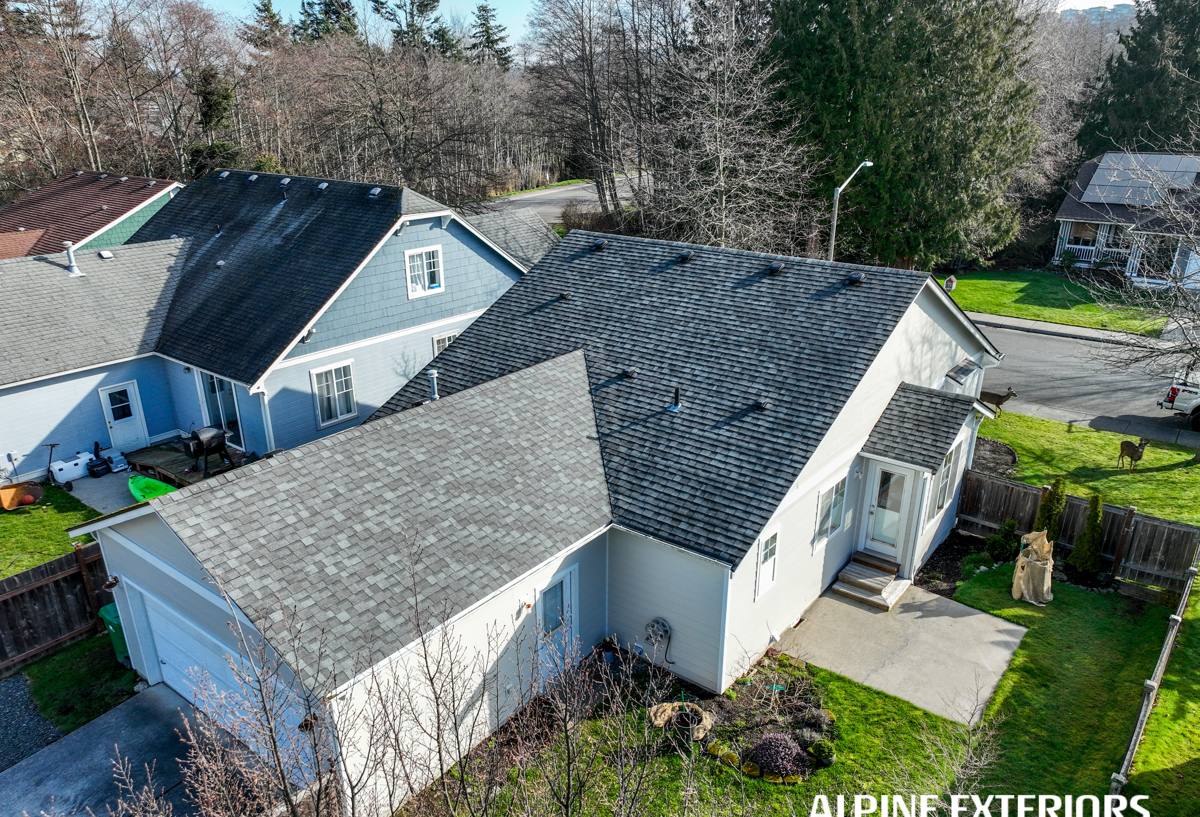
What the Climate Actually Does to a Lynden Home
It's easy to underestimate how much damage comes from moisture that never dries fast rather than moisture that falls hard. Lynden's combination of low-lying terrain, agricultural humidity, and the general dampness of Whatcom County creates conditions that are tough on certain building materials in specific, predictable ways.
Driving Rain and Wind-Driven Moisture
Storms coming off the Strait of Georgia and Puget Sound don't always fall straight down. Wind-driven rain gets pushed sideways into wall assemblies, especially around window trim, corner boards, and anywhere flashing details were rushed or skipped. Over years, that kind of moisture intrusion is what causes rot behind siding that looks fine from the curb.
Moss, Algae, and a Long Green Season
Shaded lots, tree cover, and consistently damp air give moss and algae a long growing season in this part of the county. Roofs are the most visible casualty, but siding, trim, and deck boards on the north and shaded sides of a house pick up the same growth if the material and finish don't resist it well.
Salt Air and Coastal Exposure
Lynden is inland compared to Bellingham's waterfront neighborhoods, so salt exposure here is lighter than it is right on the bay. It's still part of the broader Whatcom County coastal climate, though, and homes closer to the Nooksack corridor or open farmland can catch more wind-carried moisture than a sheltered in-town lot would. It's one more reason we evaluate every property individually rather than assuming every house in the area faces identical exposure.
Temperature Swings and Freeze-Thaw
Whatcom County winters aren't brutally cold, but they do dip below freezing regularly while staying damp. Materials that absorb moisture and then freeze are prone to cracking, swelling, and finish failure over time — a slow process that often isn't obvious until a homeowner is choosing paint colors for the third time in a decade.
Why We Install Only James Hardie Fiber Cement
We made a deliberate decision to install James Hardie fiber cement siding exclusively, and we don't install vinyl, LP SmartSide, cedar, primed spruce, or other fiber cement brands like Cemplank or Allura. That's not a marketing angle — it's a standard we hold because of what we've seen these products do, or fail to do, in exactly the kind of wet, moss-prone climate Lynden sits in.
Wood-based siding products, even engineered ones, rely on a resin-treated wood strand or solid wood substrate. In a climate this damp, any gap in the finish or flashing gives moisture a path into that substrate, and wood-based materials swell, delaminate, or rot once that happens. Vinyl holds up fine against moisture itself but expands and contracts with temperature swings, can crack in cold snaps, and fades unevenly over the long UV seasons we do get between rain systems. Other fiber cement brands may be reasonable products, but we've standardized on James Hardie specifically for its ColorPlus factory-applied finish, its HZ5 product engineering for the Pacific Northwest climate zone, and the depth of its installation documentation and warranty backing.
James Hardie fiber cement is non-combustible, doesn't feed moss and algae growth the way wood-based products can, and holds its factory finish far longer than field-applied paint on wood siding. It's also dimensionally stable — it doesn't swell and shrink with every wet-dry cycle the way wood products do, which matters enormously in a place where wet-dry cycles happen constantly for eight months of the year.
How Common Siding Materials Compare in This Climate
| Material | Moisture Behavior | Moss/Algae Resistance | Long-Term Maintenance |
|---|---|---|---|
| James Hardie Fiber Cement | Dimensionally stable, does not absorb and swell | Resists growth well with factory finish | Low — occasional wash, no repainting cycle |
| Vinyl Siding | Doesn't absorb moisture but can trap it behind panels | Moderate; growth on surface over time | Low labor, but cracks/fades and can't be repainted easily |
| Wood or LP SmartSide | Absorbs moisture at gaps, seams, cut edges | More susceptible in shaded, damp areas | Higher — periodic painting/sealing and inspection |
| Cedar | Natural material, prone to swelling and checking | Requires treatment to resist growth | Highest — regular staining or sealing |
Full Exterior Services for Lynden Properties
Siding is our core focus, but exterior systems work together, and a mismatched roof, window, or deck can undercut even the best siding installation. We handle all four:
Siding
Full James Hardie siding replacement and repair, including proper water-resistive barrier and flashing detail work — the part of the job that determines whether moisture problems show up five years down the road.
Roofing
Roof replacement and repair with attention to the same moss and moisture issues that affect siding. A roof that's shedding water properly protects everything below it, including your new siding.
Windows
Window replacement done in coordination with siding work so flashing and trim integrate correctly instead of being patched around old openings.
Decks
Deck construction and repair built for the same wet climate — proper drainage, ledger flashing, and materials chosen to hold up outdoors in Whatcom County weather.
What a Siding Project Looks Like
Every Lynden property is a little different — lot size, tree cover, sun exposure, and the age and condition of the existing walls all factor in. A typical project follows the same core process:
- On-site evaluation of existing siding, trim, and any moisture or rot damage
- Inspection of the water-resistive barrier and flashing once old siding is removed
- Repair of any damaged sheathing or framing found underneath before new siding goes on
- Installation of James Hardie panels, lap siding, or trim per manufacturer specification
- Detailed flashing and sealing at windows, doors, and roof intersections
- Final walkthrough covering warranty documentation and care recommendations
Why a Local Crew Matters Here
Contractors who don't work in Whatcom County regularly sometimes install exterior products the same way they would in a drier climate — tighter caulk-only seams instead of proper flashing, or product choices that perform fine in Eastern Washington but struggle here. We work in this weather every week. We know where water tends to find its way into a wall assembly on a Lynden property, and we build the flashing and drainage details to account for it, not just the visible finish.
Being local also means we're reachable after the job is done. If a warranty question comes up or you want an inspection a few years out, you're calling a crew that's still working in the area, not chasing down a company that moved on to the next region.
Maintaining Your Siding After Installation
James Hardie siding is low-maintenance, not no-maintenance. In a climate like this, a few habits go a long way:
- Rinse siding annually, especially on shaded or north-facing walls where moss and algae take hold first
- Keep gutters clear so overflow doesn't run directly down exterior walls
- Trim back vegetation and tree limbs that keep siding shaded and damp longer than necessary
- Have caulking and trim seams inspected periodically, particularly around windows and doors
Cost Factors for Lynden Siding Projects
Every quote depends on the specifics of the property, but a few factors consistently move the price:
| Factor | Why It Matters |
|---|---|
| Home size and wall complexity | More corners, gables, and dormers mean more cutting, trim, and labor time |
| Condition of existing sheathing | Rot or water damage found during tear-off requires repair before new siding goes on |
| Siding profile and finish selection | Lap siding, panel systems, and trim styles vary in material and installation cost |
| Access and site conditions | Tree cover, fencing, or tight lot lines can affect equipment and staging |
We provide honest, itemized estimates rather than vague ballpark numbers, so you know what you're actually paying for.
Get a Free Estimate
If you're weighing a siding, roofing, window, or deck project on a Lynden property, we're happy to take a look and walk you through what we see — no pressure, no obligation. Use the form below to request a free estimate and we'll get back to you to schedule a time that works.