 Bellingham
 Exterior Work Built for the Puget Area's Climate
Homes in and around the Puget area of Bellingham sit close enough to the water and the weather patterns that move through Whatcom County that they take a different kind of beating than a house fifty miles inland. Salt-laden air, driving rain that comes in sideways off Bellingham Bay, and a moss season that can stretch from October through May all work on a home's exterior at the same time, year after year. We're a local crew that works this area regularly, and we've built our siding, roofing, window, and deck services around what actually holds up here — not around what looks good in a showroom in a drier climate.
This page is about what we do for homes in the Puget neighborhood specifically: what the climate does to exteriors here, how we approach the work, and why we standardized on one siding product instead of offering the usual lineup of options.
What Puget-Area Homes Are Up Against
Salt Air and Moisture
Proximity to salt water changes how fast fasteners corrode, how paint film breaks down, and how quickly bare or under-protected wood starts to fail. It's not dramatic — it's slow, steady wear that shows up as premature caulk failure, rust streaking at nail heads, and paint that needs recoating years sooner than the same product would need inland.
Driving Rain
Whatcom County gets its share of straight-down rain, but the storms that come off the water often push rain sideways into walls, under trim, and into any gap in the building envelope that wouldn't be a problem in calmer weather. Wind-driven rain finds the weak points in flashing, siding laps, and window trim that a fair-weather installation might get away with elsewhere.
The Long Moss Season
Shade, moisture, and mild temperatures are exactly what moss and algae need, and this area supplies all three for most of the year. Roofs, north-facing siding, and shaded decks are the first places it shows up. Left alone, moss holds moisture against a surface far longer than open air would, which accelerates rot in wood components and shortens the life of shingles.
Siding: Why We Only Install James Hardie
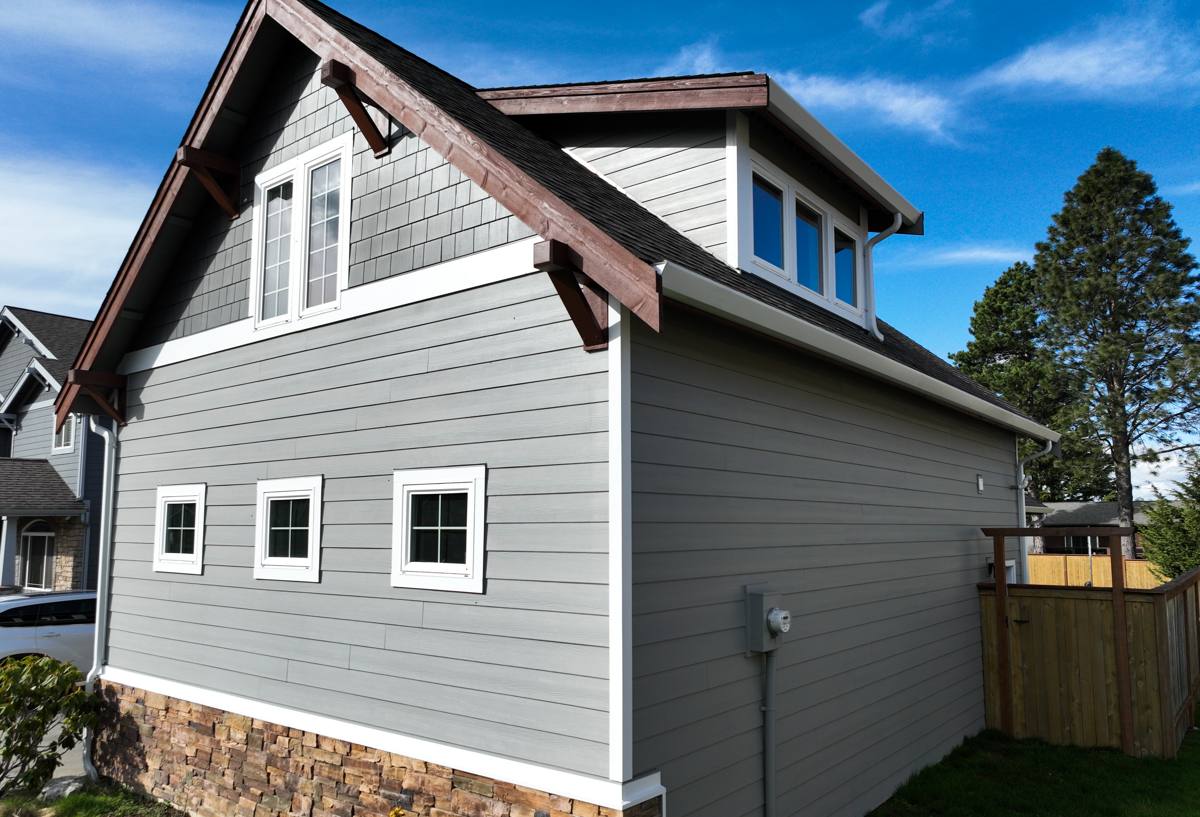
We get asked fairly often why we don't offer vinyl, LP SmartSide, or primed wood siding alongside Hardie fiber cement. The honest answer is that we made a call as a company: we'd rather install one product very well than install several products at a mediocre standard, and for this climate, fiber cement is the one that holds up with the least maintenance drama.
Vinyl
Vinyl is affordable and low-maintenance in a lot of climates, and we're not going to pretend otherwise. But it's a thin material that expands and contracts with temperature swings, and in wind-driven rain it depends heavily on correct lap and flashing work to keep water out from behind it. It also doesn't hold up well to impact, and color is baked into the material itself, so fading over years of coastal sun and salt exposure can't be touched up — the whole piece has to be replaced.
LP SmartSide and Primed Wood/Spruce
Engineered wood and primed wood products are wood-based, which means their long-term performance depends entirely on the paint film and caulking staying intact. In a climate with this much sustained moisture and a moss season this long, any breach in that protective layer — a missed caulk joint, a ding, a spot where paint wears thin — gives moisture a path into the wood. Once that starts, it's progressive, and it's hidden behind the siding until it's a bigger repair than anyone wanted.
What Fiber Cement Gets Right
James Hardie fiber cement is non-combustible, dimensionally stable across temperature and humidity swings, and comes with a factory-applied ColorPlus finish that's baked on rather than field-painted — meaning the color coat itself is engineered to resist fading and doesn't rely on a contractor's field paint job for its warranty life. Hardie also makes climate-specific HZ product lines engineered for exactly the kind of moisture exposure this region deals with. It's not a miracle material — it still has to be installed correctly, with proper clearances, flashing, and fastening — but it gives us a product whose weak points are ones we can control through installation quality, not weak points baked into the material itself.
| Factor | Vinyl | Wood/LP SmartSide | James Hardie Fiber Cement |
|---|---|---|---|
| Moisture tolerance | Depends on lap/flashing detail | Depends on paint/caulk integrity | Engineered for wet climates (HZ lines) |
| Combustibility | Combustible | Combustible | Non-combustible |
| Finish | Color molded in, fades over time | Field or factory paint, needs recoating | Factory ColorPlus finish |
| Repair if damaged | Panel replacement, color match issues | Spot repair, repaint needed | Panel replacement, factory-matched color |
| Typical warranty structure | Varies by manufacturer | Varies, often shorter | Long-term, transferable |
Roofing for Moss, Wind, and Sustained Rain
A roof in this area has two jobs: shed a lot of water fast, and resist moss and algae growth in the shaded, north-facing sections that stay damp longest. We look at ventilation, underlayment quality, and flashing detail at every valley, chimney, and roof-to-wall transition — those are the spots that fail first when wind-driven rain is part of the equation, not just straight-down rain. We'll also talk honestly about moss prevention strategy for a given roof's exposure, since not every roof needs the same approach.
Windows: The Weak Point Most Homeowners Don't Think About
Old or poorly sealed windows are one of the most common places we find hidden water intrusion during siding and exterior projects in this area. Wind-driven rain pushes moisture into gaps around frames that wouldn't leak in a calmer climate. When we replace siding, we check window flashing and integration as part of the job — a new siding job installed around a leaking window just hides the problem instead of fixing it.
What Correct Window Integration Involves
- Proper flashing tape and pan flashing at the sill, not just caulk
- Head flashing that sheds water out and away from the wall assembly
- Correct sequencing with the water-resistive barrier so water drains down and out, not into the wall cavity
- Sealant at the right joints only — over-sealing can trap moisture instead of releasing it
Decks: Built for a Wet, Shaded Climate
Decks in this area deal with the same moss and sustained-moisture issues as roofs, plus standing water on horizontal surfaces if drainage and slope aren't handled correctly at the build stage. We pay attention to board spacing, ledger flashing where the deck meets the house, and joist protection — the parts of a deck that aren't visible after the project is done but determine how long it lasts before rot becomes an issue.
Why a Local Crew Matters Here
A crew that works Whatcom County regularly knows which details matter for this specific mix of salt air, wind-driven rain, and moss exposure — and which generic installation shortcuts that work fine in a drier climate don't hold up here. We're not driving in from out of the area to do a job and disappear; we're working in these conditions on a regular basis, which shapes how we flash a window, lap a course of siding, or detail a roof valley.
What to Expect From a Project
Before We Start
- An on-site look at your home's specific exposure — sun, shade, wind direction, existing moisture damage
- An honest assessment of what's driving the need for the work, not just a sales pitch
- A clear, written scope so you know what's included before anything is signed
During the Work
We keep the site reasonably clean and protected, sequence the work to minimize the time your home's envelope is open to weather, and flag anything unexpected we find once old siding, roofing, or trim comes off — hidden rot or old damage doesn't always show until the exterior is opened up.
Cost Factors to Expect
| Factor | How It Affects the Estimate |
|---|---|
| Home size and complexity | More corners, dormers, and transitions mean more labor and material cutting |
| Condition underneath existing siding/roofing | Hidden rot or moisture damage adds repair scope once discovered |
| Product line and trim details | Hardie panel vs. lap profile, trim width, and color selection affect material cost |
| Access and site conditions | Slopes, tight lots, and landscaping can affect labor time |
If your home in the Puget area is showing early signs of wear from salt air, wind-driven rain, or a season of moss buildup, we're glad to take a look and give you a straightforward, no-pressure estimate — no obligation, just an honest read on what your home needs.