 Bellingham
 A Ferndale Contractor Who Builds for This Climate, Not a Generic One
Ferndale sits in a stretch of Whatcom County where open, low-lying farmland meets marine air moving in off the water, and that combination shapes what a house's exterior has to deal with year-round. Homeowners here aren't fighting one problem — they're fighting three at once: salt-laden air that eats away at fasteners and finishes, rain that comes in sideways on windy days instead of falling straight down, and a moss and mildew season that can run most of the calendar on shaded walls and north-facing trim. A siding contractor working in Ferndale needs to understand all three, not just show up with whatever material is cheapest to install that week.
We install James Hardie fiber cement siding exclusively, in Ferndale and across the rest of our Whatcom County service area. It's the one system we've found holds up consistently under this specific mix of coastal exposure and sustained moisture, and we'd rather turn down a job than install something we don't fully stand behind.
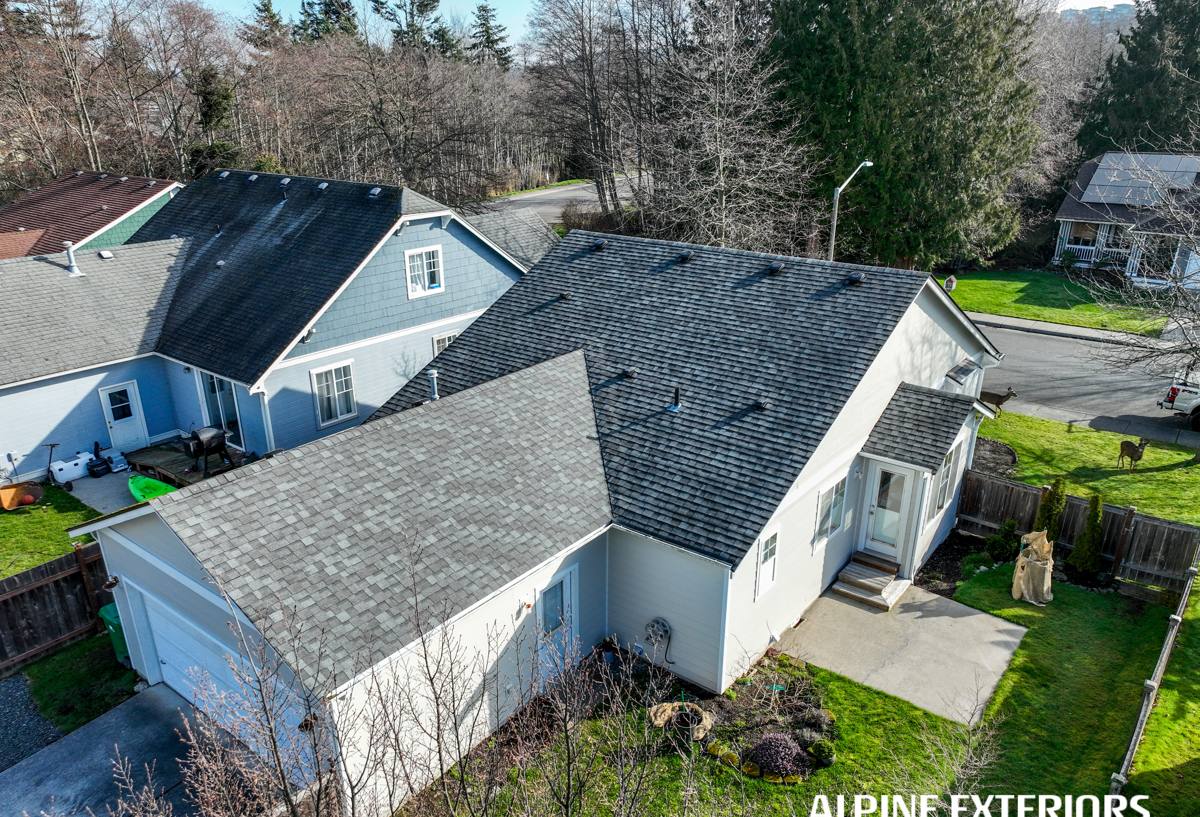
What Ferndale's Weather Actually Does to a House
Salt Air and Slow Corrosion
Ferndale doesn't have to sit right on the shoreline for salt to be a factor. Marine air carries salt inland on prevailing winds, and it settles on everything — siding surfaces, exposed fasteners, flashing, and trim. Salt accelerates corrosion in lower-grade hardware and can degrade weak finishes faster than you'd see in a drier inland climate. It's a slow process, which is exactly why it's easy to underestimate until a homeowner is dealing with rust streaks or failed fasteners a few years into a siding job that should have lasted decades.
Wind-Driven Rain
Annual rainfall totals don't tell the whole story here. What matters more is that a lot of that rain arrives sideways, pushed by wind into lap joints, trim seams, and anywhere a wall assembly has a gap. That's a harder load to manage than straight-down rain, and it's the reason siding systems that perform fine in calmer, drier regions can still fail in this one — not because the material is bad everywhere, but because it wasn't built for water finding its way in from an angle.
A Long Moss and Mildew Season
Mild temperatures, shade from trees and neighboring structures, and near-constant moisture add up to a moss and mildew season that can stretch across most of the year in Whatcom County. Any siding material that's even slightly porous, or that holds moisture against the substrate instead of shedding it, becomes a growth surface over time. It usually starts quietly on north-facing walls before it's visible from the street, which is why regular inspection matters as much as the initial material choice.
Why We Only Install James Hardie Siding
We didn't start out installing a single product line. Over years of tear-offs, repair calls, and service work across this climate, a pattern became obvious: certain materials held up, and others quietly failed in ways that showed up as callbacks two or three winters later. That's what pushed us to standardize on James Hardie fiber cement rather than offering a menu of options and letting price alone decide.
- Non-combustible core: Fiber cement doesn't feed a fire the way wood-based siding products can, which matters for household safety and can matter for insurance underwriting as well.
- Factory-applied ColorPlus finish: The color is baked on in a controlled factory process, not brushed on in the field, so it resists fading, chalking, and moisture damage far longer than site-applied paint.
- HZ5 formulation for this region: Hardie engineers specific product lines for different climate zones, and the HZ5 formulation is built for areas with heavy moisture exposure and freeze-thaw cycling — a good match for coastal Whatcom County.
- Dimensional stability: Fiber cement doesn't swell, cup, or warp the way engineered wood products can after repeated wet-season moisture cycles.
- A strong transferable warranty: Hardie's warranty structure is one of the more robust in the industry, provided the installation follows manufacturer spec.
We don't install LP SmartSide, vinyl siding, Cemplank, Allura, primed spruce, or cedar. That's not a claim that those products have no place in the market — plenty of homeowners are happy with them, in the right climate and application. It's a professional call we made for our own work: given how much sustained moisture and salt exposure this region deals with, we'd rather commit fully to one system than spread ourselves across several and quietly shift the maintenance risk onto the homeowner down the road.
What a Correct James Hardie Installation Involves
Fastening and Flashing
Fiber cement performs the way it's designed to only when it's installed the way it's designed to be installed. That means correct fastener spacing and depth, properly lapped and sealed joints, and flashing details at windows, doors, and roof-to-wall transitions that actually direct water out and away instead of trapping it. Skipping or rushing any of these steps is one of the most common ways a good product ends up with callbacks that have nothing to do with the material itself.
Clearances and Drainage
Correct ground and roofline clearances, a functioning drainage plane behind the siding, and house wrap that's integrated properly with the flashing all matter as much as the visible finish. On a Ferndale property with wind-driven rain to account for, a wall assembly that manages water at every layer — not just the top coat — is what actually keeps a home dry through the wet season.
Signs Your Ferndale Home's Siding Needs Attention
- Moss or dark staining that returns quickly after cleaning, especially on shaded or north-facing walls
- Soft or spongy siding, particularly near the base of the wall or around window and door trim
- Paint that's peeling, bubbling, or chalking well before it should
- Visible warping, cupping, or cracked boards
- Gaps opening up at seams, corners, or trim joints
- Rising heating bills that could point to a wall assembly no longer sealing the way it used to
Any one of these on its own might be minor. Several showing up together, especially on the same wall, usually means moisture has been getting behind the siding for a while.
What Drives Siding Cost in Ferndale
| Factor | What It Affects | Why It Matters in This Climate |
|---|---|---|
| Home size and wall complexity | Total material and labor | More corners, dormers, and trim joints mean more places wind-driven rain can intrude |
| Tear-off vs. overlay | Labor scope and access to the substrate | Tear-off often reveals moisture damage that's common under older siding in this region |
| Substrate condition | Repair costs before new siding is installed | Years of trapped moisture can rot sheathing and framing behind failing siding |
| Color and trim selection | Material cost and long-term finish life | Factory-applied ColorPlus finishes hold up better against salt air and UV than field-applied paint |
| Lot and site access | Labor time and equipment staging | Larger or tree-shaded lots common in Ferndale can add setup time |
These are the variables that move a price up or down — we don't quote off a generic price sheet because none of them are the same from one house to the next. A real number comes from walking the property.
Repair, or Full Replacement?
Not every siding issue in Ferndale means starting over. A section damaged by storm impact, or trim that's failed around a single window, can often be repaired and matched into existing James Hardie siding without touching the rest of the wall. But when moisture has clearly been tracking behind the siding for an extended period, or the existing material is an older product near the end of its service life, patching it usually just delays a larger job and adds cost later. We'll give you a straight answer about which situation you're actually in.
Roofing, Windows, and Decks — One Connected Exterior
Siding damage often isn't caused by the siding itself. A poorly flashed window, a roof valley that's been leaking quietly, or a deck ledger board holding moisture against the house can all show up as rot or staining on the wall nearby. Because we handle roofing, windows, and decks along with siding, we look at a Ferndale home as one connected exterior system when we're diagnosing a problem, rather than treating a wall in isolation and missing where the water is actually coming from.
Why Hiring a Local Whatcom County Crew Matters
A crew that works this county year-round sees firsthand how salt air, wind-driven rain, and a long moss season actually behave on real houses across full seasons, not just how a product performs in a manufacturer's spec sheet. That kind of repeated, local exposure shapes decisions on install day — which wall orientations need extra flashing attention, how much clearance actually matters on a shaded lot, and which details are worth the extra time so a homeowner isn't dealing with a callback two winters later. Ferndale's mix of open terrain and marine air exposure isn't identical to every other town in Whatcom County, and a contractor who works here regularly accounts for that instead of applying the same approach everywhere.
If your Ferndale home needs new James Hardie siding, a repair, or just an honest look at what's happening behind an aging wall, we're glad to take a look. Use the form below to schedule a free, no-pressure estimate.