 Bellingham
 Siding Built for Fairhaven's Marine Climate
Fairhaven sits close enough to the water that its homes deal with a different set of exterior stresses than houses further inland in Whatcom County. Salt-laden air off Bellingham Bay, wind-driven rain that comes in sideways during the wetter months, and a moss and algae season that can stretch most of the year all work on exterior siding in ways that add up over time. If you own a home in Fairhaven, you've probably already noticed how quickly north-facing walls or shaded siding can pick up green growth, or how paint and caulk lines seem to fail faster here than they might somewhere drier.
We're a local crew that works throughout Bellingham and Whatcom County, and Fairhaven is one of the neighborhoods where we spend a lot of time. That matters because siding decisions that work fine in a dry inland climate don't always hold up the same way a few blocks from saltwater. We install James Hardie fiber cement siding exclusively, and for homes in this kind of environment, the reasons why go beyond a preference — they're rooted in what actually survives here.
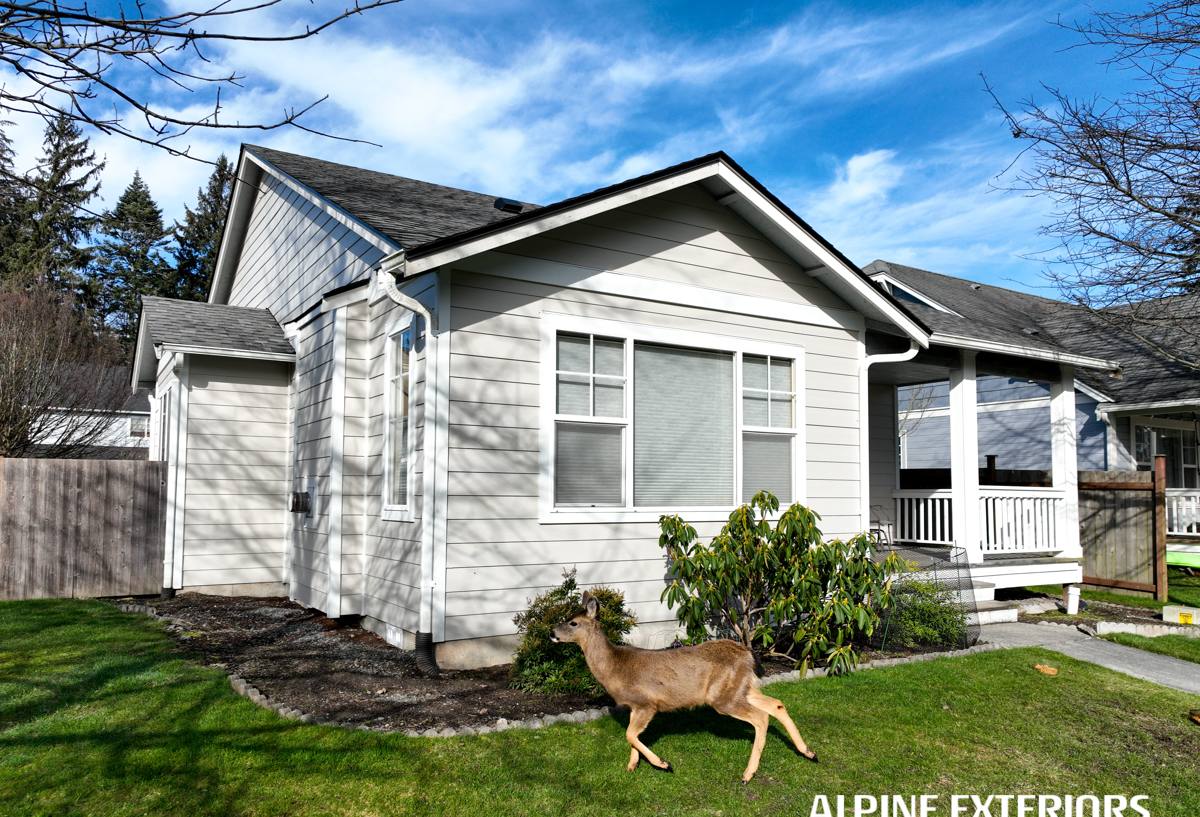
What Fairhaven's Climate Does to Siding
Salt Air and Corrosion
Airborne salt doesn't just affect metal fasteners and flashing — it accelerates the breakdown of certain siding materials and finishes faster than inland exposure would. Salt-laden moisture gets into seams, joints, and any place water can sit, and it speeds up wear on caulking, trim, and lower-quality paint systems. Homes closer to the water tend to need more frequent maintenance simply because of this constant low-level exposure.
Driving Rain and Wind-Driven Moisture
Bellingham gets a lot of rain overall, but the kind that matters most for siding performance is wind-driven rain — moisture pushed sideways into wall assemblies rather than falling straight down and running off. Fairhaven's position relative to the water and prevailing weather patterns means many homes take on more of this sideways moisture load than a similar house set further inland. That makes water management at seams, laps, and penetrations (windows, vents, hose bibs) a bigger deal here than in a drier region.
Moss, Algae, and Shade
Between tree cover common in many Fairhaven yards and the region's damp, mild climate, moss and algae growth on siding is close to a year-round concern rather than a seasonal one. Shaded walls and areas that don't get much direct sun dry out slowly after rain, which gives organic growth more time to establish. Materials that hold moisture at the surface, or that have seams and edges where debris collects, tend to show this the most.
Why We Install James Hardie and Not Alternatives
We get asked fairly often why we don't offer vinyl, LP SmartSide, or other fiber cement brands. It's not that those products don't have a place in the market — it's that for the climate we work in, and for the standard we've decided to hold ourselves to, James Hardie is the product we're willing to put our name behind.
Vinyl
Vinyl siding is inexpensive and low-maintenance in a general sense, but it's a petroleum-based product that expands and contracts significantly with temperature swings, and its seams and panel laps are places where wind-driven rain can find a way behind the cladding over time. In a marine environment with sustained moisture exposure, that's a trade-off we'd rather not make on a homeowner's behalf.
Wood-Based Composite Siding (LP SmartSide)
Engineered wood siding has improved a great deal over the decades, but it's still a wood-fiber product at its core, which means it's more sensitive to sustained moisture than fiber cement. In a climate with a long wet season and heavy moss pressure, that sensitivity is exactly the vulnerability we're trying to design around, not toward.
Other Fiber Cement Brands
Some competing fiber cement products are reasonable alternatives on paper. Our decision to standardize on James Hardie specifically comes down to their factory-applied ColorPlus finish, their HZ product lines engineered for specific climate zones (the Pacific Northwest falls under their HZ5 designation), and a warranty structure we consider strong and genuinely backed. Consistency also matters to us — training one crew to install one system correctly, to spec, every time, produces better results than spreading expertise across multiple product lines.
James Hardie: The Basics for a Fairhaven Home
| Feature | What It Means for Fairhaven Homes |
|---|---|
| Non-combustible fiber cement | Doesn't feed a fire the way wood-based products can; relevant given regional wildfire smoke seasons |
| ColorPlus factory finish | Baked-on finish resists fading and holds up better against salt air than field-applied paint |
| HZ5 climate engineering | Formulated for regions with sustained moisture exposure, like coastal Whatcom County |
| Dense, moisture-resistant core | Resists the swelling and softening that moisture-heavy climates cause in wood-based siding |
| Transferable warranty | Adds resale value — a real consideration in a desirable neighborhood like Fairhaven |
Installation Details That Matter in This Climate
The product itself is only part of the equation. Fiber cement siding performs the way it's supposed to only when it's installed correctly, and in a climate like Fairhaven's, small installation shortcuts show up faster than they would in a milder region.
- Proper clearance between siding and grade, decks, and roof lines to prevent standing moisture contact
- Correct fastening patterns and fastener spacing per Hardie's published specs, not generic guidelines
- Weather-resistant barrier and flashing detail work at every window, door, and penetration
- Properly caulked and sealed joints, especially at butt seams and trim intersections
- Rainscreen or ventilation gap consideration where appropriate, to let walls dry out between wet spells
- Panel and trim gaps sized correctly to allow for expansion without forcing water intrusion points
A lot of the siding problems we get called out to look at in this area trace back to one of these details being skipped, not to a failure of the material itself.
Beyond Siding: Roofing, Windows, and Decks in Fairhaven
Siding doesn't operate in isolation on a house. Roofing, windows, and decks all interact with the same water management and moisture concerns that drive our siding recommendations, and we handle all four so that the whole exterior envelope works together instead of being patched together by separate trades on separate timelines.
Roofing
A roof in poor condition sends water where it shouldn't go, including behind or down onto siding at the roofline. Addressing roofing issues at the same time as siding work often prevents a second round of damage down the road.
Windows
Window flashing and integration with the siding system is one of the most common failure points on any home. When we replace siding, we pay close attention to how it ties into existing or new window flashing, since this is a frequent source of hidden moisture intrusion.
Decks
Where a deck attaches to a house, siding and structural framing meet in a spot that's exposed to a lot of moisture cycling. Coordinating deck and siding work helps avoid the gaps and improvised transitions that cause problems later.
Why a Local Crew Matters for Fairhaven Homes
Whatcom County's building requirements, coastal exposure zones, and typical construction styles vary somewhat from neighborhood to neighborhood, and Fairhaven's older housing stock and proximity to the water mean it has its own quirks compared to, say, a newer subdivision further inland. A crew that works this area regularly knows what tends to go wrong on homes like these, what inspectors here are looking for, and how to plan a project around the region's rain patterns rather than fighting them.
Working locally also means we're not far away if a warranty question or a maintenance question comes up after the job is done. That's a real advantage over a crew that flies in from out of the area for a single project.
Cost Factors for Fairhaven Siding Projects
| Factor | Why It Affects Cost |
|---|---|
| Home size and complexity | More square footage, corners, and trim detail means more material and labor time |
| Existing siding removal | Tear-off of old material and any moisture damage repair adds time before new siding goes on |
| Siding profile and trim selection | Lap width, panel vs. plank style, and trim detail level all affect material cost |
| Access and site conditions | Tight lots, slopes, or limited staging area near the water can affect labor efficiency |
| Combined scope | Bundling siding with roofing, window, or deck work can improve overall efficiency and sequencing |
What to Expect When You Work With Us
We walk every home in person before quoting anything, because moisture damage, ventilation issues, and trim condition aren't things you can accurately assess from a photo or a satellite view. From there we put together a clear, specific scope — what's being replaced, what product and colors are being used, and what the installation plan looks like — so there aren't surprises once work starts.
If you're weighing a siding project in Fairhaven, whether it's a full replacement, a repair after storm damage, or you're just trying to understand your options before committing to anything, we're happy to take a look and give you a straightforward, no-pressure estimate.