 Bellingham
 Happy Valley's Exterior Challenge
Happy Valley is one of Bellingham's older, well-established neighborhoods, and homes there run the gamut from early-1900s craftsman-style houses to mid-century builds and newer infill construction. What they share is exposure to the same weather pattern that defines exterior work across Whatcom County: salt-tinged air off Bellingham Bay, driving rain that comes sideways more often than straight down, and a heavy tree canopy that keeps large sections of siding, roofing, and decking in the shade for much of the year. That combination is hard on building materials in ways that don't show up immediately — it shows up five, ten, or fifteen years in, as moisture damage, moss growth, and paint failure that a homeowner in a drier climate simply doesn't have to plan for.
We work on homes throughout this part of Bellingham regularly, and the patterns repeat: north- and west-facing walls that never fully dry out, roof valleys and gutter lines that collect moss and organic debris, and original wood trim or siding that's been repainted every few years just to keep moisture out. Understanding why that happens is the first step in choosing exterior materials that actually hold up here instead of just looking good on installation day.
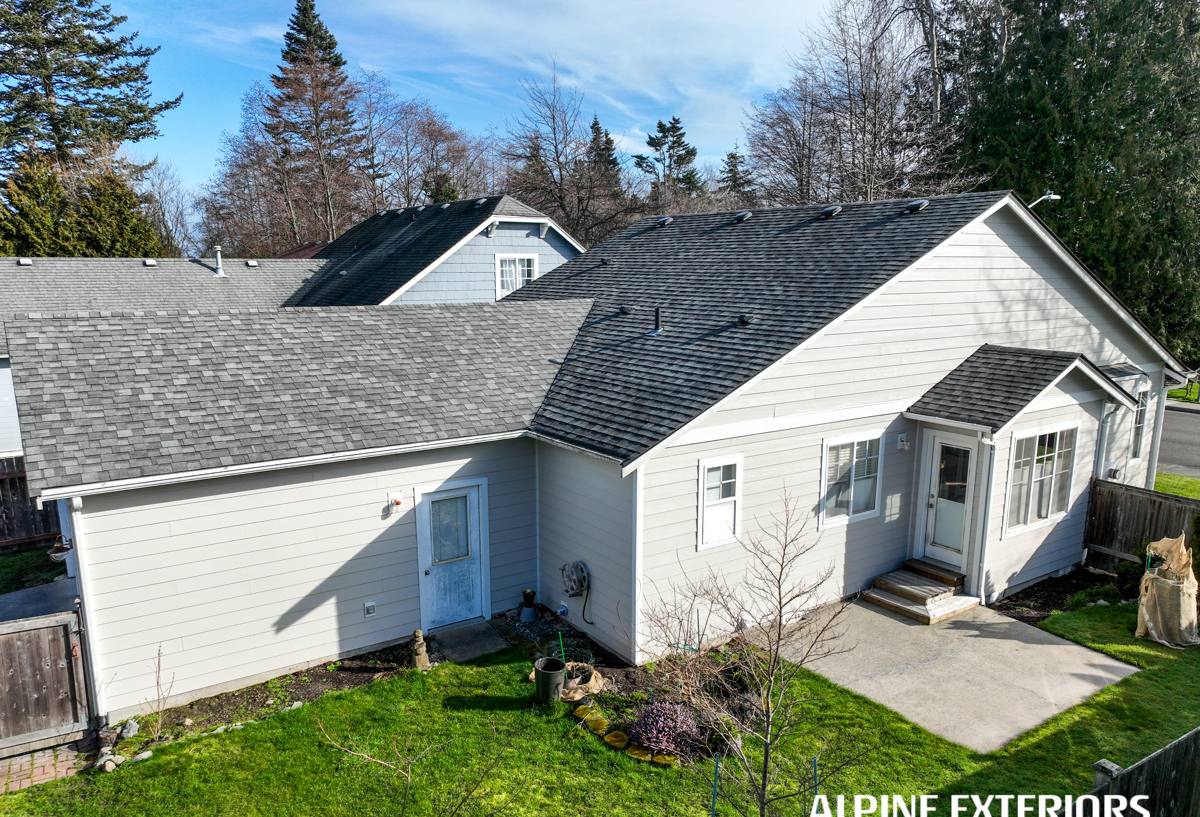
Salt Air and Coastal Moisture
Being close to Bellingham Bay means homes in this area deal with airborne salt in addition to ordinary rain. Salt-laden moisture accelerates corrosion on fasteners, flashing, and any metal component on a house, and it's tougher on porous or absorbent siding materials than inland rain alone. Wood-based products — cedar, primed spruce, and engineered wood siding like LP SmartSide — are particularly sensitive to this combination of salt and standing moisture, because their wood fiber content will absorb water at cut edges, seams, and fastener penetrations if the finish isn't perfectly maintained. Once moisture gets behind the surface layer, it doesn't evaporate quickly in our climate, and that's when rot and swelling start.
Vinyl siding handles salt air better than wood products in one sense — it won't rot — but it has its own coastal weakness: prolonged UV and salt exposure can fade and chalk the surface over time, and vinyl's loose-hung installation style leaves gaps where wind-driven rain can get behind the panels during the kind of storms this area sees several times a winter.
Why This Matters for Material Choice
None of this means a house near the bay can't be sided well — it means the material and the installation detailing both have to be chosen with coastal exposure in mind, not just cost or appearance. That's a big part of why we standardized on one product rather than offering everything on the market.
The Long Moss Season
Whatcom County's moss season is long — realistically, moisture stays present in shaded areas for most of the year, not just the wettest winter months. On a Happy Valley property with mature trees, north-facing exposure, or a roofline that shades part of the siding, moss and algae will colonize any surface that holds moisture and organic debris: roofing, siding, deck boards, and even window sills. Moss isn't just cosmetic. It holds water against the surface underneath it, and on wood-based products that moisture retention is what eventually leads to soft spots, delamination, and rot at seams and edges.
This is where the difference between siding products becomes very practical. A fiber cement product with a factory-applied finish resists moss staining and doesn't provide the same food source and water-holding surface that raw or lightly primed wood does. It still needs occasional cleaning in heavily shaded spots, but it isn't degrading structurally the way wood-based siding can when moss sits on it season after season.
Why We Install Only James Hardie Fiber Cement Siding
We made a deliberate decision years ago to install James Hardie fiber cement exclusively — not vinyl, not LP SmartSide, not Cemplank or Allura, not primed spruce or cedar. That's not a marketing angle; it's a standard we hold because of what we've seen play out on homes in exactly this kind of climate.
- Non-combustible material — fiber cement doesn't feed a fire the way wood-based siding can
- Factory-applied ColorPlus finish — baked-on color that resists fading and moss staining far better than field-applied paint
- HZ5 and HZ10 product lines — engineered specifically for high-moisture, cold, and wet climate zones like ours
- Dimensionally stable — doesn't swell, warp, or shrink with our seasonal humidity swings the way wood products do
- Strong transferable warranty — backed by decades of real-world performance in wet Pacific Northwest climates
We're not going to tell homeowners that vinyl or LP SmartSide are bad products across the board — they have legitimate uses and plenty of homes wear them without major issues in milder climates. What we will say is that after years of callbacks, moisture inspections, and re-siding jobs on homes with those products in exactly this kind of weather, we stopped installing anything except a product engineered to handle sustained wet exposure without the maintenance burden or moisture risk that comes with the alternatives. That's a professional standard, not a knock on every home that already has something else on it.
Comparing Siding Options for This Climate
| Material | Moisture Behavior Here | Maintenance | Our Position |
|---|---|---|---|
| James Hardie Fiber Cement | Excellent — engineered for wet climates, resists moss staining | Occasional wash; factory finish holds color | What we install |
| Vinyl Siding | Won't rot, but wind-driven rain can get behind loose panels | Low, but fades/chalks with salt & UV over time | Not installed |
| LP SmartSide | Wood-strand core is moisture-sensitive at cuts and seams | Requires vigilant caulk/paint upkeep | Not installed |
| Cedar / Primed Spruce | Absorbs moisture; prone to rot in shaded, damp spots | Frequent repainting/resealing needed | Not installed |
Beyond Siding: Roofing, Windows, and Decks
Siding is only part of how a Happy Valley home holds up against this climate. Roofing takes the direct hit from driving rain and is the first place moss establishes itself — a roof that isn't ventilated and maintained properly will trap moisture in the attic space and shorten its own lifespan, and eventually cause damage to the siding and trim below it. Windows are the other pressure point: older single-pane or poorly flashed windows are a common source of the water intrusion we find when we open up a wall during a siding replacement. And decks, especially shaded ones under trees, deal with the same moss and moisture retention that affects roofing and siding, just at ground level where rot often goes unnoticed longer.
We handle all four — siding, roofing, windows, and decks — because they function as one connected system on a house. Flashing details at a window have to tie into the siding correctly, a roof's drip edge and gutter system have to work with the siding below it, and a deck ledger board attached to the house has to be flashed so it doesn't become a moisture entry point. Treating these as separate, disconnected projects is how a lot of the water damage we get called out for actually started.
Why a Local Crew Matters
Exterior work in Whatcom County isn't the same job as exterior work in a drier region, and it isn't something a crew learns from a manual. Knowing how deep to set flashing on a west-facing wall that takes wind-driven rain, understanding which parts of a Happy Valley lot are going to stay shaded and damp longest, and being familiar with the county's permitting and inspection process for siding, roofing, and deck work all come from doing this work locally, year after year, not from a generic install checklist. A crew that works in this climate every week also knows what failure actually looks like here — which is different from what a manufacturer's brochure describes.
A Practical Maintenance Checklist for This Area
- Clean gutters and downspouts at least twice a year — clogged gutters push water back toward siding and fascia
- Wash moss and algae off shaded siding, roofing, and deck surfaces before it has a chance to hold moisture long-term
- Inspect caulking and flashing around windows and doors annually, especially before the wet season sets in
- Trim back tree limbs and vegetation that keep sections of the house shaded and damp
- Check deck ledger boards and fasteners yearly for signs of moisture intrusion where the deck meets the house
- Have your roof inspected periodically rather than waiting for a visible leak
What to Expect From an Estimate
When we come out to look at a Happy Valley home, we're evaluating the whole exterior picture — how much shade and moisture exposure different walls actually get, where the roof and gutter system is doing its job (or isn't), whether windows are contributing to moisture problems, and what condition the current siding or trim is really in once we look past the surface. That gives homeowners a clear, honest picture of what needs attention now versus what can wait, rather than a one-size-fits-all sales pitch.
If you're dealing with moss buildup, moisture damage, aging siding, or you're just planning ahead for a Bellingham winter, we're happy to come take a look. Use the form below to request a free, no-pressure estimate for your Happy Valley home.