 Bellingham
 James Hardie Siding for Barkley: Matching the Product to the Climate
Barkley sits inside Bellingham, in Whatcom County, close enough to the water that its homes take on the same weather pattern that defines exterior work across this part of the coast: salt air drifting in off the bay, rain that arrives sideways as often as it falls straight down, and a moss season that runs long enough to feel less like a season and more like a permanent condition on shaded walls. Siding here either handles that combination or it doesn't, and there isn't much middle ground once a few winters have gone by.
This page is about one thing specifically: James Hardie fiber cement siding, installed on Barkley homes, and what it takes to get that installation right in this particular climate. We install James Hardie exclusively — no vinyl, no LP SmartSide, no primed spruce or cedar, no other fiber cement brand — and the reasoning behind that standard matters less here than the practical question most Barkley homeowners actually have: what does correct Hardie siding look like on a house like mine, in a place like this, and how do we get there without cutting corners.
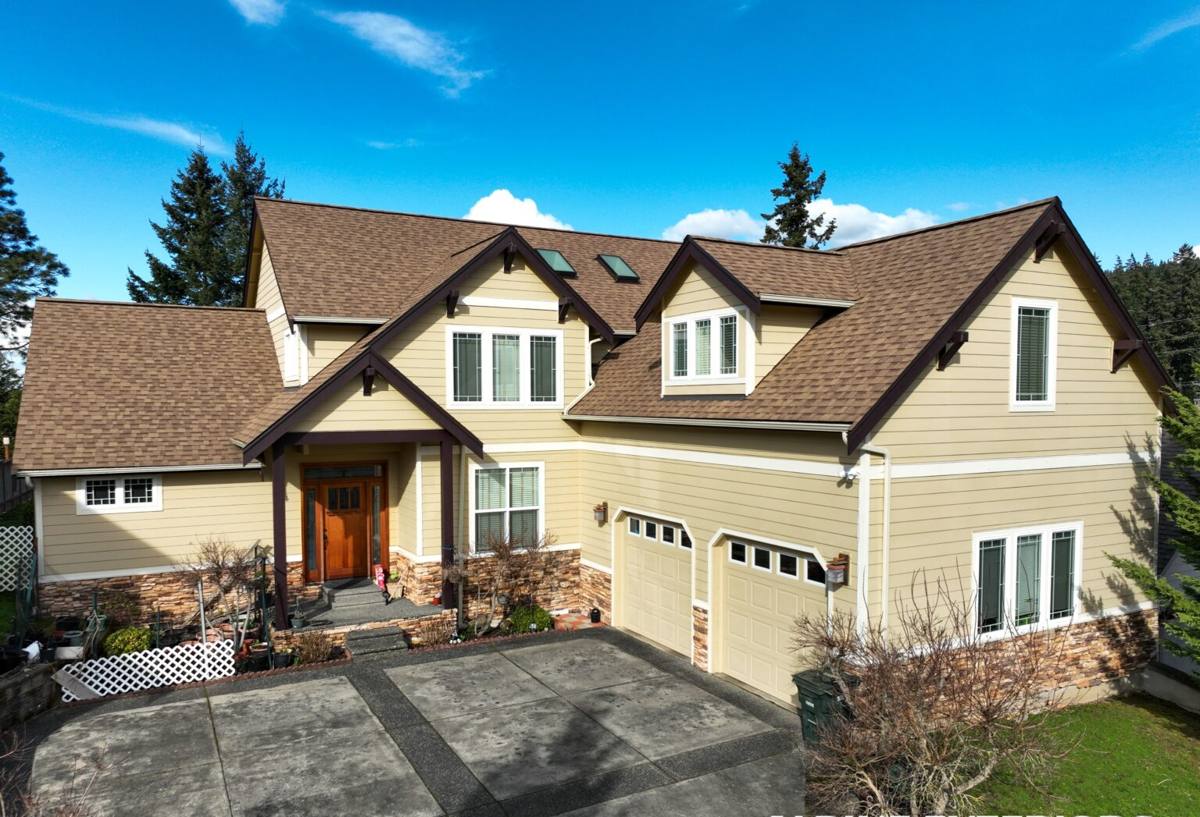
What Salt Air, Driving Rain, and a Long Moss Season Actually Demand
Salt Air
Marine air moving through Barkley carries enough salt to accelerate corrosion on exposed fasteners, hinges, and lower-grade trim hardware over time. It's a slow process rather than a dramatic one, which is exactly why it's easy to underestimate — a siding system needs corrosion-resistant fastening from day one, because by the time rust streaks show up on the surface, the damage underneath has usually been building for years.
Driving Rain
Storms in this part of Whatcom County typically move in with wind behind them, which pushes rain sideways into laps, seams, and fastener points that a calmer climate wouldn't stress nearly as hard. A siding product engineered around straight-down rainfall can still leak here if the water-resistive barrier and flashing weren't detailed for wind-driven moisture specifically. That single difference is usually what separates a wall assembly that stays dry for decades from one that starts failing behind the cladding within a few wet seasons.
A Long Moss Season
Mild temperatures, consistent humidity, and tree cover across Bellingham give moss and mildew an extended growing window, often close to year-round on north-facing and shaded walls. Moss doesn't just discolor a surface — it holds moisture against it far longer than open air would, and on a material that absorbs moisture readily, that sustained dampness is what eventually leads to soft spots and rot at seams and edges, not just a cosmetic green tint.
Why James Hardie's Engineering Is a Fit for This Combination
James Hardie doesn't build one generic board for the whole country. Its HZ5 formulation is engineered specifically for regions with heavy, sustained moisture exposure and freeze-thaw cycling rather than desert heat or hurricane wind, which lines up closely with what Barkley homes actually experience through a full year. Fiber cement itself doesn't swell, cup, or warp the way wood-based siding can after repeated wet-season moisture cycles, and it won't feed rot or serve as an easy foothold for moss the way absorbent, porous materials do. It's also non-combustible, which matters for household safety independent of the climate question.
ColorPlus Finish Under Sustained Moisture and UV
The color coat on Hardie's ColorPlus products is baked on at the factory under controlled conditions rather than brushed on at the job site. That matters more here than in a drier climate, because field-applied paint needs a real curing window to bond and harden properly, and Barkley doesn't reliably offer long stretches of dry, moderate weather during much of the install season. A factory-cured finish sidesteps that problem entirely and holds up longer against the fading and chalking that constant moisture and UV cycling cause over time. Touch-up at cut edges uses Hardie's matched touch-up product rather than field-mixed paint, which keeps the finish consistent at exactly the joints most exposed to weather.
What a Correct Installation on a Barkley Home Actually Requires
Buying the right board is only half the job. James Hardie only performs the way it's engineered to when it goes on according to the manufacturer's actual specifications, and in a climate this wet, the gap between a correct installation and a shortcut one shows up faster than it would somewhere drier.
Fastening and Clearance
Hardie specifies particular fastener types, spacing, and depth, and getting those wrong is one of the most common ways a good product starts performing poorly. Siding also needs real clearance above grade, roofing, decking, and hardscape — skip that clearance and the bottom courses stay damp far longer than they should, which is exactly the condition that leads to early failure at the edge closest to the ground.
House Wrap and Flashing as One System
Most siding failures we see in this climate trace back to water getting behind the cladding, not through it. That means the weather-resistive barrier, window and door flashing, and every wall penetration have to be lapped, sealed, and integrated as one continuous system rather than treated as separate steps finished in isolation. It's also the part of a job that's easiest to rush and hardest to inspect once the new siding is up, which is exactly why it deserves the most attention rather than the least.
Joints, Gaps, and Caulking
Butt joints need correct gapping and sealant, not a tight, caulk-everything approach that traps moisture instead of letting it drain. Corner boards, trim intersections, and any point where two materials meet are where wind-driven rain finds its way in first, and detailing those joints correctly is a bigger factor in long-term performance than most homeowners assume when they're comparing quotes on price alone.
Where Installation Shortcuts Show Up First
| Installation Detail | What Gets Skipped on a Rushed Job | How It Shows Up on a Barkley Home |
|---|---|---|
| Fastener type and spacing | Wrong nail gauge or over-driven fasteners | Splitting at fastener points and early corrosion streaking from salt-laden air |
| Clearance above grade and hardscape | Siding installed too close to the ground, deck, or patio | Bottom courses stay wet longer and soften first, especially on shaded sides |
| House wrap laps and seals | Seams taped loosely or left unsealed | Water tracks behind the siding invisibly until sheathing damage is already advanced |
| Flashing at windows and penetrations | Flashing skipped or reversed-lapped | Staining and soft trim around openings that wind-driven rain can reach directly |
| Butt joint gapping and caulk | Joints caulked tight with no room to drain | Trapped moisture at seams instead of shedding water outward as designed |
None of these mistakes are visible on install day. They show up two, five, or ten winters later, which is exactly why the installation details matter as much as the product choice itself.
How Our Process Works on a Barkley Hardie Project
- Walkthrough and assessment: We look at the whole exterior, not just the siding — current condition, sun and shade exposure by wall, any signs of trapped moisture — before pricing anything.
- Tear-off and substrate check: Once old siding is off, we check the sheathing underneath for rot or soft spots. Installing new Hardie siding over damaged sheathing just hides a problem that keeps getting worse behind the wall.
- Install to Hardie's published spec: Fastening, clearance, house wrap, and flashing get built as one integrated system, detailed for this specific climate rather than a generic national standard.
- Final walkthrough and warranty registration: We confirm the finished work meets spec and register the project so the manufacturer warranty is properly in place, not left as an assumption.
Choosing a Profile and Finish for a Barkley Home
James Hardie's product line covers more ground than most homeowners realize going in. HardiePlank lap siding is the most common choice and works well on traditional and craftsman-style homes; HardieShingle gives a more textured, staggered look for homes leaning toward a cottage or coastal aesthetic; HardiePanel is a vertical option often used on gables or as a modern accent; and HardieTrim matches the same durability at corners, window casings, and fascia so the whole exterior ages at the same rate. Texture options run from smooth to cedarmill, and color runs through Hardie's factory ColorPlus palette. The right combination usually comes down to the home's existing architecture and how much of each wall sits in direct weather versus a more sheltered exposure, which is part of what we walk through on-site rather than deciding from a photo.
Why a Crew That Already Works Barkley Matters
A contractor who works this stretch of Whatcom County regularly starts to recognize patterns a generic, out-of-area install crew simply hasn't had the reps to notice: which wall orientations in Barkley take the most direct wind-driven rain, where moss tends to establish first based on tree cover and drainage, and how much clearance a given lot actually needs given how consistently damp the ground stays through fall and winter. That familiarity shows up in small, on-site judgment calls — where flashing gets extra attention, how fastener spacing adjusts for a particularly exposed gable end — that a homeowner rarely sees directly but feels in how the siding performs over the following decade. It also means faster response if a warranty question comes up years later, instead of chasing down a company that only existed for the length of one contract.
What to Ask Before Hiring for a James Hardie Project
- Confirm current Washington state contractor licensing and insurance, and ask to see it rather than taking it on faith
- Ask specifically whether they install Hardie's HZ5 formulation or a standard line not matched to this climate
- Ask how they handle sheathing rot discovered during tear-off, and get that answer before work starts, not after
- Ask about their fastening pattern and clearance approach in plain terms — a contractor who can explain it clearly usually understands why it matters
- Ask whether the project gets registered for the manufacturer warranty, and who handles that step
- Ask how ColorPlus touch-up is handled at cut edges and trim joints, since that detail affects how the finish ages over the following years
If your Barkley home needs new James Hardie siding, a repair on existing Hardie siding, or just an honest look at what's going on behind an aging wall, we're glad to walk the property with you. Reach out using the form below to schedule a free, no-pressure estimate.