 Bellingham
 Why Birch Bay Roofs Wear Out Faster Than the Manual Says
Every asphalt shingle comes with a manufacturer's expected lifespan, and almost none of those numbers were calculated with a Birch Bay roof in mind. Homes sitting close to the water here deal with a combination that shortens roof life in ways an inland Whatcom County roof never sees: salt-laden air that accelerates corrosion on fasteners and flashing, wind-driven rain that gets pushed sideways under normal shingle overlaps instead of running straight down, and a moss and algae season that runs long thanks to our mild, wet winters and shaded, humid mornings.
None of these factors are dramatic on their own. The problem is that they compound. A roof that's slowly losing granule protection from moss root intrusion is also the roof least able to shed wind-driven rain at the laps, and the fastener corrosion from salt air is happening at the exact spots — ridge caps, flashing edges, nail heads — where wind uplift is already testing the roof hardest. By the time a homeowner notices a stain on the ceiling, the underlying issues have usually been building for a few seasons.
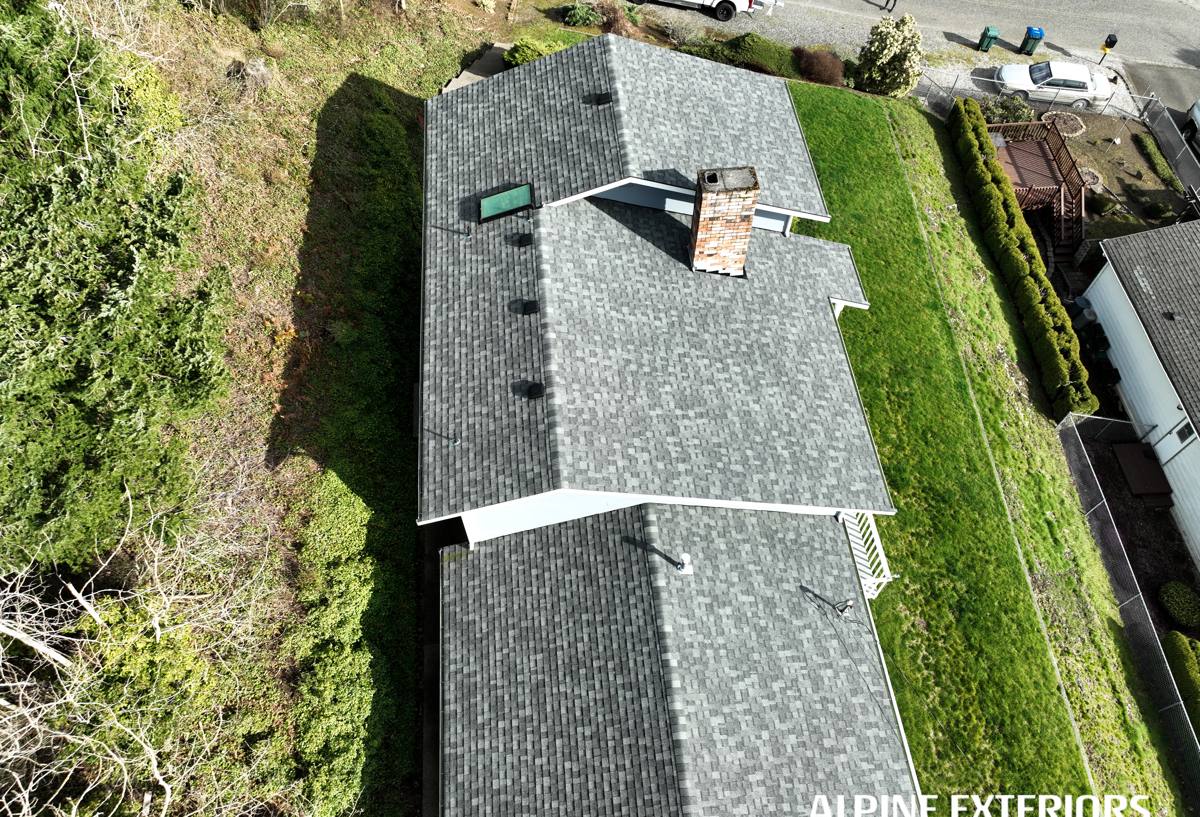
Signs a Birch Bay Roof Needs Replacing, Not Just Patching
Repair makes sense for isolated damage — a cracked pipe boot, a section lifted in a windstorm, a few missing shingles. Replacement becomes the honest recommendation when the damage is systemic rather than local. Here's how we tell the difference on a coastal roof:
- Granule loss visible across large areas of the roof, not just one slope, usually showing up as dark, balding patches
- Moss growth that has re-established within a year of cleaning, which points to shingle-level damage rather than just surface buildup
- Soft or spongy decking felt underfoot, especially near eaves, valleys, and chimneys — a sign water has been getting past the shingle layer
- Rusted or corroded flashing at valleys, chimneys, and sidewalls, common near the water where salt air speeds up metal fatigue
- Shingles that are curling, cupping, or cracking across multiple slopes rather than in one weather-exposed spot
- A roof approaching or past 20 years old with no major work done, regardless of how it looks from the ground
If only one or two of these apply and they're confined to a small area, repair is usually the right call and we'll say so. Replacement only makes sense when the roof as a system is failing, not when one part of it is.
Choosing a Roofing System for a Salt-Air, High-Moisture Site
Material choice matters more in Birch Bay than it does a few miles inland. We steer homeowners toward products and specs that are proven to hold up against salt exposure and sustained moisture rather than whatever looks best on a sample board.
| Roofing Option | How It Handles Salt Air & Moss | Trade-Offs to Know |
|---|---|---|
| Architectural (laminate) asphalt shingle | Good moss resistance with algae-resistant (AR) granules; heavier profile sheds wind-driven rain better than 3-tab | Best value for most homes; still needs periodic moss treatment near shaded slopes |
| 3-tab asphalt shingle | Thinner profile is more vulnerable to wind-driven rain intrusion at the laps and to moss root penetration | Lower upfront cost, but we don't recommend it for exposed Birch Bay sites given its shorter service life here |
| Standing seam metal | Excellent moss and moisture resistance since there are no exposed fasteners or shingle laps for water to work into | Higher material and install cost; fastener and coating quality matter a lot near salt air, so spec matters |
| Cedar shake/shingle | Attractive but naturally holds moisture, which is exactly what accelerates moss and rot in our climate | Requires the most ongoing maintenance of any option here; we'll walk through this honestly if it's on the table |
We're not going to tell a homeowner that any one product is the only right answer — budget, style, and how long you plan to own the home all factor in. What we will do is explain the real maintenance burden and moisture behavior of each option before you sign off, not after.
Underlayment and Fasteners Matter as Much as the Shingle
A premium shingle over a cheap underlayment and standard fasteners is still a compromised roof on a coastal site. For Birch Bay homes we spec self-adhered ice-and-water shield at eaves, valleys, and penetrations — the areas where wind-driven rain most often finds a way in — and corrosion-resistant fasteners rated to hold up against salt exposure rather than standard galvanized nails that can start rusting within a few seasons this close to the water.
What a Correct Roof Replacement Actually Involves
A roof replacement is more than swapping old shingles for new ones. Done right, it's a full system rebuild:
- Tear-off: complete removal of old roofing down to the deck — never a layover, which traps moisture and hides deck problems
- Deck inspection and repair: any soft, delaminated, or water-damaged sheathing gets replaced before anything new goes down
- Ice-and-water shield: installed at eaves, valleys, and around all penetrations, which is where wind-driven rain causes the most damage on exposed sites
- Synthetic underlayment: a full moisture barrier across the deck, not just felt paper
- Flashing: new step, valley, and counter-flashing at every chimney, wall, and roof transition — reused flashing is a common shortcut we won't take
- Shingle or panel installation: installed to manufacturer nailing patterns and exposure specs, which is what actually determines wind and warranty performance
- Ridge and attic ventilation: corrected or upgraded so the roof can dry from underneath, not just shed water from above
- Cleanup and magnetic sweep: full site cleanup, including a nail sweep of the yard and driveway
Ventilation and Moisture: The Half of the Job That Gets Skipped
Most roof failures we see in this area aren't caused by what's happening on top of the roof — they're caused by moisture trapped underneath it. A roof deck that can't breathe stays damp longer after every rain event, which is exactly the condition moss and algae need to take hold, and it's also what causes plywood delamination and premature shingle failure from below. Balanced intake and exhaust ventilation is a standard part of any replacement we do, not an upsell. On a lot of older Birch Bay homes, the original ventilation was undersized or blocked entirely, and correcting it during a re-roof is one of the most effective things we can do for the new roof's lifespan.
Our Roof Replacement Process
The process is straightforward, and we walk you through each step before it happens:
- On-site assessment: we inspect the deck, attic ventilation, flashing points, and current roof age/condition — not just a look from the ground
- Written estimate: a clear scope and price, with material options explained honestly, including trade-offs
- Material selection: you choose the product and color; we make sure the spec fits a coastal site
- Scheduling around weather: we plan install windows around Whatcom County's wetter stretches to protect an open deck
- Tear-off and rebuild: full system replacement as outlined above, with deck issues addressed as they're found, not guessed at ahead of time
- Final walkthrough: we review the finished roof with you before calling the job done
Cost Factors for a Birch Bay Roof Replacement
Every roof is different, but the price of a replacement here is driven by a consistent set of factors:
| Factor | Why It Affects Cost |
|---|---|
| Roof size and pitch | More square footage and steeper slopes both increase material and labor time |
| Number of layers to remove | Homes with an existing layover roof require extra tear-off labor and disposal |
| Deck condition | Soft or rotted sheathing found during tear-off adds material and labor to replace |
| Material choice | Standing seam metal and premium architectural shingles cost more upfront than standard shingle lines |
| Roof complexity | Valleys, dormers, skylights, and multiple chimneys all add flashing work and time |
| Access and staging | Steep sites, limited driveway access, or proximity to power lines can affect equipment and labor needs |
We don't quote a number before seeing the roof, because guessing on deck condition or complexity leads to surprise change orders later. Our estimate reflects what we actually find on your roof.
Why Hiring a Crew That Already Works Birch Bay Matters
Roofing crews who mostly work drier, inland jobs don't always plan for what a shoreline site throws at a roof and a job site: wind direction and exposure that changes staging and safety decisions, salt air's effect on fastener and flashing choices, and moss patterns that come back if the ventilation and material specs aren't adjusted for the site. We work throughout Bellingham and Whatcom County, including Birch Bay, and we spec every coastal replacement with that exposure in mind rather than applying a generic inland roofing approach to a site that doesn't behave like one.
Local, ongoing work also means we're not guessing at permitting requirements or what inspectors in this county expect to see on a re-roof — that familiarity keeps a project moving instead of stalling on avoidable paperwork issues.
Protecting Your New Roof After Installation
A correctly installed roof still benefits from basic upkeep, especially this close to the water:
- Clear moss and debris from valleys and gutters at least once a year, more often under overhanging trees
- Have flashing points checked periodically, since salt air corrosion is gradual and easy to miss from the ground
- Keep gutters and downspouts flowing freely so water isn't backing up under the eaves
- Trim back branches that keep a roof slope shaded and damp longer than the rest of the roof
- Schedule a quick visual inspection after major windstorms rather than waiting for a leak to show up inside
If your Birch Bay roof is showing its age or you just want an honest opinion on whether it's due for replacement, we're happy to take a look. Reach out for a free, no-pressure estimate using the form below.