 Bellingham
 Building Decks That Actually Hold Up in Cordata
Cordata sits in north Bellingham, close enough to the water and the marine weather patterns that roll in off Bellingham Bay to feel every bit of what Whatcom County throws at outdoor structures. A deck here isn't just a design project — it's a structure that has to survive months of driving rain, a long stretch of low sun angles and shade that never quite dries out, and the salt-tinged air that comes with living this close to Puget Sound. We build custom decks for homes in this area with that reality in mind, not as an afterthought but as the starting point for every material and framing decision we make.
A lot of deck problems we get called out to fix didn't start as bad workmanship — they started as a deck designed for a drier climate and installed here anyway. Undersized gaps between boards, missing flashing, ledger boards that trap water against the house — all of it works fine in a place with a normal dry season. In Cordata, those same shortcuts show up as rot, moss buildup, and soft spots within a few wet seasons.
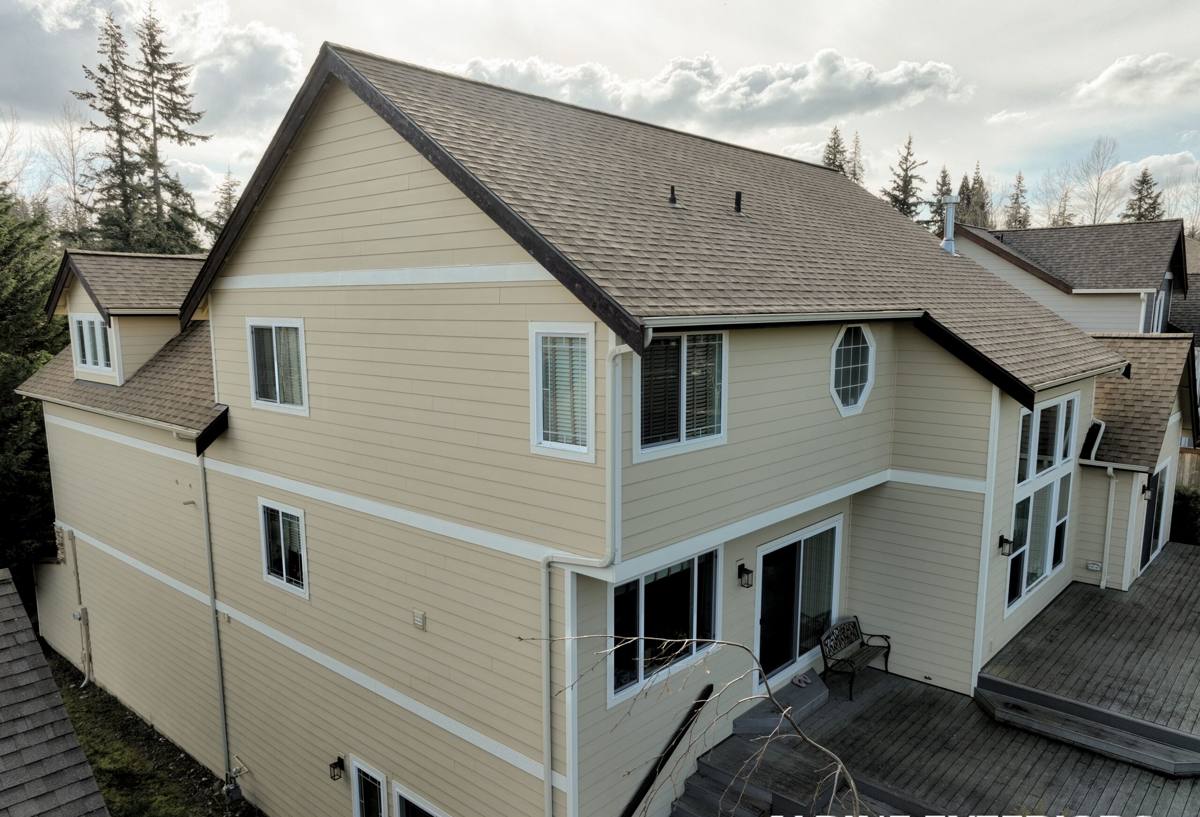
What Bellingham's Climate Does to an Outdoor Deck
Driving Rain and Standing Moisture
Whatcom County doesn't just get rain — it gets sustained, wind-driven rain that finds its way into every gap, seam, and fastener hole a deck has. Water that isn't given a clear path to shed and dry will sit against wood fibers, ledger connections, and post bases, and that's where rot starts. Decks that face north or sit under mature trees, which describes a fair number of lots in this area, dry out even slower between storms.
Moss Season
Bellingham's moss season runs long — realistically most of the fall through spring stretch — and it doesn't just grow on roofs. Deck boards, especially horizontal surfaces with tight spacing or a north-facing orientation, collect moss and algae that hold moisture against the wood and turn the surface slick and slippery underfoot. A deck built without airflow underneath, or with boards spaced too tight, gives moss exactly the damp, shaded conditions it needs to take hold.
Salt Air
Proximity to the Sound means fasteners, brackets, and any exposed metal hardware are dealing with a mildly corrosive environment year-round. Standard-grade hardware that would last decades inland can start showing rust and pitting well ahead of schedule here. It's a slow process, but it's a real one, and it matters most at structural connection points — the parts of a deck you really don't want failing quietly.
Designing a Deck for a Cordata Lot
Cordata is a newer, growing part of Bellingham with a mix of lot sizes and home styles, and that means deck projects here range from compact patio-level decks to larger multi-level structures meant for entertaining. A few things we weigh specifically for this neighborhood:
- Orientation relative to prevailing wind and rain direction, so the deck isn't catching the worst of every storm broadside
- Tree cover and shade patterns, which affect both moss growth and how fast the deck actually dries after rain
- Drainage across the yard — a deck built on a low spot without proper footing drainage will fight standing water for its whole life
- How the deck ties into the home's existing siding and trim, so the ledger connection doesn't become a hidden leak point
- Lot setbacks and any HOA or covenant guidelines that apply to newer Cordata developments
None of this is exotic — it's the same due diligence any competent deck builder should do. The difference is that we're doing it with Whatcom County's specific rainfall and moss patterns already baked into the default assumptions, instead of treating them as edge cases.
Decking Material Options: How They Hold Up Locally
Every decking material has real trade-offs once you factor in our climate. We'll walk through the honest pros and cons for your project rather than pushing whatever's easiest to install.
| Material | Moisture & Moss Behavior | Maintenance | Typical Lifespan | Cost Factor |
|---|---|---|---|---|
| Pressure-treated fir/hemlock | Resists rot when properly sealed; needs consistent airflow underneath to avoid moss buildup | Annual cleaning and re-sealing recommended | 15–20 years with upkeep | Lowest upfront cost |
| Western red cedar | Naturally rot- and insect-resistant; still needs airflow and periodic cleaning to control surface moss | Periodic cleaning, occasional oiling to maintain color | 20–25 years | Mid-range |
| Composite decking | Doesn't absorb water or rot, but surface moss/algae can still grow if boards stay damp and shaded | Periodic washing; no sealing or staining needed | 25–30+ years | Higher upfront, lower long-term labor |
| Tropical hardwoods | Very dense and naturally moisture-resistant, but installation is unforgiving of shortcuts | Occasional oiling to prevent graying | 25+ years | Highest upfront cost |
We're straightforward with clients about the trade-offs on each option. Composite costs more up front but removes the sealing and staining cycle entirely, which matters a lot in a climate where that cycle is more frequent than in drier regions. Cedar is a strong middle ground if you want a natural look and are willing to keep up with periodic maintenance. Pressure-treated lumber is a legitimate budget choice, but only if the framing underneath gives it the airflow and drainage it needs to actually reach its expected lifespan — otherwise you're re-doing sections of it sooner than you should.
What "Built Correctly" Actually Means Here
A deck can look finished and still be built wrong in ways that only show up after a couple of wet seasons. The parts that matter most in our climate aren't usually the visible ones:
Ledger and Flashing
Where the deck attaches to the house is the single most common failure point we see on older or poorly built decks. Proper flashing — installed so water sheds away from the house rather than behind the ledger board — is non-negotiable. Skipping it or doing it wrong is how you end up with hidden rot in the wall framing behind the deck, which is a far more expensive repair than the deck itself.
Footings and Post Bases
Footings need to be set below frost depth and designed so posts don't sit directly in standing water. Post bases that hold wood up off the concrete, rather than embedding it, keep the most vulnerable part of the post — the end grain — away from constant moisture contact.
Board Spacing and Airflow
Gapping between deck boards isn't just cosmetic — it's what lets water shed quickly and lets air move underneath to dry the structure out between storms. Tight spacing looks clean on install day and turns into a moss farm within a year or two in this climate.
Fasteners and Hardware
Given the salt air exposure this close to the water, we use corrosion-resistant fasteners and structural hardware rated for exterior, coastal-adjacent conditions rather than standard-grade hardware. It costs a little more. It also means the connections holding your deck together aren't quietly corroding behind the scenes.
Our Process for Cordata Deck Projects
- On-site assessment — we look at your lot's drainage, sun exposure, tree cover, and how the deck will tie into your home before any design work starts
- Design and material walkthrough — we go over layout, size, and material trade-offs in plain terms, including what each option actually costs to maintain over time
- Permitting — we handle the permit process for the scope of work, since deck permitting requirements depend on size, height, and attachment method
- Framing and structural work — footings, ledger flashing, and structural connections get built to hold up under sustained wet-weather conditions, not just pass a quick inspection
- Decking, railing, and finish work — final surface installation with correct spacing and detailing around posts, stairs, and transitions
- Walkthrough — we go over basic care for whatever material you chose, so you know what upkeep to expect and when
Keeping a Cordata Deck in Good Shape Year-Round
Even a well-built deck needs some seasonal attention in this climate. This is the general rhythm we recommend to homeowners in the area:
- Sweep debris and leaves off the deck regularly through fall — trapped organic material holds moisture and feeds moss
- Do a moss and algae cleaning pass at least once a year, more often on shaded or north-facing sections
- Check and clear any debris from underneath the deck where airflow can get blocked over time
- Inspect fasteners and hardware periodically for early signs of corrosion, especially on older installations
- Re-seal or oil wood decking on the manufacturer's recommended schedule rather than waiting until it visibly needs it
- Check the ledger flashing area and house siding connection annually for any signs of water intrusion
Why a Crew That Already Works Cordata Makes a Difference
Deck-building fundamentals don't change from one neighborhood to the next, but familiarity with how a specific area's lots drain, how much shade a given orientation actually gets, and which construction details tend to fail first in this exact climate comes from doing the work here repeatedly. A crew that already builds and repairs decks around Bellingham and greater Whatcom County isn't guessing at how much moss pressure a shaded north side will see, or how aggressive the flashing detail needs to be — they've already seen what happens when it's done wrong, and they build to avoid it the first time.
That local experience also shows up in smaller, practical ways: knowing which material suppliers stock what locally, understanding regional permitting expectations, and being available for follow-up if something needs adjustment after the first real wet season tests the work.
Get an Honest Look at Your Project
If you're weighing a new deck or replacing one that's past its prime, we're happy to come take a look, talk through what your lot and layout call for, and give you a straightforward estimate — no pressure, no upsell on materials you don't need. Use the form below to get started.