 Bellingham
 Cordata's Climate Puts Real Demands on Siding
Cordata sits close enough to the water and the tree line that homes here take on a specific mix of punishment: salt-laden air drifting in off the bay, long stretches of driving rain through fall and winter, and a moss season that can run most of the year in shaded, north-facing spots. None of that is dramatic on its own, but stacked together year after year, it's exactly the kind of slow, cumulative exposure that separates siding that holds up for decades from siding that starts showing problems in five to eight years.
Salt air is corrosive to fasteners and trim metal, and it accelerates the breakdown of finishes that aren't engineered for coastal exposure. Driving rain finds every gap in flashing and caulk, and it doesn't take a hurricane to do it — a sideways rain event a few times a winter is enough if the water has somewhere to go. Moss and algae need shade, moisture, and organic material to root, and Cordata's tree cover and marine humidity supply all three. Siding here isn't just a weather barrier, it's a material that has to resist rot, corrosion, and biological growth at the same time.
Why We Only Install James Hardie Fiber Cement
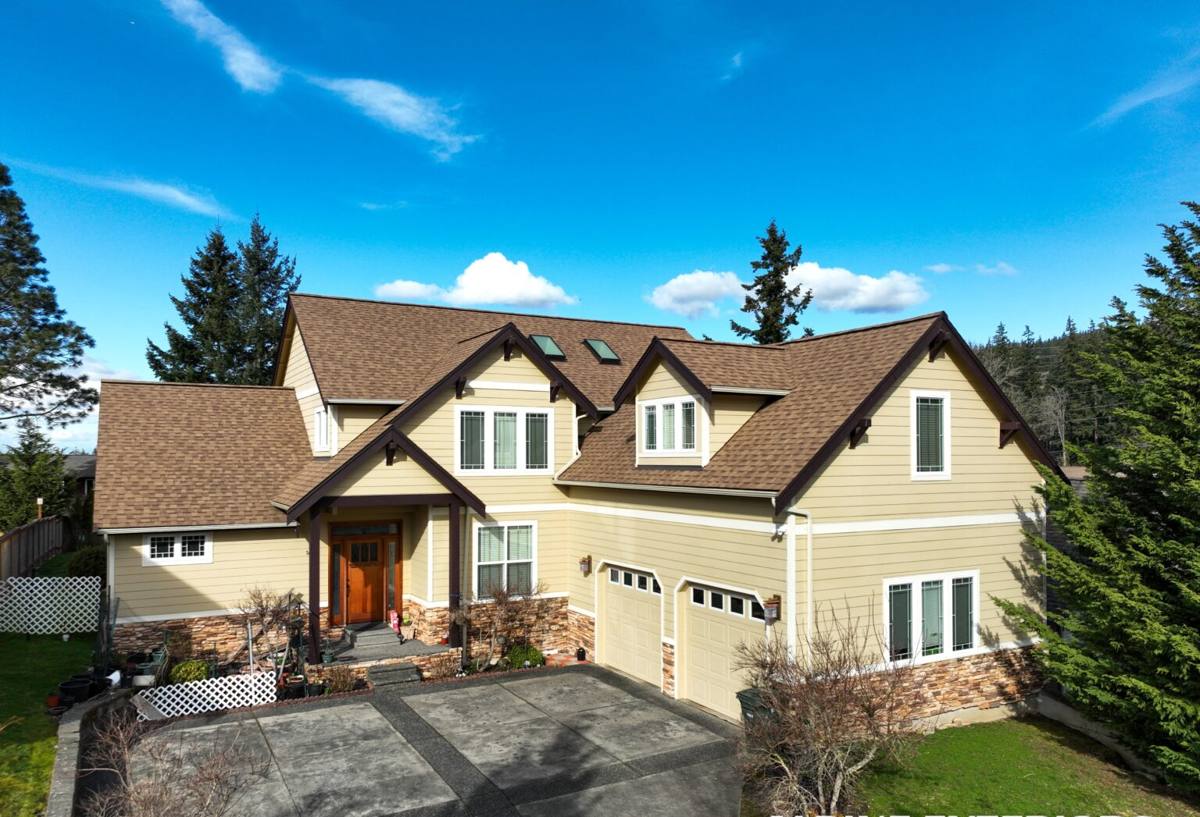
We standardized on James Hardie fiber cement for every home we side, and we don't install vinyl, LP SmartSide, cedar, primed spruce, Cemplank, or Allura. That's not a marketing position — it's a decision based on what actually holds up under Whatcom County conditions.
Fiber cement is a mix of cement, sand, and cellulose fibers, cured into a dense, non-combustible board. It doesn't absorb water the way wood-based products do, so it doesn't swell, delaminate, or invite rot at cut edges the way engineered wood siding can once its edge seal is compromised. It doesn't warp or gap the way vinyl can as temperatures swing, and it holds paint and factory finish far longer than raw wood products because the substrate itself isn't feeding moisture into the finish from underneath.
James Hardie specifically engineers its HardieZone system for regional climates, and the Pacific Northwest falls under the HZ5 designation — built with a moisture and mildew resistance formulation suited to sustained damp conditions rather than dry-climate exposure. That's a meaningful difference from a generic fiber cement board not engineered for a wet marine climate.
What Homeowners Give Up With the Alternatives
- Vinyl: Lightweight and low cost upfront, but it expands and contracts with temperature swings, can crack in cold snaps, and offers no fire resistance — its seams and J-channels also give moss and mildew places to take hold.
- LP SmartSide and primed spruce: Wood-strand or solid wood substrates depend entirely on an intact factory or field-applied seal; any cut edge, nail hole, or caulk failure exposes wood fiber directly to moisture, and in a climate this wet that's a standing invitation to swelling and rot.
- Cedar: Beautiful when new, but it needs ongoing refinishing to resist the region's rain and moss, and untreated or under-maintained cedar is a genuine fire and rot liability over time.
- Cemplank and Allura: Both are legitimate fiber cement products, but we've standardized on one manufacturer, one warranty structure, and one factory finish system so every install, touch-up, and warranty claim works the same way across every home we do.
What a Correct Fiber Cement Install Actually Involves
Fiber cement is only as good as its installation. The board itself resists moisture and rot, but a sloppy install can still trap water behind it, and trapped water behind siding causes damage no siding material can fully prevent. In a climate like Cordata's, the details matter more than in a dry region, because there's simply more water looking for a way in.
The Non-Negotiables
- A drainable weather-resistive barrier installed correctly behind the siding, with proper lapping so water sheds down and out rather than working its way behind seams.
- Correct fastener placement and spacing, using fasteners rated for fiber cement so boards don't blow out or work loose in wind-driven rain.
- Proper clearance at grade, decks, and roof lines — fiber cement that sits too close to soil, concrete, or standing water wicks moisture regardless of the product's own resistance.
- Factory-primed and factory-finished ColorPlus boards with field touch-up only where cuts expose raw substrate, so the finish performs the way it was engineered to rather than relying on a field-applied coat to do the same job.
- Correct caulking and flashing at every window, door, and penetration — the single most common source of water intrusion isn't the siding field, it's the trim and transition details around openings.
Cutting fiber cement also throws respirable silica dust, which means proper cutting methods and dust control aren't optional extras — they're part of doing the job correctly and safely, both for the crew and for anyone living in the home during the project.
Our Process on a Cordata Home
We start with a walk-around assessment of the existing siding, sheathing, and trim, looking specifically for moisture damage, moss buildup along shaded elevations, and any prior repairs that may have compromised the water-resistive barrier. Because we work in this area regularly, we already have a good sense of which elevations on a typical Cordata lot take the worst of the driving rain and where moss tends to establish first — usually north- and west-facing walls under tree cover.
From there, the process is straightforward: remove the old siding down to sheathing, repair or replace any damaged sheathing, install a new drainable house wrap, flash every window and door opening properly, and install the Hardie boards and trim to manufacturer spec with correct fastening and clearances. We finish with sealed joints and touch-up paint matched to the ColorPlus finish where field cuts require it.
We also don't skip the boring parts — permitting, proper disposal of old siding, and protecting landscaping and walkways during tear-off. A siding job that's fast but sloppy on the edges isn't actually fast, because it creates callbacks later.
Comparing Siding Options for a Cordata Climate
| Factor | James Hardie Fiber Cement | Vinyl | Wood / LP SmartSide |
|---|---|---|---|
| Moisture resistance | Engineered for HZ5 marine climate | Water sheds off but seams trap moisture | Depends entirely on intact seal at edges |
| Salt air / corrosion resistance | Non-metallic substrate, stable finish | Fasteners and trim can corrode over time | Fasteners and finish both vulnerable |
| Moss and algae resistance | Dense surface, factory finish resists growth | Seams and channels collect debris and moisture | Porous surface, needs regular treatment |
| Fire resistance | Non-combustible | Combustible, can melt or deform | Combustible |
| Finish longevity | ColorPlus factory finish, long warranty | Color can fade, no refinishing option | Needs periodic repainting or resealing |
Cost Factors Homeowners Should Understand
Fiber cement costs more upfront than vinyl and often more than a basic wood-based product, but the comparison only makes sense over the life of the siding, not the invoice for year one. The real cost drivers on a Cordata job are usually the same handful of things.
| Cost Factor | Why It Matters Here |
|---|---|
| Sheathing condition | Years of moss and moisture exposure sometimes mean hidden rot that has to be repaired before new siding goes on |
| Home elevation count and trim detail | More corners, gables, and window trim mean more flashing and cutting labor |
| Siding profile and finish | Lap width, board texture, and color selection all affect material cost |
| Access and site conditions | Tree-lined lots common in Cordata can add setup and protection time |
| Tear-off and disposal | Removing and hauling old siding is often underestimated in DIY or low-bid quotes |
We give straightforward, itemized estimates rather than a single vague number, so homeowners can see exactly what's driving the price on their specific home.
Living With Fiber Cement Through Moss Season
One advantage of fiber cement in this climate is how little ongoing maintenance it actually needs compared to wood-based alternatives. It won't rot from moss contact the way untreated wood can, but moss and organic debris can still build up on the surface and hold moisture against the finish over time. A periodic gentle rinse — never high-pressure blasting, which can force water behind boards and damage caulk lines — keeps growth from establishing and keeps the ColorPlus finish looking the way it should. Keeping nearby vegetation trimmed back so more light and air reach shaded elevations also goes a long way in a neighborhood with as much tree cover as Cordata has.
Why a Crew That Already Works Cordata Matters
Siding work isn't uniform across a region — a crew that mostly works dry, inland climates doesn't necessarily think the same way about drainage planes, flashing sequencing, or clearance details that matter most where rain is heavier and more frequent. Working Cordata and the surrounding Bellingham area regularly means we already know the local permitting process through the City of Bellingham and Whatcom County, we're familiar with the microclimates between shaded and exposed lots in the neighborhood, and we're not learning coastal detailing for the first time on your house.
It also means warranty support that's actually local. If a question comes up two years after installation, you're calling a crew that's still working in the same neighborhood, not tracking down a contractor who moved on to other regions.
Get a Straightforward Estimate
If you're weighing a siding replacement in Cordata, we're happy to walk the exterior with you, point out anything specific to your home's exposure, and put together a clear, no-pressure estimate. There's no obligation — just a straight answer on what your home needs and what it would take to do the job right. Use the form below to get started.