 Bellingham
 Building New in Happy Valley: Get the Windows Right the First Time
Happy Valley is one of Bellingham's older, established neighborhoods, and most of the new-construction work we see here is infill: a teardown-rebuild on an existing lot, an addition that needs matching new windows, or a new home going up on one of the remaining buildable parcels. That context matters. New-construction windows are installed before or during the exterior finish work — siding, trim, and weather-resistive barrier all get tied into the window flanges as the house is buttoned up. Unlike a retrofit replacement window dropped into an existing opening, this is your one shot to get the flashing, the water management, and the window-to-wall connection built correctly from bare framing forward. Mistakes made here don't show up as a drafty window in year one — they show up as rot inside the wall cavity in year seven, after the siding is already painted and the punch list is long closed out.
For a Happy Valley build, that means thinking about window installation as part of the building envelope, not as a standalone product order.
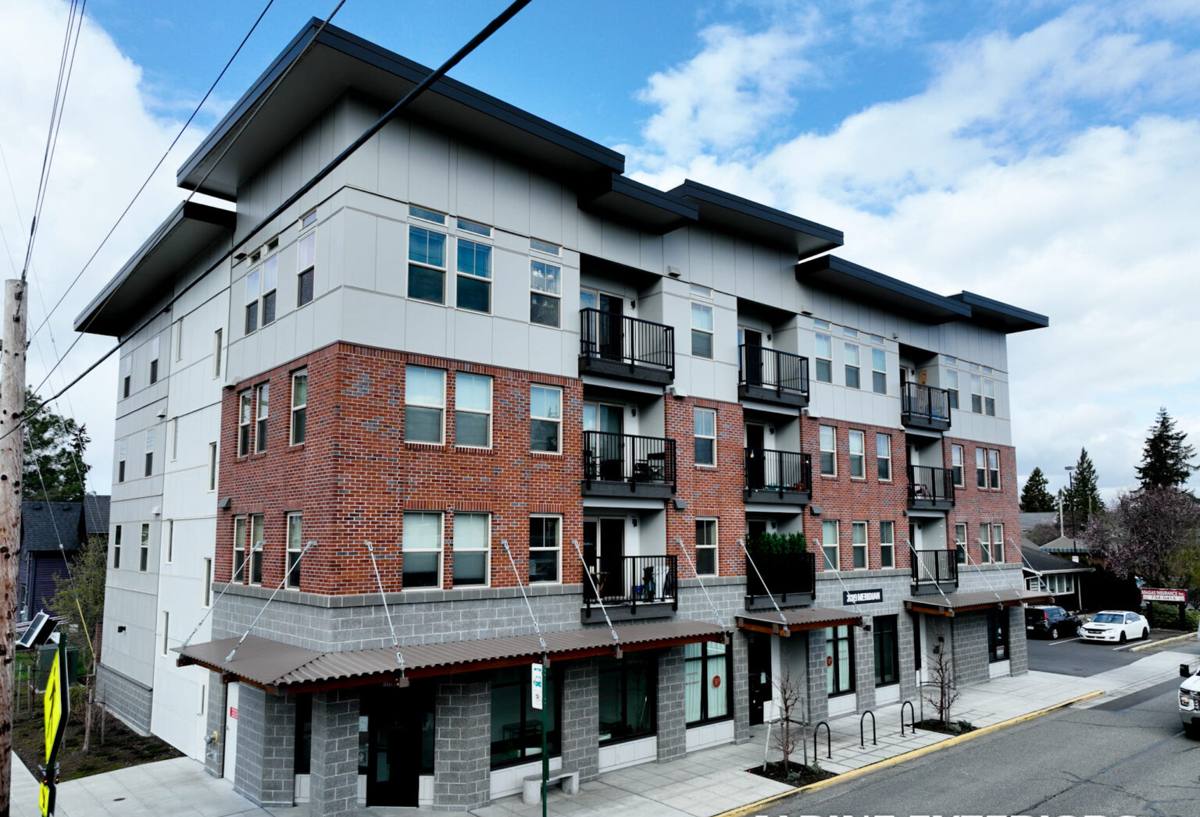
What Bellingham's Climate Actually Does to New Windows
Whatcom County sits close enough to salt water that homes throughout Bellingham, including Happy Valley, deal with a mix of marine air, wind-driven rain, and a long damp season where moss and algae get a foothold on anything that stays wet. None of that is exotic — it's just persistent, and persistence is what wears down a poorly detailed window opening.
- Salt air: accelerates corrosion on unprotected fasteners, cheaper hardware, and some metal flashing if it's not a marine-rated material or properly coated.
- Driving rain: Bellingham's rain rarely falls straight down — wind pushes it sideways into wall assemblies, which is why sill pan flashing and proper head flashing lap sequencing matter more here than in drier climates.
- Long moss season: extended periods of shade and dampness, especially on north- and west-facing walls common in this neighborhood's tree-covered lots, mean any spot where water is allowed to sit — a flat sill, a poorly sloped stool, a clogged weep — becomes a growth surface faster than homeowners expect.
None of these conditions are unusual for Whatcom County. But they do mean that a window package and installation method that works fine in a drier inland climate isn't automatically the right call for a new build in Happy Valley.
New-Construction vs. Replacement Windows: Not the Same Job
It's worth being clear about terms, because "new-construction window" gets used loosely. A true new-construction window has a nailing flange around the perimeter that gets fastened directly to the sheathing and integrated with the weather-resistive barrier and flashing before siding goes on. A replacement (or "pocket") window is designed to be inserted into an existing frame with the old exterior trim left in place — no flange, no direct sheathing attachment.
| Factor | New-Construction Window | Replacement/Pocket Window |
|---|---|---|
| Best used for | New builds, additions, full teardowns to studs | Existing homes keeping current trim/siding |
| Water management | Full flashing system built from scratch — sill pan, WRB integration, flange sealing | Relies on the existing opening's condition |
| Sightline / glass area | Larger glass area, thinner sightlines | Slightly smaller due to fitting inside old frame |
| Typical timing | Installed during framing/siding phase | Installed any time, independent of siding work |
If your Happy Valley project is genuine new construction or a gut-to-the-studs addition, new-construction flange windows are almost always the right call — they let us control the water management from the ground up instead of working around whatever is already there.
Where This Trips People Up
We occasionally get called in on a build where a general contractor or window supplier substituted pocket-style windows into new framing to save cost or lead time. It can be made to work, but it requires extra detailing to compensate for the missing flange, and it's not how the assembly was designed to perform. On a new build, spec new-construction flange windows unless there's a specific structural reason not to.
Materials and Glass: What Actually Holds Up Here
There's no single "best" window material — every option is a trade-off between upfront cost, maintenance, and how it behaves in a wet, salt-influenced climate over decades, not years.
| Material | Maintenance Load | Moisture Behavior | Notes for Happy Valley |
|---|---|---|---|
| Vinyl | Low — no painting, occasional cleaning | Doesn't rot; seams and welds are the weak point over time | Solid value choice for most new builds; check frame reinforcement on larger openings |
| Fiberglass | Low | Very stable in wet/dry cycling, minimal expansion movement | Strong option where budget allows; handles our humidity swings well |
| Wood or wood-clad | High — exterior clad reduces but doesn't eliminate upkeep | Vulnerable at any point the cladding or seal is compromised | Beautiful interior look; we recommend it only where gutters, overhangs, and maintenance plans are realistic |
| Aluminum | Low | Conducts cold, can condense; corrosion resistance varies by coating | Less common for residential new builds here; better suited to certain commercial applications |
For glass, dual-pane with a low-E coating and an argon fill is the baseline we'd recommend for any new Bellingham build — it's not an upgrade so much as the standard that makes sense given our heating season and persistent cloud cover. Where a wall faces prevailing wind and rain, we'll also talk through upgraded weatherstripping and a heavier-duty frame profile rather than assuming the base package is enough.
Flashing and Water Management: Where Correct Installation Actually Lives
The window unit itself is maybe a third of what determines whether a new-construction window performs for 20+ years. The rest is installation sequence:
- Sill pan flashing installed and sloped to shed water outward, before the window ever goes in the opening
- Weather-resistive barrier lapped correctly — upper courses over lower, so water sheds down and out, not behind the barrier
- Flange sealed to the WRB with a compatible tape or sealant on the sides and top, left open at the bottom weep path so any incidental water can still drain
- Head flashing integrated last, lapping over the WRB above the window
- Fasteners placed per the manufacturer's schedule — enough to meet structural and warranty requirements, not just "enough to hold it in place"
Get the sequence backward — even by one layer — and you can trap water behind the barrier instead of shedding it, which is exactly the kind of hidden problem that shows up as rot years later, well after the driving rain and moss season have had repeated chances to find the weak point.
Our New-Construction Window Process
For a Happy Valley project, our process runs alongside the framing and siding schedule rather than as an isolated trade:
- Plan review and window schedule: we confirm sizes, egress requirements, and product selection against the architectural plans before ordering.
- Opening prep: rough openings checked for square and correct dimension before any flashing goes in.
- Sill pan and WRB integration: flashing installed and tied into the building wrap in the correct lap sequence.
- Window set and fasten: unit shimmed level and plumb, fastened per manufacturer spec, operation checked before anything is sealed shut.
- Head flashing and sealant: final flashing and sealant applied at the top and sides, weep path confirmed clear.
- Siding coordination: trim and siding installed tight to the window with the water path still leading outward, not into the wall.
- Walkthrough: every window operated and checked for square, level, and proper latching before we consider the job finished.
Cost Factors for a New-Construction Window Package
Every build is different, but the line items that actually move the number on a Happy Valley project tend to be the same few things.
| Factor | Why It Moves the Price |
|---|---|
| Window count and size | Larger glass areas and more openings increase both unit and labor cost |
| Material choice | Vinyl, fiberglass, and wood-clad sit at different price points, as shown above |
| Glass package | Upgraded low-E coatings, tempered glass at required locations, and specialty shapes add cost |
| Wall exposure | Walls facing prevailing wind-driven rain may warrant heavier flashing details or upgraded weatherstripping |
| Access and stage of build | Coordinating install timing with framing and siding crews affects scheduling and labor efficiency |
We'd rather walk a site and give you real numbers than throw out a broad range that doesn't reflect your actual plan set — but as a general rule, material and glass package selection tend to matter more to the final cost than installation labor itself.
Why a Crew That Already Works Happy Valley Matters
Happy Valley's lots vary — some are tight infill parcels with limited staging room, others carry mature tree cover that keeps north and west walls shaded and damp longer into the season. A crew that's worked the neighborhood knows to expect those conditions going in, rather than discovering them mid-project. We also coordinate directly with the general contractors and framing crews already common on Bellingham new-builds, which keeps the window installation properly sequenced with the rest of the envelope instead of becoming a scheduling afterthought.
Being local also means we're not disappearing after the final draw. If a question comes up in year three about a window that's sticking or a sill that's holding water, we're still a Whatcom County company you can call.
Before You Sign a Window Package, Confirm:
- Whether the quoted windows are true new-construction flange units or pocket-style units being substituted in
- What glass package is included by default, and what an upgrade to a heavier low-E or impact-rated pane costs
- Who is responsible for sill pan flashing and WRB integration — the window installer or the siding crew
- Whether the quote includes coordination with your framing/siding schedule or assumes a separate site visit
- What the manufacturer's warranty actually covers versus what's covered by installation workmanship
If you're planning new construction or an addition in Happy Valley, we're happy to walk the plans with you and give you a straight answer on windows, timing, and cost — no pressure, no pushy sales pitch. Use the form below to request a free estimate.