 Bellingham
 Building Decks That Actually Hold Up in Lynden
Lynden sits far enough inland to dodge some of the direct salt air that coastal Bellingham neighborhoods deal with, but it still gets the same long, wet Whatcom County winters, heavy dew, and moss season that wear down poorly built outdoor structures. A deck in this area isn't just a weekend carpentry project — it's an exterior structure that sits exposed to standing moisture for months at a time, often shaded by trees or the house itself, which means it dries slowly. We build decks in Lynden with that reality in mind from the footings up, not as an afterthought once the boards are down.
Homeowners here usually come to us after seeing what happens to a deck that wasn't detailed correctly: soft spots near the house, black staining on the underside of boards, rust streaks from the wrong fasteners, or a railing post that's gone spongy at the base. Almost all of it traces back to the same handful of mistakes made during construction — mistakes that are cheap to avoid and expensive to fix later.
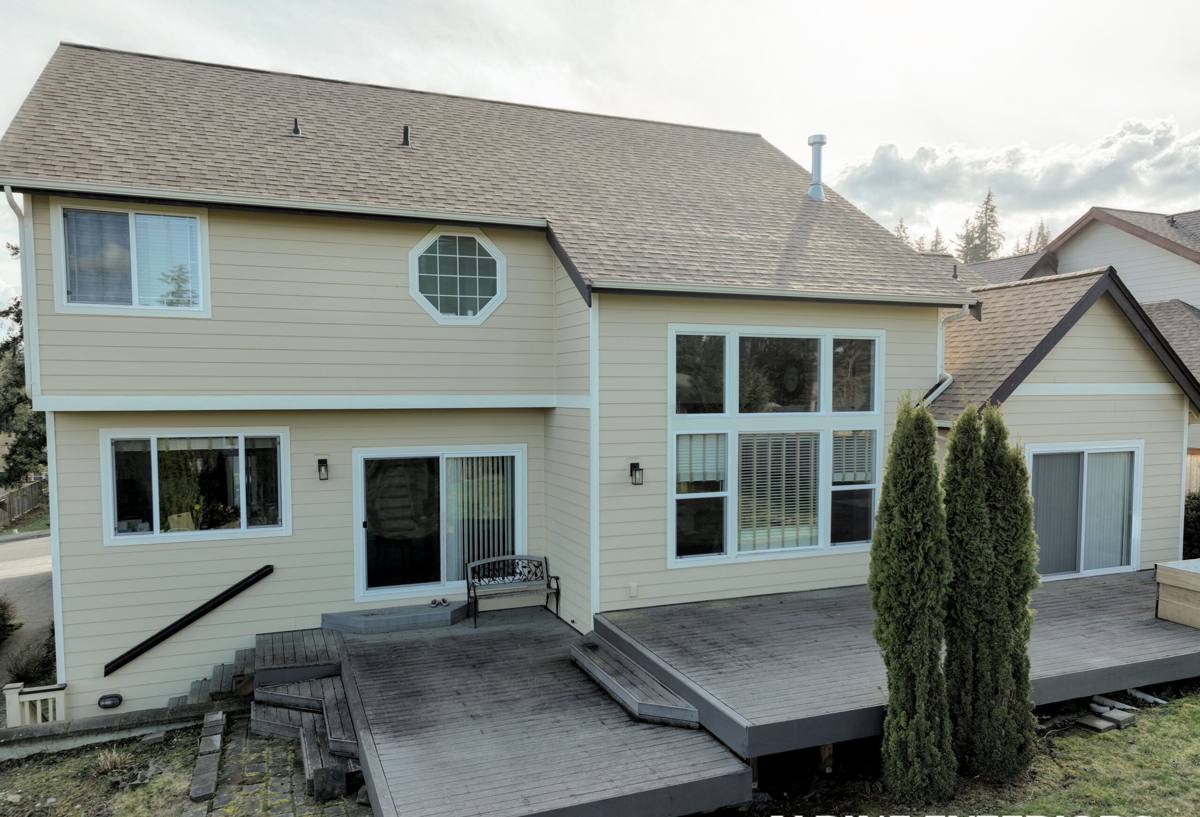
What Lynden's Climate Demands From a Deck
Long wet season, slow drying
Whatcom County's fall-through-spring stretch means a deck can stay damp for days between dry spells. Any design that traps water — flat ledger connections, tight board spacing, low airflow underneath — turns into a moisture trap. Decking needs gaps sized to let water shed and air move, and the substructure needs enough clearance off the ground for real ventilation, not just code minimums.
Moss and organic buildup
Moss doesn't just grow on roofs in this area — it takes hold on decks too, especially on the shaded side of a house or under overhanging trees, which are common on Lynden's larger residential lots. Moss holds moisture against the wood surface and grout lines between boards, accelerating rot in wood decking and staining composite decking if it isn't addressed. Board spacing, surface texture, and periodic cleaning access all factor into how much of a problem this becomes over time.
Freeze-thaw cycling
Whatcom County doesn't get brutal winters, but it does get repeated freeze-thaw swings through the cold months. Water that gets into a fastener hole, a post base, or a poorly sealed cut end expands and contracts repeatedly, which is how small gaps turn into structural problems over a few seasons.
Where Deck Failures Actually Start
In our experience, the vast majority of deck problems in this region come from a small number of build details, not from the decking material itself. Getting these right matters more than which brand of boards ends up on top.
- Ledger board attachment: where the deck ties into the house is the single most common failure point if it isn't flashed correctly — water gets behind the ledger and into the house's rim joist.
- Footing depth and bearing: footings that aren't set below frost depth or onto solid bearing soil can shift over time, especially with the freeze-thaw cycling common here.
- Fastener choice: using the wrong screws or hangers in a wet climate leads to corrosion, staining, and eventually a weakened connection.
- Post base drainage: posts set directly in concrete without a standoff base wick moisture up the grain and rot from the bottom.
- Board spacing and airflow underneath: too tight, and the deck never fully dries between rain events.
Decking Material Options for This Climate
There's no single "best" decking material — the right choice depends on budget, how much maintenance a homeowner wants to take on, and how exposed the deck is to shade and moisture. We'll walk through the honest trade-offs rather than push whatever has the best margin.
| Material | Upfront Cost | Maintenance | How It Handles Our Climate |
|---|---|---|---|
| Pressure-treated wood | Lowest | Annual cleaning, periodic sealing | Good if sealed regularly; neglect leads to graying, splintering, and moss buildup faster than other options |
| Cedar | Mid-range | Sealing every 1-2 years | Naturally rot-resistant, ages well, but still needs upkeep to hold color and resist moss |
| Composite decking | Higher | Occasional washing, no sealing | Handles constant moisture well; surface texture matters for slip resistance when wet or mossy |
| PVC/synthetic decking | Highest | Minimal | Fully moisture-proof board, best long-term option for shaded, damp areas of a lot |
For decks in shadier parts of a Lynden property — near trees, on the north side of a house, or under a second-story overhang — we generally steer homeowners toward composite or PVC decking simply because those areas never get the sun exposure needed to dry wood out between rains. For open, sun-exposed decks, a well-maintained cedar or treated wood deck can perform just fine for years.
Structural Details We Never Skip
Ledger flashing done right
Where the deck attaches to the house gets a proper flashing system — not just caulk — so water sheds away from the rim joist instead of collecting behind the ledger board. This is the detail most responsible for hidden rot when it's done wrong, and it's invisible once the deck is finished, which is exactly why it has to be done correctly the first time.
Footings sized for the load and the soil
We size and set footings based on the actual soil conditions and frost depth for the site, not a generic minimum. A deck that will carry a hot tub or a large gathering area needs different footing engineering than a small platform deck.
Corrosion-resistant hardware throughout
Structural screws, joist hangers, and post bases are matched to the decking and framing material and rated for exterior, wet-climate use. This avoids the rust streaking and hardware failure that shows up within a few years when the wrong fasteners get used to save cost.
Post bases that keep wood off standing water
Posts sit on raised, ventilated bases rather than buried in concrete, so the end grain never sits in trapped moisture.
Our Process for a Lynden Deck Project
- On-site assessment: we look at drainage patterns on the lot, shade exposure, soil conditions, and how the deck will tie into the existing structure.
- Design and material selection: we walk through layout, railing style, and decking material trade-offs based on your budget and how much maintenance you want to take on.
- Permitting: most decks above a certain height or attached to the house require a permit through Whatcom County or the applicable local jurisdiction — we handle that process.
- Footings and framing: footings are set to proper depth, framing is built with corrosion-resistant hardware, and the ledger is flashed before anything else goes on.
- Decking, railing, and finish work: boards are spaced for drainage and airflow, railings are installed to code, and all cut ends are sealed.
- Final walkthrough: we go over care and maintenance specific to whatever material you chose, so you know what upkeep actually looks like season to season.
Before You Sign a Contract: A Practical Checklist
Whether you hire us or someone else, these are the things worth confirming before deck work starts on your property:
- Does the contractor pull the required permit, or ask you to skip it?
- Is ledger flashing specified in writing, not just verbally promised?
- Are footing depths specified based on your actual soil and frost conditions?
- What fastener and hardware brand/rating is being used?
- Is there a written warranty on labor, separate from the manufacturer's material warranty?
- Does the quote break out decking material cost separately from framing and labor?
Why Local Experience on Decks Matters
A deck built from a generic national plan doesn't account for the fact that Lynden properties often have specific drainage patterns, mature tree cover, and soil conditions that differ block to block. A crew that regularly works Whatcom County has already seen how local moss growth, shade patterns, and winter moisture behave against different decking materials over multiple seasons — not just at installation, but three, five, ten years out. That's the difference between a deck that needs major repair inside a decade and one that just needs routine cleaning and the occasional board replacement.
We also know which inspection requirements and setback rules apply locally, so there are no surprises mid-project. That familiarity saves time and prevents costly rework.
Get an Honest Look at Your Project
If you're planning a new deck or replacing one that's showing its age, we're happy to come take a look, walk the site with you, and give you a straightforward estimate — no pressure, no upsell on materials you don't need. Use the form below to request a free estimate for your Lynden property.