 Bellingham
 Roof Repair Built for Birchwood's Weather, Not Just Any Roof
Birchwood sits close enough to the water and the tree line that its roofs take a different kind of beating than a roof twenty miles inland. Salt-laden air off Bellingham Bay works on exposed metal fasteners and flashing year-round. Long stretches of driving rain push water sideways into laps and seams that were never designed to handle wind-driven moisture. And the moss season here isn't a two-month nuisance — it's closer to eight or nine months, thanks to shade from mature trees and a climate that rarely dries a roof out completely between storms. A roof repair in this neighborhood has to account for all three at once, not just patch the one problem a homeowner happened to notice.
We work on roofs across Bellingham and Whatcom County, but Birchwood's mix of older homes, mature tree canopy, and its proximity to the water gives it a repair profile that's worth understanding before you decide what your roof actually needs.
Signs a Birchwood Roof Needs Repair, Not Just a Look
Most roof failures we see in this area don't start as a full roof problem — they start as one weak point that gets ignored through a few wet seasons. Homeowners usually notice one of these first:
- A water stain on a ceiling or in an attic corner that shows up after a heavy rain, then seems to dry out and get forgotten about
- Granules collecting in gutters or at the base of downspouts
- Visible moss buildup along the shaded or north-facing slopes of the roof
- Curling, lifting, or cracked shingles, especially near valleys or roof edges
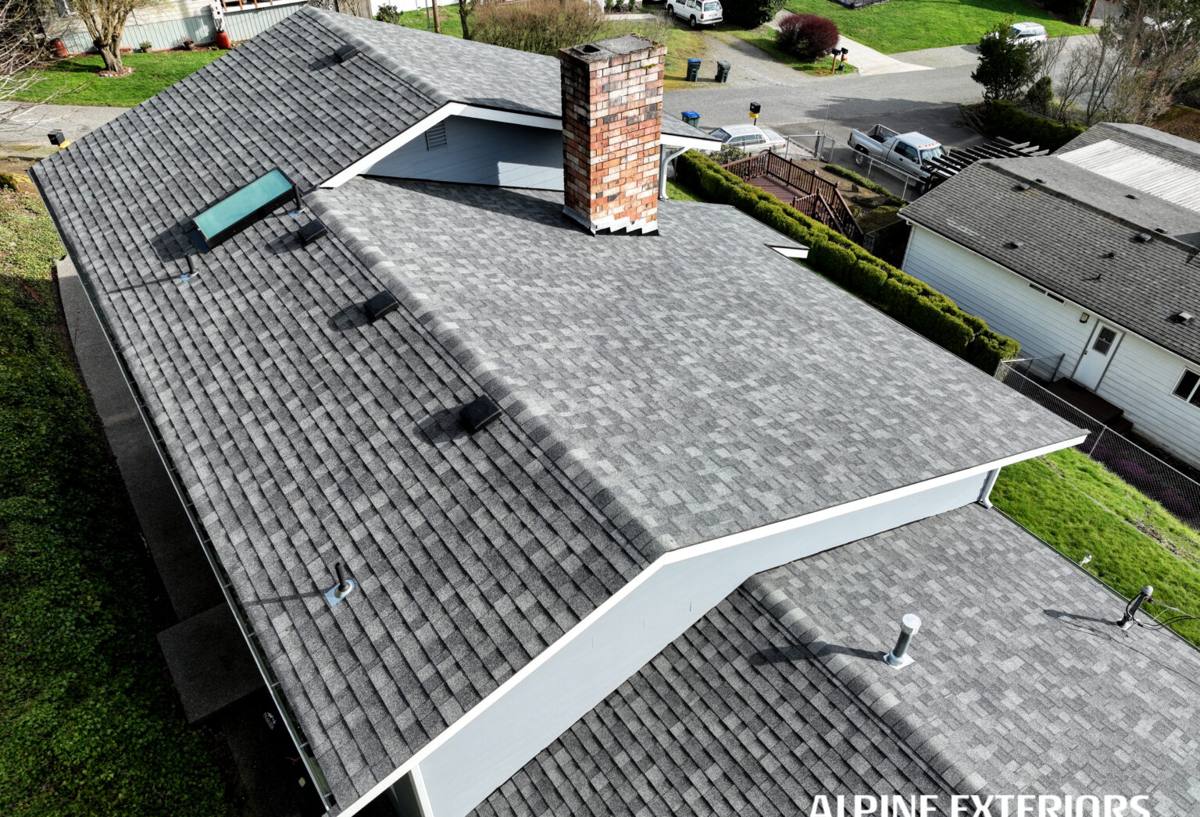
- Rusted or lifted flashing around chimneys, vents, or skylights
- Soft spots in the roof deck you can feel underfoot if you're up there, or sagging visible from the ground
- Daylight visible through the attic roof boards
Any one of these is worth a look. In our experience, the homeowners who call earliest end up with the smallest repair bills — waiting through one more wet season almost always turns a flashing repair into a deck repair.
How Salt Air, Rain, and Moss Actually Damage a Roof
Salt Air and Metal Components
Salt air accelerates corrosion on anything metal on a roof — nail heads, flashing, gutter fasteners, and vent boots with metal collars. Corroded fasteners lose their grip on shingles and lose their seal around penetrations, which is exactly where leaks start. It's a slow process, which is why it's easy to overlook until a fastener actually fails.
Driving Rain and Wind
Bellingham's storms often come with wind, which means rain doesn't just fall straight down — it gets pushed under shingle edges, into valleys, and around flashing laps that would be fine in a calm rain. Repairs in this area need to assume wind-driven water, not just gravity, or the same leak comes back the next storm.
Moss and Trapped Moisture
Moss does more than look bad. It holds moisture against the shingle surface long after the rest of the roof has dried, which softens asphalt granule adhesion and, on wood or older composition roofs, promotes rot underneath. Moss growing in a mat can also lift shingle edges just enough to let wind-driven rain get underneath. Removing moss without addressing what's feeding it — usually shade and poor airflow — means it's back within a season.
What a Correct Roof Repair Actually Involves
A repair that holds up in this climate is more than swapping a shingle or squeezing in a tube of sealant. Our process on a typical repair includes:
- Full diagnosis, not spot-checking. We trace the water back to its actual entry point, which is often several feet from the stain or drip you can see indoors.
- Deck inspection at the repair area. If the sheathing underneath is soft or delaminated, replacing shingles over it just hides a bigger problem.
- Flashing review, not just shingle replacement. Most leaks we trace in this area involve flashing — around chimneys, skylights, dormers, or where a lower roof meets a wall — more often than the field shingles themselves.
- Matching materials correctly. Mismatched shingle profiles or incompatible flashing metal can create new problems even when the immediate leak is fixed.
- Moss and debris clearing where relevant. If moss contributed to the failure, we address it as part of the repair, not as an upsell afterward.
- Sealing and fastening to current standards. Corroded fasteners get replaced, not just re-driven.
Common Roof Repair Scenarios We See in Birchwood
| What Homeowners Notice | Likely Cause | What the Fix Usually Involves |
|---|---|---|
| Ceiling stain after heavy rain | Failed flashing at a penetration or wall intersection | Flashing removal and reinstallation, deck check underneath |
| Moss patches on shaded slopes | Trapped moisture from shade and poor airflow | Moss removal, treatment, and shingle condition check |
| Granules in gutters, thinning shingles | Age and weathering, often accelerated by salt air | Section replacement if isolated, or a broader inspection if widespread |
| Leak near chimney or skylight | Corroded or improperly lapped flashing | Full flashing replacement, not just re-sealing |
| Soft spot or slight sag underfoot | Deck rot from prolonged moisture exposure | Localized deck replacement before re-roofing that section |
Repair vs. Replacement: How We Make the Call
Not every problem calls for a full roof replacement, and we don't default to recommending one. But there's a point where patching stops making financial sense. We weigh:
| Factor | Favors Repair | Favors Replacement |
|---|---|---|
| Age of roof | Under 10-15 years, single problem area | Nearing or past expected lifespan |
| Extent of damage | Localized to one section or penetration | Widespread granule loss, multiple leak points |
| Deck condition | Solid, dry sheathing | Rot or soft spots in multiple areas |
| Repair history | First repair, or infrequent | Same area repaired more than once already |
We'll tell you honestly which side of that line your roof falls on, including when a repair is the right and reasonable choice — we're not trying to sell a replacement a roof doesn't need yet.
Our Process, Start to Finish
For a Birchwood roof repair, the process typically looks like this:
- Initial inspection: We look at the roof from the ground and, when needed, up close, plus the attic side if accessible, to trace the actual source of the problem.
- Written estimate: You get a clear explanation of what we found and what we recommend, in plain terms, before any work starts.
- Scheduling around weather: Roof repairs need a reasonably dry window to do correctly. We plan around Bellingham's rain patterns rather than rushing a repair into a wet forecast.
- The repair itself: Deck check, flashing and shingle work, fastening, and cleanup, matched to what the diagnosis actually found.
- Final walk-through: We show you what was done and why, and flag anything else worth watching going forward.
Maintenance That Extends the Life of a Repair
A good repair holds up longer with a little seasonal attention. We recommend homeowners in this area keep an eye on:
- Gutters and downspouts clear before the fall rains start
- Overhanging branches trimmed back to reduce shade and debris buildup, which cuts down on moss
- A visual check from the ground each fall and spring for shifted, missing, or discolored shingles
- Attic checks after major storms for any new staining
- Moss treatment before it establishes into thick mats, not after
None of this replaces a professional inspection, but it catches problems while they're still small and cheap to fix.
Why a Crew That Already Works Birchwood Matters
Roofing problems in this neighborhood tend to repeat themselves in predictable ways — the same flashing details fail, the same shaded slopes grow moss, the same wind direction drives rain into the same valleys. A crew that's already worked on roofs in this specific pocket of Bellingham recognizes these patterns quickly instead of treating every roof as a first-time puzzle. That translates into a faster, more accurate diagnosis and a repair that's built for the conditions this roof actually faces, not a generic fix pulled from a manual written for a drier climate. It also means we're familiar with the older construction common in parts of Whatcom County, where roof decks and original flashing details don't always match what's standard on newer builds.
What Reasonable Roof Repair Should Cost
Costs vary widely depending on what's actually wrong, how accessible the roof is, and whether the deck underneath is sound. A small flashing repair is a modest job. A repair that includes deck replacement, extensive moss remediation, or multiple problem areas costs more, simply because more labor and material are involved. We won't quote a number without seeing the roof, because a fair estimate depends on an honest diagnosis first — but we'll always explain what's driving the cost so there are no surprises.
If you're dealing with a leak, visible moss, or just want an honest second look at a Birchwood roof, we're glad to come out for a free, no-pressure estimate — just fill out the form below.