 Bellingham
 Board & Batten Siding in Sehome: A Look That Has to Work as Hard as It Looks Good
Board and batten has become one of the most requested siding profiles in Sehome — the bold vertical lines read as craftsman, modern farmhouse, or clean contemporary depending on the trim and color choices around it. It's a good fit for the mix of older homes and newer infill you'll find in this part of Bellingham, close to Western Washington University and the wooded rise of Sehome Hill. But board and batten is also one of the least forgiving siding profiles to install badly. Every seam, every batten, every transition is a decision point, and in a marine climate like ours, a wrong decision doesn't take long to show up as a stain, a soft spot, or a streak of green.
This page covers what board and batten siding actually needs to hold up in Sehome specifically — not siding in general, and not board and batten in a dry inland climate where the margin for error is a lot wider.
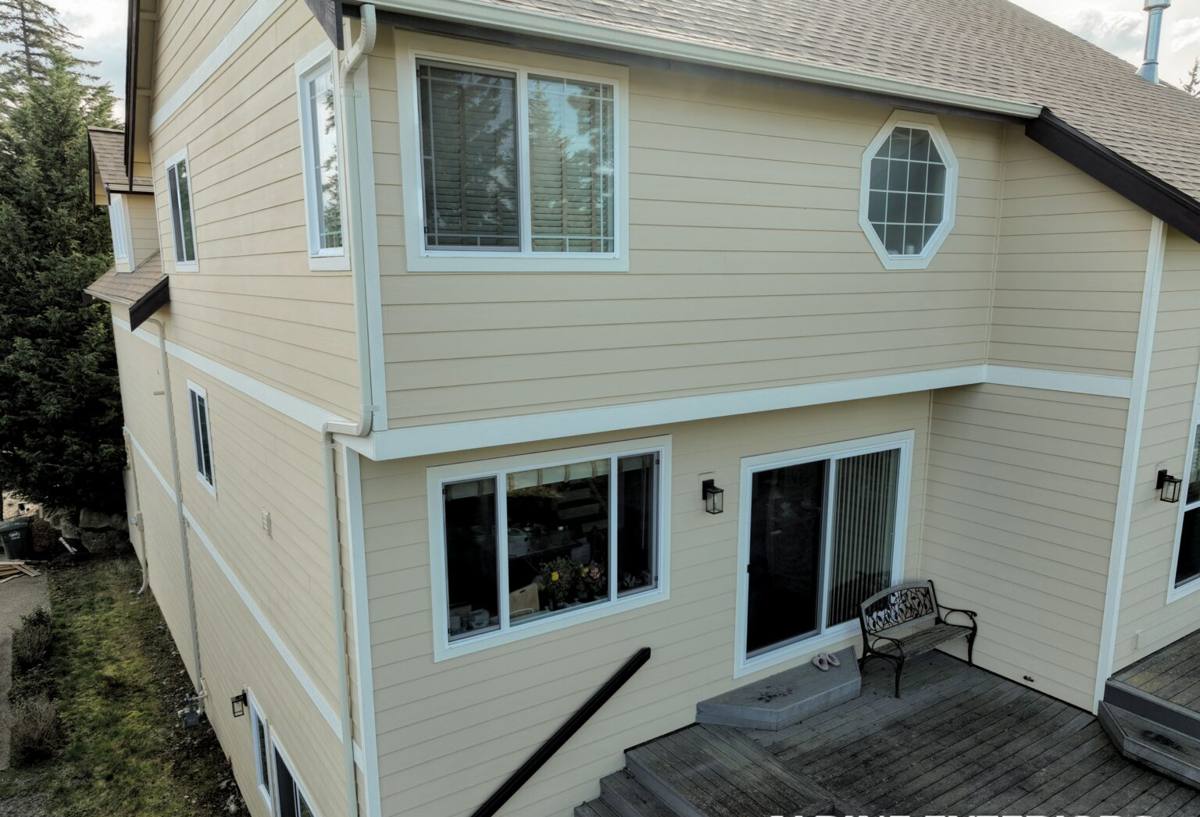
What Bellingham's Climate Does to Board & Batten Siding Over Time
Salt Air and Corrosion
Sehome sits close enough to Bellingham Bay that salt-laden air is a real factor, not a theoretical one. Salt air accelerates corrosion on fasteners, flashing, and any exposed metal trim. On a board and batten wall, the battens themselves create dozens of extra fastener lines compared to standard lap siding — if those fasteners and the flashing behind them aren't rated for a marine-adjacent environment, corrosion shows up as rust streaks bleeding down the face of the siding well before the siding material itself has aged out.
Driving Rain and Wind-Driven Moisture
Storms coming off the Salish Sea don't just drop rain straight down — they push it sideways into walls, especially on west- and south-facing elevations. Vertical board and batten actually sheds bulk water reasonably well because gravity has a clean, uninterrupted path down the face of each board. The risk isn't the open field of the wall — it's the horizontal breaks: window heads, roof-to-wall intersections, deck ledgers, and the bottom termination near grade. Wind-driven rain finds any gap at those points and drives it sideways and upward, not just down.
Moss, Algae, and a Long Wet Season
Whatcom County's moss season runs long. Shaded north- and east-facing walls, lots tucked under mature trees, and anywhere airflow is blocked by fences or landscaping will grow moss and algae faster than open, sun-exposed elevations. Board and batten's vertical battens create narrow shadow lines and slightly recessed seams that hold moisture a little longer than a flat wall — not a flaw in the profile itself, but a reason the finish and the drainage detailing behind it matter more here than in a drier region.
What a Correct Board & Batten Installation Actually Involves
The visual appeal of board and batten is simple; the assembly behind it is not. A correct installation in this climate is built in layers, not just fastened to the wall:
- A continuous weather-resistive barrier installed shingle-style so every lap sheds water downward and outward
- A drainage gap (rainscreen) behind the siding so any moisture that does get past the face has somewhere to go besides the sheathing
- Panels and battens fastened into solid framing at the manufacturer's specified spacing — not just wherever is convenient
- Metal flashing at every window head, door head, and horizontal trim transition, installed to actually direct water outward
- Kick-out flashing at every point where a roofline meets a sidewall, so runoff is diverted away from the siding instead of running behind it
- A bottom termination detail held above grade, decks, and roof surfaces with a drip edge or weep gap, not sealed flush to the ground
- Caulking used only where it belongs — as a secondary seal, never as the only thing keeping water out of a seam
Skip any one of these steps and the siding can still look right for a year or two. In Sehome's rain and salt air, the gaps in that list are usually what show up first — not the siding material itself.
The James Hardie Board & Batten System We Install
We install one board and batten system: James Hardie fiber cement panels with Hardie trim boards set as the battens, finished in ColorPlus factory-applied color. We don't offer this profile in vinyl, LP SmartSide, or unfinished wood, and that's a deliberate standard, not a lack of options.
A few specifics that matter for a coastal Whatcom County application:
- Non-combustible core. Fiber cement doesn't feed a fire the way wood-based or vinyl products can, which matters for insurance underwriting as much as for peace of mind.
- Climate-engineered formulation. James Hardie builds its siding to different specs for different regions — our part of Western Washington falls into their HZ5 engineering zone, formulated for sustained damp exposure rather than a hot, dry climate.
- Factory-applied ColorPlus finish. The color and clear coat are baked on in a controlled facility before the boards ever reach the job site, which gives more even coverage and better adhesion than field-applied paint on a wet Bellingham afternoon.
- Won't rot, and won't feed moss the way raw wood can. Fiber cement doesn't provide the organic material that algae and moss use as a food source the way untreated wood siding does, which matters directly for the shaded, damp walls common around Sehome.
The battens themselves are factory-finished Hardie trim, fastened per manufacturer spec and back-primed at the cut ends on site — a detail that's easy to skip and one of the first places amateur installs fail.
Board & Batten Material Comparison for Sehome Homes
| Factor | James Hardie Fiber Cement | Cedar / Raw Wood | Vinyl | LP SmartSide |
|---|---|---|---|---|
| Moisture behavior in driving rain | Stable; won't swell or warp | Absorbs water; prone to cupping | Sheds water but seams can trap it | Engineered wood core can swell at cut edges if not sealed |
| Moss / algae resistance | No organic food source | Susceptible, needs treatment | Resists organic growth but shows surface staining | Susceptible where finish is compromised |
| Salt air / corrosion exposure | Material itself unaffected; depends on fastener quality | Unaffected but finish degrades faster near salt air | Can become brittle over time near the coast | Finish and edge sealant stressed by salt exposure |
| Fire rating | Non-combustible | Combustible | Combustible; can melt/deform | Combustible |
| Typical factory finish life | 15-year ColorPlus finish warranty | Repaint every 3-7 years | Color baked in but fades and chalks over time | Repaint on manufacturer's schedule |
None of these products are without merit, and homeowners are free to choose any of them. We simply don't install anything but the Hardie system on the projects we take on, because it's the one we're willing to warranty in this climate.
Our Process, Start to Finish
- On-site assessment. We look at the existing wall assembly, sun/shade exposure on each elevation, and any current moisture or moss issues before quoting anything.
- Removal and inspection. Old siding comes off and the sheathing underneath gets checked for hidden rot or past water intrusion before we close the wall back up.
- Weather barrier and rainscreen. A continuous WRB and drainage gap go in first — this layer does more long-term work than the siding itself.
- Panel and batten installation. Hardie panels and battens go up to manufacturer fastening spec, with flashing integrated at every window, door, and roof intersection as we go, not added afterward.
- Detail work. Kick-out flashing, bottom terminations, and trim transitions get finished and checked before any caulking is applied.
- Final walkthrough. We go over the finished wall with the homeowner, including what routine maintenance actually looks like for board and batten in our climate.
Why a Crew That Already Works in Sehome Matters
Sehome's housing stock is a mix — older bungalows near the university, newer infill on smaller lots, homes tucked under tree cover on the hill, and others sitting more exposed toward the bay. Each of those situations changes how a wall dries out and how much shade-driven moss pressure it deals with year-round. A crew that's worked this neighborhood already knows to look closer at north-facing walls under mature trees, to expect more corrosion-conscious fastening near the water, and to plan install timing around Whatcom County's wet stretches rather than fighting them. That local pattern recognition is the difference between a spec-sheet installation and one that's actually built for the wall it's going on.
Maintaining Board & Batten Siding in a Marine Climate
A correctly installed Hardie board and batten wall is low-maintenance, not no-maintenance. A simple annual routine keeps it that way:
- Rinse the exterior once or twice a year with a garden hose to clear salt residue and organic buildup — skip the pressure washer, which can force water behind seams
- Check gutters and downspouts before the fall rains start; overflowing gutters are one of the most common causes of siding damage we see, not the siding itself
- Watch shaded, tree-covered elevations for early moss growth and address it before it spreads rather than after
- Inspect caulking at window and door trim yearly, since sealant is the first layer to age out, well before the siding or finish does
- Trim back landscaping and tree limbs that keep a wall shaded and damp longer than the rest of the house
If you're weighing board and batten for a home in Sehome and want a straight answer on what it would take — and cost — to do it right on your specific walls, we're glad to come take a look. The estimate is free, there's no pressure, and you'll get a clear breakdown of what your project actually needs.