 Bellingham
 Building Decks for Sehome's Older Housing Stock
Sehome sits close to downtown Bellingham and Western Washington University, and a lot of the homes in this neighborhood date back several decades. That means a fair number of the decks we get called out to look at are original or close to it — built long before anyone was thinking about ledger flashing, joist tape, or how a deck actually needs to shed water away from the house instead of trapping it. When we build new or rebuild in Sehome, we're not just putting down boards. We're correcting the mistakes that were standard practice when a lot of these homes went up.
Because Sehome is inland from the water compared to some Bellingham neighborhoods but still fully inside the Whatcom County marine climate, decks here deal with the same core problem every deck in this region deals with: it rains a lot, for a long time, at moderate temperatures that never quite dry things out between storms. That combination is harder on wood and hardware than a shorter, colder, drier winter would be.
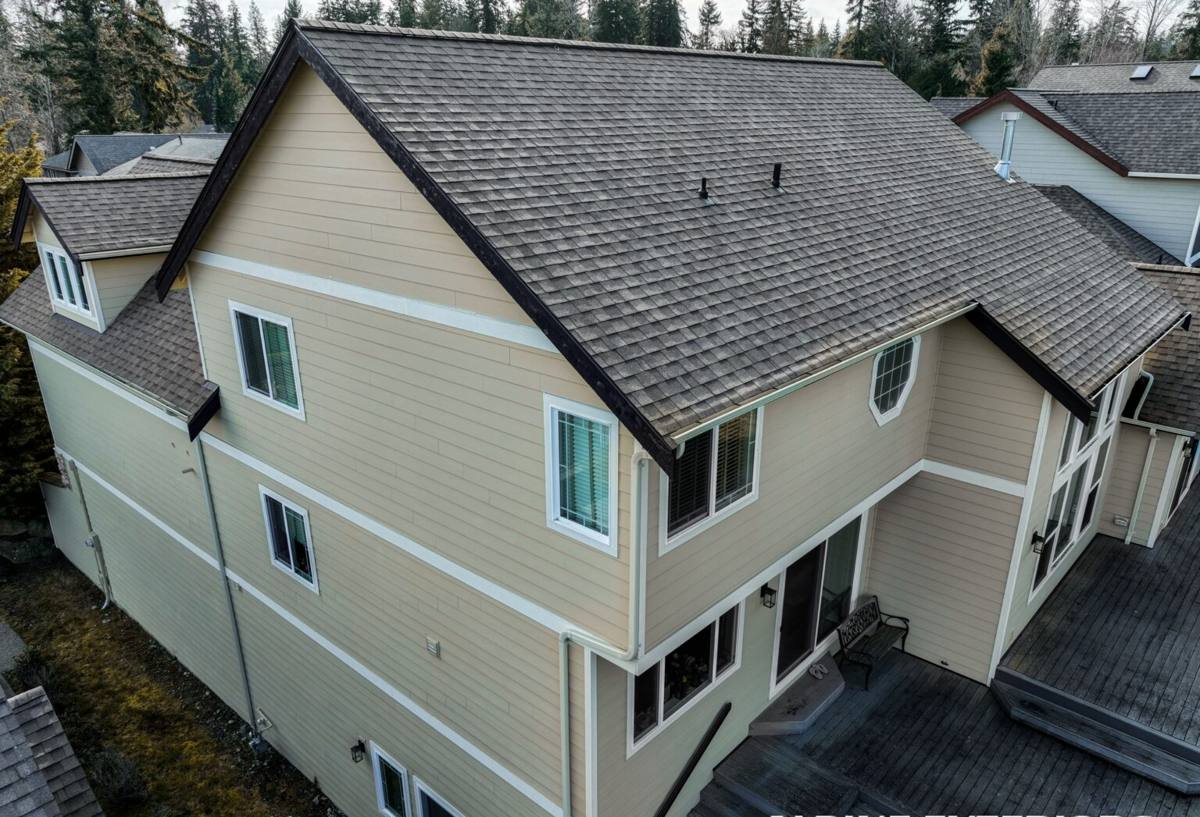
What Bellingham's Climate Actually Does to a Deck
A deck failure here rarely looks dramatic. It's not one storm — it's years of the same slow process repeating every wet season. Understanding what's actually happening helps explain why we build the way we do.
Driving rain and standing moisture
Rain in this region doesn't just fall straight down — wind off the Sound pushes it sideways into ledger boards, stair stringers, and any horizontal surface that isn't sloped to drain. Where a deck ties into the house, that driving rain gets forced behind siding and trim if the flashing wasn't detailed correctly. That's the single most common rot source we find on Bellingham decks: not the decking itself, but the ledger connection to the house.
The long moss season
Bellingham's moss season runs most of the year, not just a few weeks. Moss and algae hold moisture directly against wood and composite surfaces, and on decking that stays shaded — under trees, on the north side of a house, near the arboretum-adjacent lots common in Sehome — that moisture barely gets a chance to evaporate. Moss also makes deck boards and stairs genuinely slippery, which is a safety issue as much as a maintenance one.
Salt air and fastener corrosion
Sehome isn't waterfront, but Bellingham as a whole sits on Bellingham Bay, and salt-laden air moves further inland than most homeowners expect, especially with the prevailing wind patterns. Over years, that air accelerates corrosion on any fastener, bracket, or hanger that isn't rated for it. A joist hanger that rusts and weakens is invisible until the deck starts to feel spongy or a board pulls loose.
Where Sehome Decks Actually Fail
After years of working on homes in this neighborhood, the failure points are consistent. We check every one of these on an existing deck before we ever recommend a full rebuild versus a repair.
- Ledger board attachment to the house — missing or failed flashing, lag bolts instead of proper structural screws, no water-resistive barrier behind it
- Joist hangers and post bases showing rust streaks or scaling, especially near ground contact
- Decking boards cupping or checking where they sit flat instead of shedding water
- Stair stringers with rot at the base where they meet grade
- Guardrail posts loose at their connection — often the first thing a homeowner actually notices
- Moss buildup on north-facing or tree-shaded sections holding moisture against the wood
- Under-deck areas with no ventilation, trapping humid air against framing year-round
What a Correct Deck Build Involves Here
A deck that's going to hold up in this climate isn't built differently in some exotic way — it's built to the details that get skipped when speed matters more than longevity. That starts below grade and works up.
Footings and framing
Post footings need to go below frost depth and bear on undisturbed, well-drained soil — which matters in Sehome's mix of clay-heavy and fill soils near older lots. We use pressure-treated framing rated for ground contact where posts and beams are close to grade, and we keep framing lumber off wet soil with proper post bases rather than burying wood directly.
Ledger connection and flashing
This is where we spend the most care, because it's where we see the most failures. A correct ledger installation includes flashing that laps over a water-resistive barrier, proper structural fasteners (not just lag screws driven by feel), and a gap or flashing detail that keeps water from wicking between the ledger and the house sheathing. Done right, this connection should outlast the decking itself.
Fasteners and hardware
Given the salt-air exposure across Bellingham, we use hot-dip galvanized or stainless hardware rated for coastal-adjacent conditions rather than standard zinc-coated fasteners that corrode faster in this environment. It costs a little more up front and saves a full hardware replacement down the line.
Decking material and drainage
Whether it's wood or composite, boards need proper gapping for drainage and airflow, and the substructure needs to be sloped slightly away from the house so water has somewhere to go. We also make sure the space under the deck has some ventilation rather than being sealed off, since trapped humid air is what accelerates rot in framing that's otherwise protected from direct rain.
Wood vs. Composite for a Sehome Deck
Both materials work here — the right choice depends on how much upkeep a homeowner actually wants to do, not which one is "better" in the abstract.
| Factor | Wood (cedar/PT) | Composite |
|---|---|---|
| Moss/algae resistance | Needs periodic cleaning and sealing | Still needs cleaning, but doesn't absorb moisture the same way |
| Upfront cost | Lower material cost | Higher material cost |
| Long-term maintenance | Re-sealing/staining every few years | Occasional washing, no sealing |
| Appearance over time | Grays and weathers, character changes | Consistent color, doesn't gray |
| Repairability | Individual boards easy to replace | Board replacement possible, color matching can be harder on older product lines |
| Structural framing underneath | Pressure-treated wood either way | Pressure-treated wood either way |
One thing that doesn't change based on decking material: the framing underneath is still wood, still needs the same flashing and hardware attention, and still needs to be built to shed water. Composite decking on top of a poorly built substructure just hides the problem longer before it shows up.
Repair, Refresh, or Rebuild
Not every deck in Sehome needs to come out. We look at three things to make that call: the condition of the ledger connection and framing, the condition of the posts and footings, and how much of the visible decking is actually still sound.
- Repair makes sense when the framing and ledger are solid but individual boards, a stair stringer, or railing sections have failed
- Refresh (cleaning, re-sealing, hardware upgrades) fits a deck that's structurally fine but neglected — common on rental properties and homes that changed hands recently
- Rebuild is the right call when the ledger connection is compromised, footings are undersized or heaving, or rot has reached the primary framing members
We'll tell you honestly which category your deck falls into. A deck that only needs a refresh doesn't need a full rebuild sold to it, and we're not going to recommend tearing something out that has years of life left in it.
Our Process for a Sehome Deck Project
The process is straightforward, but we don't skip steps to move faster.
- On-site assessment of the existing deck or the build site — checking soil, drainage, and how the deck will tie into the house
- Honest recommendation: repair, refresh, or rebuild, with the reasoning explained plainly
- Design and material selection matched to how the space will actually be used and how much upkeep you want long-term
- Permitting where required — Bellingham and Whatcom County have specific requirements for deck height, guardrails, and footing depth that we handle
- Build, starting with footings and framing, then the ledger and flashing detail, then decking and railings
- Final walkthrough covering how to maintain the deck through the wet season — cleaning, drainage checks, and what to watch for
Why a Local Crew Matters for This Kind of Work
Deck building isn't complicated in theory, but the details that determine whether it lasts 10 years or 30 are regional. A crew that mostly works drier climates doesn't think about ledger flashing and fastener corrosion the same way a crew working Bellingham year-round does, because they don't see the failures caused by skipping those details. We work on homes throughout Whatcom County, including Sehome, and the patterns repeat often enough that we know where to look before a problem becomes visible from the surface.
We're also around after the build. If a guardrail loosens or a board needs attention two years down the line, you're not tracking down a crew that only does one-off jobs out of the area.
Maintaining a Deck Through a Bellingham Winter
Whatever we build, it'll last longer with a little seasonal attention. This isn't a hard maintenance schedule — just the handful of things that actually matter here.
- Sweep leaves and debris off the decking regularly through fall — trapped organic matter holds moisture and feeds moss
- Clean moss and algae off decking and stairs before it builds up, especially on shaded sections
- Check that gaps between boards haven't filled in with debris, which blocks drainage
- Inspect the ledger area and any visible flashing once a year for gaps or staining
- Look at guardrail posts for movement — loose connections are usually the first sign of a bigger issue
- Re-seal wood decking on the manufacturer's recommended schedule rather than waiting until it looks dry and gray
If you're in Sehome and thinking about a new deck, a rebuild, or just want an honest read on what shape your current one is in, we're happy to come take a look. The estimate is free, there's no pressure attached to it, and you'll get a straight answer either way — use the form below to get started.