 Bellingham
 Building Decks for South Hill's Particular Climate
South Hill sits up on the slope above downtown Bellingham, which means homes here catch weather a little differently than properties closer to the water or tucked into flatter neighborhoods. You get more direct exposure to driving rain off the Sound, salt-laden air on windy days, and the same long, damp moss season that grinds on every exterior surface in Whatcom County from late fall through spring. A deck built without that in mind will look fine for a year or two and then start showing problems — soft spots, black streaking, fasteners bleeding rust, boards cupping at the edges.
Building a deck correctly for South Hill isn't about using exotic materials. It's about respecting how water moves across a structure in this climate, choosing fasteners and connectors that won't corrode, and framing in a way that lets air circulate underneath so moisture doesn't just sit there all winter. That's the whole job, really — get the water management right and the rest follows.
What South Hill Properties Actually Need
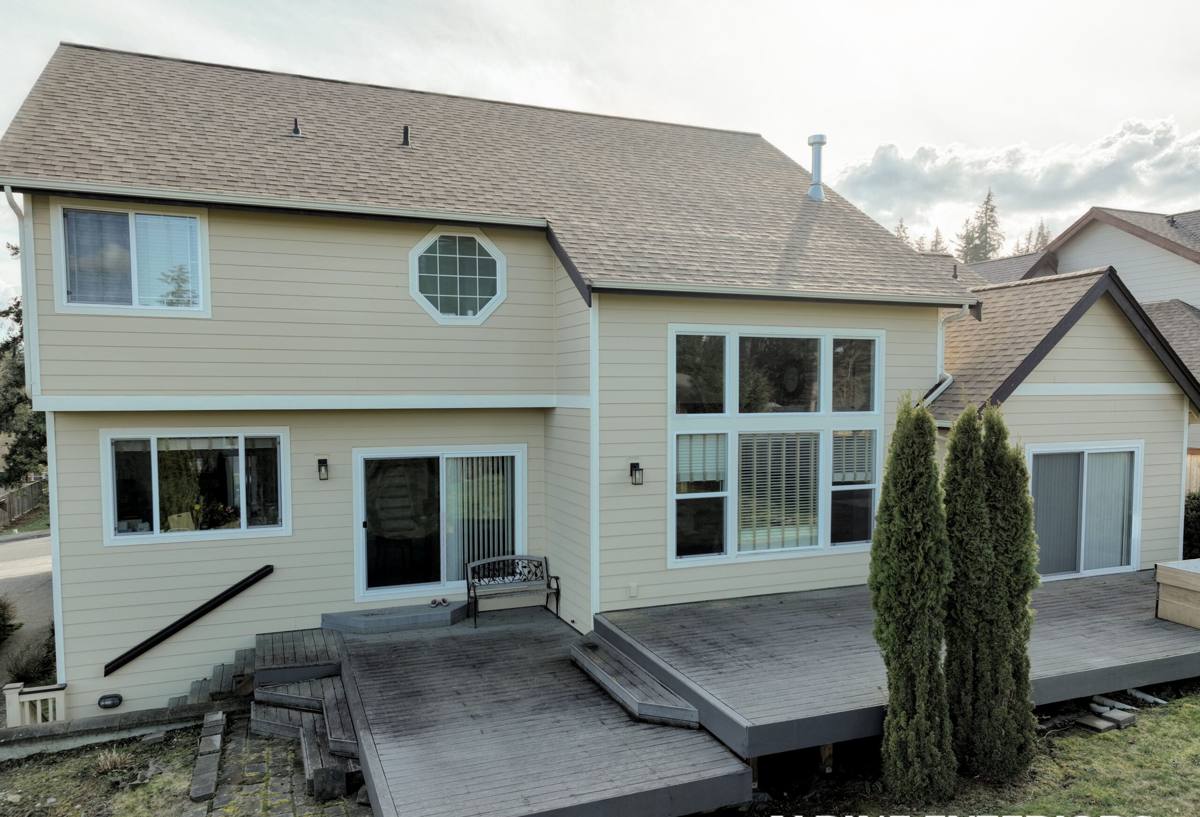
Elevation changes are common on South Hill lots, and a lot of homes here have decks that step down a slope or cantilever out over a grade change. That kind of framing needs to be engineered properly — ledger attachment, post footings, and joist spans all matter more when you're not building on flat, uniform ground. We see a fair number of older decks in this area that were built to whatever code existed decades ago, with ledger boards bolted straight to the rim joist with no flashing at all. That's one of the most common failure points we find, and it's almost always hidden until the siding or trim around it starts to show rot.
Beyond the structural side, South Hill's tree cover and shade patterns mean a lot of decks stay damp longer after a rain than a deck out in the open would. That changes what we recommend for decking material, gap spacing between boards, and how aggressive we get with ventilation underneath.
Signs an Existing Deck Is Struggling
- Dark green or black staining that keeps coming back within weeks of cleaning
- Soft or spongy spots when you walk across certain boards
- Rust streaks bleeding out from screw heads or joist hangers
- Gaps between decking boards that have closed up or become uneven
- Visible daylight gaps or movement where the ledger meets the house
- Railing posts that flex more than they used to
Getting the Water Management Right
Most deck failures in this climate aren't about the decking boards themselves — they're about what's underneath and behind them. The ledger board, where the deck attaches to the house, is the single highest-risk point on any deck. If that connection isn't flashed correctly, water works its way behind the ledger, into the rim joist, and eventually into the wall framing itself. In a region with as much sustained damp weather as Whatcom County gets, that process can move faster than homeowners expect.
Our approach starts with proper flashing at the ledger — a self-adhering waterproof membrane behind the ledger board, metal flashing over the top, and a gap left between the house and the decking so water sheds away from the wall instead of into it. Every fastener below deck level gets hot-dip galvanized or stainless hardware, not standard coated screws, because salt air speeds up corrosion on anything less. Joist hangers and structural connectors get the same treatment.
Ventilation Underneath
Low-clearance decks and decks built close to grade are common on sloped South Hill lots, and they're also the ones most prone to trapping moisture underneath. We frame with enough clearance for airflow wherever the site allows, and where clearance is tight, we look at options like grated skirting or spaced fascia venting rather than sealing the underside completely. A deck that can breathe dries out between storms. One that can't stays damp through the whole wet season.
Choosing Decking Material for This Climate
There's no single right answer here — it depends on budget, how much maintenance you actually want to do, and how much shade the deck sits in. We'll walk through the honest trade-offs rather than push one product.
| Material | Upfront Cost | Maintenance | How It Handles This Climate |
|---|---|---|---|
| Pressure-treated wood | Lowest | Annual cleaning, re-sealing every 1-2 years | Performs fine if sealed consistently; neglect shows fast in shaded, damp spots |
| Cedar | Moderate | Regular sealing/staining to hold color and resist rot | Naturally rot-resistant but still needs upkeep in constant damp exposure |
| Composite decking | Higher | Occasional washing, no sealing/staining | Very consistent in wet climates; quality varies by brand, so we're selective about which lines we install |
| PVC/capped polymer | Highest | Minimal — washing only | Best moisture resistance of the group; higher cost is the main trade-off |
For a shaded South Hill lot where moss and algae are a constant fight, we usually steer homeowners toward composite or capped polymer if the budget allows, simply because it removes the sealing/staining maintenance cycle that's easy to fall behind on in a climate where dry weekends are limited. Wood is still a completely legitimate choice — it just requires the owner to actually keep up with maintenance, and we're upfront about that before you commit to it.
Framing and Structural Details We Don't Skip
A deck is only as good as what's under the boards. We size joists and beams for the actual span and load, not the minimum the code allows, and we don't rely on undersized ledger connections just because they're faster to install. On sloped South Hill sites, footing depth and post placement get engineered for the actual grade, not assumed from a standard flat-lot layout.
What a Correct Framing Job Includes
- Ledger flashed with waterproof membrane and metal counter-flashing, never just caulked
- Structural screws or through-bolts at the ledger, not deck screws alone
- Joist hangers and post bases in corrosion-resistant galvanized or stainless steel
- Footings sized and placed for the actual slope and soil conditions on site
- Adequate under-deck clearance or venting where clearance is limited
- Beveled or sloped ledger flashing detail so water sheds away from the house
Railings, Stairs, and Fasteners
Railing posts take a lot of abuse from wind and repeated flexing, and on an elevated South Hill deck, a loose railing post is a real safety issue, not just a cosmetic one. We anchor posts through the rim joist with structural blocking behind them rather than just toe-screwing into the decking, which is a shortcut that shows up as wobble within a season or two. Stair stringers get the same corrosion-resistant hardware as the rest of the frame, since stairs sit closer to grade and catch more splash-back moisture during heavy rain.
Every fastener on an exterior deck in this region should be rated for ground contact and coastal exposure — that's not an upsell, it's just what holds up here. Mixing standard interior-grade screws into an exterior deck build is one of the most common corner-cuts we see on older decks we're asked to repair.
Our Process for South Hill Deck Projects
- On-site assessment — we look at grade, drainage, existing structure (if replacing a deck), and sun/shade exposure to understand what the deck will actually deal with year-round.
- Design and material discussion — honest trade-offs on decking material, railing style, and layout based on your budget and how much upkeep you want to take on.
- Permitting — most deck work at any real height or size requires a permit through the City of Bellingham or Whatcom County depending on the exact location; we handle that process.
- Framing and flashing — the structural work and waterproofing details that determine whether the deck lasts.
- Decking, railing, and finish work — installed to manufacturer spec, with attention to fastener spacing and board gaps appropriate for our wet season.
- Final walkthrough — we go over care and maintenance specific to whatever material you chose.
Why Local Experience on South Hill Matters
A crew that's worked this specific part of Bellingham knows which lots have tricky grade changes, which areas get heavier moss buildup from tree cover, and how a house sits relative to prevailing wind and rain direction. That's not something you can fully account for from a generic checklist — it comes from having actually built and repaired decks on these streets and seeing which details hold up and which ones don't. We'd rather flag a site-specific issue during the estimate than discover it two years into the deck's life.
Maintaining Your Deck After It's Built
Whatever material you choose, a little seasonal attention goes a long way in this climate. Clear leaves and debris from between boards before the wet season sets in — trapped organic material is what feeds moss and mildew growth. Check railing posts and stair connections once a year for movement. If you went with wood, stay on top of the sealing or staining schedule rather than waiting until it visibly needs it. If you went with composite or PVC, an occasional wash is really all it takes.
If you're planning a new deck or dealing with an existing one that's showing its age, we're happy to take a look and give you a straightforward assessment — no pressure, no upsell, just what we'd actually recommend for your property. Fill out the form below for a free estimate.