 Bellingham
 Deck Replacement Built for Sudden Valley's Site Conditions
Sudden Valley sits under heavy tree canopy along Lake Whatcom, and that setting is exactly what makes deck replacement here different from a typical Bellingham job. The trees that make the neighborhood beautiful also mean less direct sun, more standing moisture on horizontal surfaces, and a moss season that runs longer than it does out in the open. Add in the marine-influenced air that moves through Whatcom County off Bellingham Bay, and you've got a combination of shade, humidity, and driving rain that a lot of decks simply weren't built to handle for the long haul.
We're not talking about a deck that falls down. We're talking about the slow failures: framing that stays damp days after a storm because the canopy blocks airflow, ledger boards that trap water against the house, fasteners that corrode faster than expected, and surface boards that grow moss and algae within a season or two of cleaning. A deck replacement done right in Sudden Valley accounts for all of that from the framing up, not just the decking you can see.
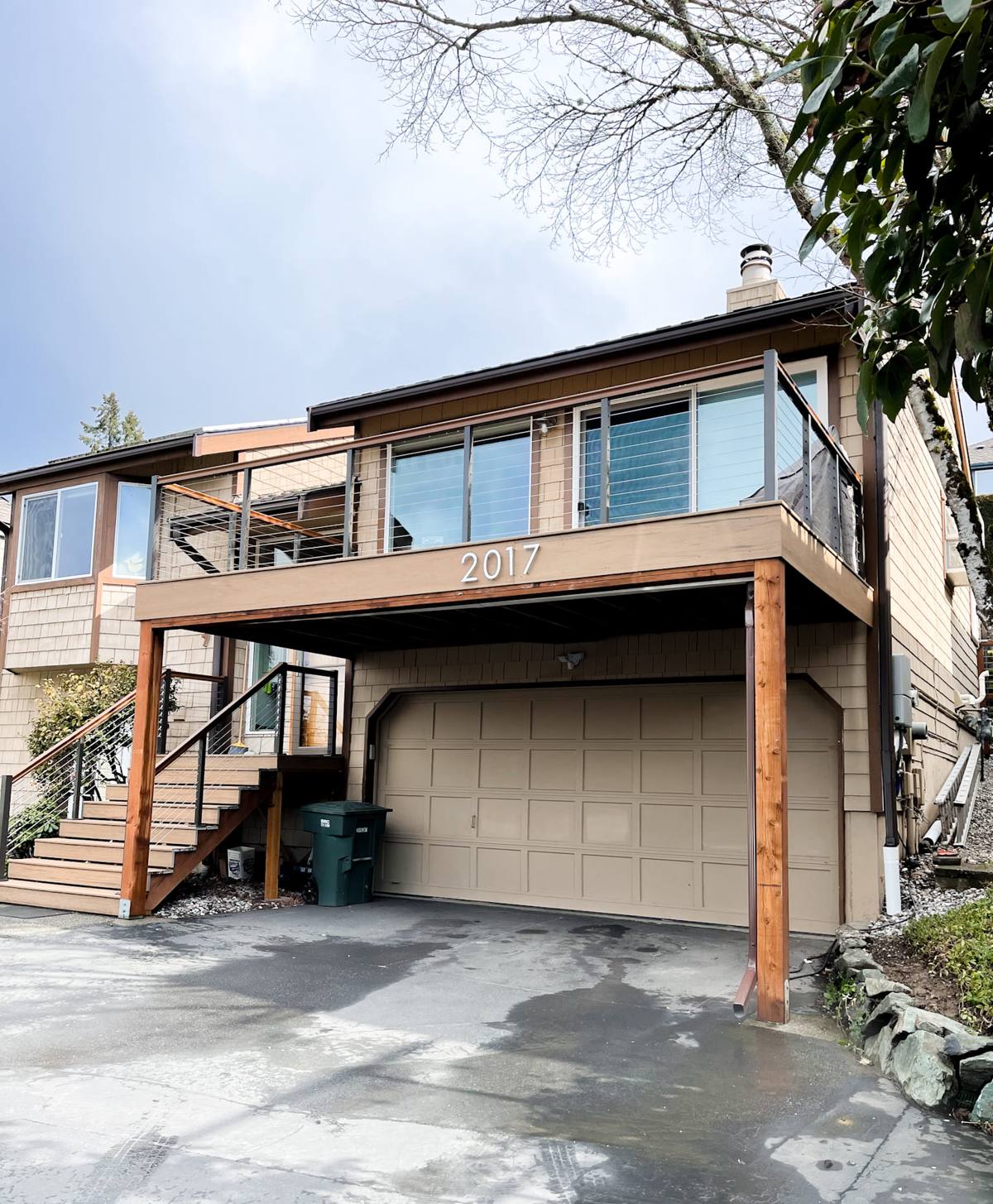
Signs a Sudden Valley Deck Needs Replacement, Not Just Repair
Repair makes sense when the problem is isolated — a few rotten boards, a loose railing, a stair tread that's cracked. Replacement is the honest call when the damage has reached the structure itself or when patching would just be delaying the same failure. In a shaded, moisture-heavy setting like Sudden Valley, structural problems tend to show up sooner than homeowners expect because the wood underneath stays wet longer between drying cycles.
- Soft or spongy spots anywhere on the decking surface, especially near the house or under planters
- Ledger board separating from the house, or visible gaps/staining where it meets the siding
- Joists or beams that are dark, soft, or crumbling when probed with a screwdriver
- Persistent moss or algae that returns within weeks of cleaning, even in shaded areas
- Rust streaking from fasteners or connectors, a sign the hardware is failing underneath
- Railings that flex or posts that wiggle at the base — often a sign of rotted blocking, not just a loose bolt
- A deck more than 20-25 years old built to older code, especially if it lacks proper flashing or a ledger connection detail
If you're only seeing one or two of these, a repair may still be reasonable. If you're seeing several, or if the framing itself is compromised, replacement is usually the more honest and more cost-effective path — repeated patch jobs on failing framing rarely pencil out over time.
What a Correct Deck Replacement Involves
Starting With the Structure, Not the Surface
The decking boards are what you see, but the framing is what determines whether the deck lasts. A proper replacement starts with footings sized and set to current code, posts and beams rated for the actual span and load, and joists spaced to support whatever decking material goes on top. In a shaded lot like most of Sudden Valley, we also pay close attention to ground clearance and airflow underneath the deck — tight clearance combined with tree cover is a recipe for framing that never fully dries out.
The Ledger Connection
Most deck failures that end up as safety issues trace back to the ledger board — the piece that attaches the deck to the house. It has to be properly flashed so water sheds away from the house wall instead of running behind the siding, and it has to be fastened with structural connectors rated for the load, not just decking screws. This is one of the most common shortcuts on older or lower-bid deck work, and it's one we don't cut corners on.
Fasteners and Hardware
In a damp, shaded climate, fastener corrosion is a real long-term issue. We use hardware rated for the decking material and treated lumber being used — stainless or coated fasteners where the material calls for it — so you're not dealing with rust streaks and failing connections five or eight years down the road.
Choosing the Right Decking Material for a Shaded, Wet Site
Every decking material handles moisture and shade differently, and Sudden Valley's tree cover changes the calculus compared to a deck out in full sun. Here's how the common options actually perform in this kind of setting.
| Material | Performance in Shade & Moisture | Maintenance | Typical Lifespan |
|---|---|---|---|
| Pressure-treated lumber | Prone to moss and mildew in shade; needs airflow to dry properly | Annual cleaning, periodic sealing/staining | 10-15 years before boards need attention |
| Cedar | Naturally rot-resistant but still needs to dry out between rains; shade slows that | Regular cleaning and refinishing to hold color and resist moss | 15-20 years with upkeep |
| Composite decking | Handles moisture well, resists rot, but can still grow surface algae/moss in deep shade | Periodic washing; no staining or sealing required | 25-30+ years, manufacturer-dependent |
| PVC/capped polymer | Best moisture resistance of the common options; least affected by standing dampness | Lowest maintenance; occasional washing | 25-30+ years, manufacturer-dependent |
None of these materials are moss-proof — moss needs a surface and moisture, and Sudden Valley provides both. But composite and capped polymer decking give homeowners the most margin for error when the deck sits under trees for most of the day, since they don't absorb water the way wood does and they don't need refinishing to stay protected. We'll walk you through the real trade-offs for your specific site rather than pushing one product across the board.
Our Deck Replacement Process
- On-site assessment. We inspect the existing deck's framing, ledger connection, footings, and drainage, and take note of tree cover, sun exposure, and any moss or moisture patterns specific to your lot.
- Honest scope and estimate. We tell you plainly whether you're looking at a full tear-out or a partial rebuild, and what material options fit your budget and the site's conditions.
- Permitting. Deck replacements of most sizes require a building permit; we handle that process and build to current code, including proper guardrail height, stair geometry, and structural connections.
- Demolition and disposal. Old decking, framing, and hardware are removed and hauled off — we don't leave debris behind or leave you to deal with it.
- Framing and ledger work. New footings, posts, beams, and joists go in to current code, with proper ledger flashing sized for our rainfall and site drainage addressed so water moves away from the house and the ground underneath the deck.
- Decking, railing, and finishing. Your chosen decking material is installed along with railings, stairs, and any fascia or trim, finished to match the look of your home.
- Final walkthrough. We go over the finished deck with you, including simple maintenance guidance suited to your specific amount of shade and tree cover.
Permits and Design Review in Sudden Valley
Sudden Valley is a covenant-controlled community, and many properties here are subject to architectural or design review in addition to standard county building permits. We build that into the timeline up front rather than treating it as an afterthought — that means confirming what documentation your review process requires, keeping your plans consistent with typical neighborhood standards, and not starting demolition until permitting is squared away. On top of that, Whatcom County's own building permit requirements apply to most deck replacements regardless of size, particularly when footings, framing, or guardrails are being rebuilt rather than just resurfaced.
What Deck Replacement Costs, and What Drives the Price
Every deck is different, so we won't quote a number without seeing the site — but the factors below are what actually move the price on a Sudden Valley job, more than square footage alone.
| Cost Factor | Why It Matters Here |
|---|---|
| Framing condition | A full tear-out to footings costs more than resurfacing sound framing, but shaded lots more often need the full rebuild |
| Decking material | Composite and PVC cost more up front than wood but need far less upkeep in this climate |
| Deck height and access | Multi-level or elevated decks common on Lake Whatcom's sloped lots require more framing and railing work |
| Site access | Tree cover, narrow driveways, and slope can add labor time for material staging and equipment access |
| Permitting and design review | Covenant review and county permitting both add lead time that should be planned for, not rushed |
| Drainage and grading work | Sites with poor water runoff under the deck may need added drainage work to protect the new framing long-term |
Broadly, a straightforward resurfacing on sound framing sits at the low end of the range, while a full tear-out and rebuild with composite or PVC decking, new footings, and railing sits at the higher end. We'll give you real numbers after we've actually looked at your deck.
Why Hiring a Crew That Already Works Sudden Valley Matters
A deck built by someone unfamiliar with this neighborhood tends to make the same mistakes: framing sized for a sunnier lot, decking chosen without accounting for shade and moss, or ledger and drainage details that work fine in a drier setting but fail here within a few years. Crews who already work in Sudden Valley know the tree cover, the lake-adjacent humidity, and the covenant review process, so the deck gets designed for the site it's actually sitting on — not a generic template.
That local familiarity also matters for the practical side of the job: knowing the access points on the community's roads, understanding typical lot slopes around the lake, and having already been through the design review process with other homeowners here. It saves time and avoids surprises partway through the project.
Maintaining a New Deck in Sudden Valley's Climate
Even the best-built deck needs some upkeep in this environment. A little seasonal attention goes a long way toward protecting your investment:
- Sweep leaves and debris off the surface regularly, especially in fall — trapped organic matter holds moisture and feeds moss
- Rinse or gently wash the deck surface a couple times a year to knock back algae and moss before it takes hold
- Keep gutters and downspouts near the deck clear so runoff isn't dumping extra water onto or under the structure
- Check railings and stair connections annually for looseness, which shows up faster in damp conditions
- For wood decking, plan on resealing or restaining on the schedule your material calls for — skipping a cycle in this climate shortens the boards' life noticeably
- Trim back overhanging branches where practical to improve airflow and sun exposure on the deck surface
If you're weighing repair versus replacement, or you just want an honest look at what your current deck needs, we're happy to come take a look. The estimate is free, there's no pressure, and you'll get a straight answer about what your deck actually needs — use the form below to get started.