 Bellingham
 Composite Decking Built for South Hill's Conditions
South Hill is one of Bellingham's older, more established neighborhoods — elevated streets, mature trees, and a mix of homes ranging from early-1900s builds to newer construction. That elevation and tree cover is part of what makes the area desirable, but it also creates a specific set of conditions for anything built outdoors. Shade from mature trees keeps decks damp longer after rain. Slight slopes and older foundations mean framing isn't always square or level. And like the rest of Whatcom County, South Hill sits under a long wet season with driving rain off the water and a moss season that can run from fall through spring.
Composite decking holds up well here, but only when it's installed with those specifics in mind. A composite deck installed the same way you'd install one in a dry inland climate will show problems within a few years — trapped moisture, algae growth in shaded boards, fastener issues from constant wet-dry cycling. Getting it right in South Hill means treating the framing, drainage, and board selection as one connected system, not just laying boards over whatever structure is already there.
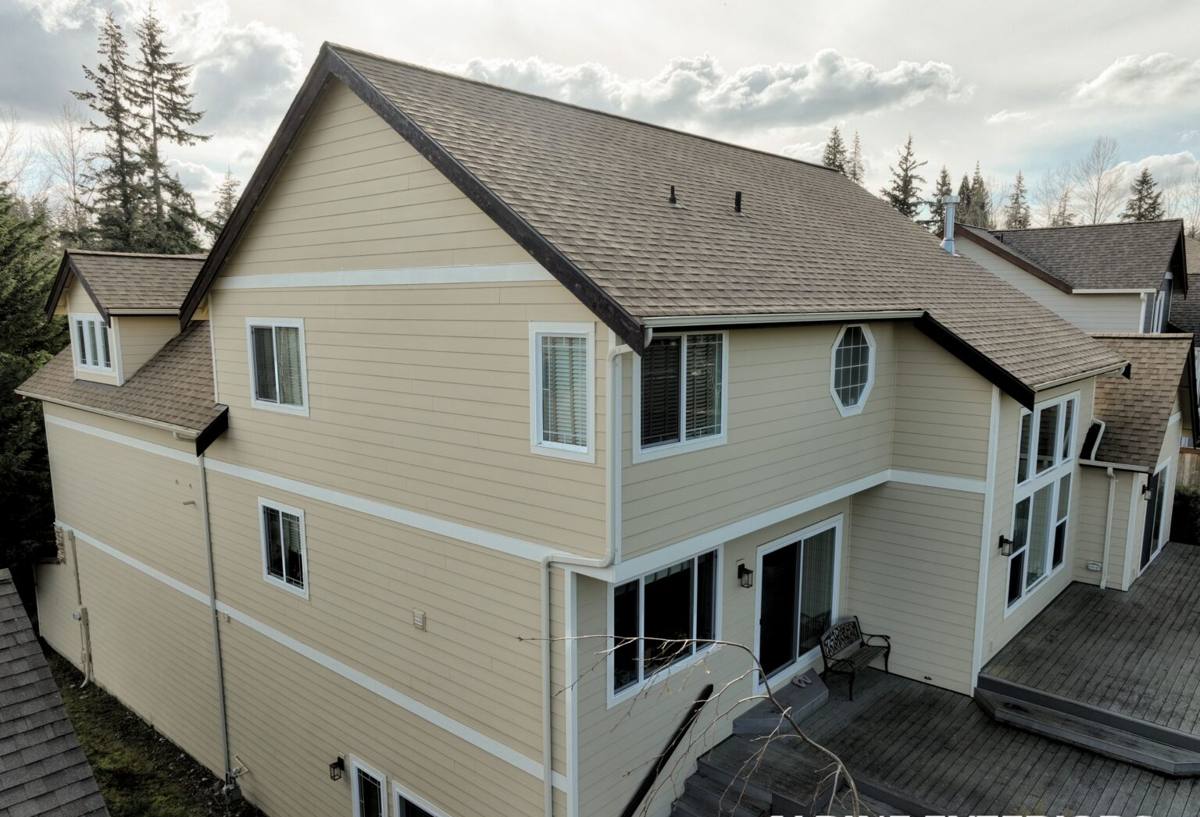
What This Climate Actually Does to a Deck
Bellingham's marine climate brings a few specific stresses that matter for decking choices and installation details:
- Salt air: Proximity to Bellingham Bay means airborne salt accelerates corrosion on fasteners, brackets, and railing hardware that aren't rated for it.
- Driving rain: Wind-driven storms push water sideways, not just down — meaning ledger board flashing and gaps between decking and siding matter as much as the surface itself.
- Long moss season: Shaded, north-facing, or tree-covered sections of a deck stay damp for extended stretches, which is exactly the environment moss and algae need to establish.
- Freeze-thaw cycling: Whatcom County gets enough cold snaps that trapped moisture in framing or fasteners can freeze, expand, and loosen connections over a few winters.
None of these are dealbreakers for composite decking — they're just the reasons a deck installed with generic assumptions underperforms here, while one built with these specifics in mind lasts.
Why This Matters More on Shaded or Sloped South Hill Lots
Many South Hill properties have tree cover or sit on a grade, which changes how water moves across and under a deck. A flat, open-yard installation can get away with less attention to drainage. A sloped or shaded lot can't — water needs somewhere to go, and shaded boards need enough airflow underneath to actually dry between rain events instead of staying damp for weeks.
What a Correct Composite Deck Installation Involves
A composite deck is only as good as what's underneath it. The board itself is the last thing installed, not the first thing to think about.
Framing and Structure
Joist spacing, beam sizing, and post footings all need to match the actual load and span — not just what was there before if we're replacing an old deck. On older South Hill homes, existing framing is often undersized by current code, or footings weren't set below frost depth. We evaluate the structure before assuming it's reusable.
Ledger Flashing and Water Management
Where a deck attaches to the house, proper flashing keeps water from working its way behind siding and into the wall assembly — this is one of the most common failure points on older decks in this region, and it's invisible until it isn't. Joist tape over the framing adds another layer of protection against the constant wet-dry cycling this climate produces.
Fasteners and Hardware
Given the salt air off the bay, we use fasteners and structural hardware rated for coastal/corrosive exposure, not standard interior-grade hardware. Hidden fastener systems for the decking itself also matter — fewer surface penetrations means fewer points where water can get into the board core over time.
Ventilation Underneath
Composite boards need airflow beneath them to shed moisture. Low-clearance decks, or ones enclosed with skirting that blocks airflow, hold humidity against the underside of the boards and framing — accelerating the exact problems the composite material is otherwise resistant to.
Board Layout and Drainage
Board direction and gapping are set based on how water actually moves off the specific deck, not a default pattern. On a shaded or sloped lot, that often means adjusting layout so water isn't pooling against the house or in low corners.
Composite vs. Wood vs. PVC: An Honest Comparison
Every decking material is a tradeoff. Here's how they compare for a wet, shaded, salt-air environment like South Hill:
| Material | Moisture Behavior | Maintenance | Moss/Algae Resistance | Typical Lifespan |
|---|---|---|---|---|
| Pressure-Treated Wood | Absorbs and releases moisture; prone to cupping/splitting over time | Annual staining/sealing needed | Low — porous surface holds moisture and organic growth | 10–15 years |
| Capped Composite | Solid, low-absorption core with a protective cap | Occasional washing; no staining/sealing | Good — smooth cap sheds moisture and resists staining | 25–30+ years (mfr. warranty dependent) |
| PVC/Cellular | Fully synthetic, essentially non-absorbent | Occasional washing | Very good, though can show surface grime in deep shade | 25–30+ years |
We install capped composite for most South Hill projects because it strikes the right balance of moisture performance, low maintenance, and appearance — without the higher cost premium of full PVC systems. We're glad to walk through PVC as an option too; the honest tradeoff is usually cost versus a marginal moisture-resistance gain that most homes don't need.
Our Process
- On-site assessment: We look at the existing structure (if any), grade, shade exposure, and how water currently moves across the site.
- Structural evaluation: Footings, ledger connection, and framing are checked against current code before anything is reused.
- Permit coordination: Most deck work in the City of Bellingham and unincorporated Whatcom County requires permits, particularly for elevated decks and guardrails. We handle that paperwork as part of the job.
- Demolition and framing: Old decking and any compromised framing is removed and replaced or reinforced.
- Flashing, tape, and drainage detailing: This is the step that determines how the deck performs in five or ten winters, not the first one.
- Composite installation: Boards, hidden fasteners, and trim are installed to spec, with layout adjusted for the specific site's drainage.
- Railings and finish work: Guardrail height and baluster spacing are set to current code, especially important on elevated South Hill lots.
- Final walkthrough: We go over care basics and what to watch for in year one.
Maintenance in a Long Moss Season
Composite decking doesn't need staining or sealing, but it isn't zero-maintenance in this climate. A couple habits go a long way:
- Sweep off leaves and debris regularly, especially in fall — trapped organic matter under leaves is what feeds moss and algae growth.
- Wash the deck surface with soap and water (or a composite-safe cleaner) once or twice a year, more often on shaded sections.
- Keep gutters and downspouts clear so roof runoff isn't dumping extra water onto or near the deck.
- Avoid high-pressure pressure washing directly on composite boards — it can etch the cap surface; a soft wash is safer.
- Check railing hardware annually for corrosion, particularly on homes closer to the water where salt air exposure is higher.
What Affects the Cost of a Composite Deck
| Factor | Why It Matters |
|---|---|
| Deck size and shape | More square footage and complex shapes (angles, multiple levels) increase material and labor time |
| Existing framing condition | Reusable structure costs less than a full tear-out and rebuild |
| Height and footing depth | Elevated decks on sloped South Hill lots often need deeper footings and additional structural support |
| Board tier | Composite lines range from entry-level to premium capped boards, affecting both price and warranty length |
| Railing type | Composite, aluminum, or cable railing systems vary significantly in cost |
| Stairs and add-ons | Stairs, built-in lighting, and picture-frame border details add labor and material |
We give a firm, itemized quote after the on-site assessment — not a ballpark over the phone — because the framing condition and site specifics change the number more than the decking material does.
Why a Crew That Already Works South Hill Matters
South Hill's mix of older homes, sloped lots, and tree cover means every deck project has a few site-specific wrinkles — a ledger connection into older siding, a footing that needs to go deeper because of the grade, drainage that has to route around an existing structure. A crew that's worked this neighborhood before recognizes those patterns quickly instead of discovering them mid-project. We also know the permitting expectations for both the City of Bellingham and Whatcom County, which keeps the paperwork from becoming a delay.
Being local also means we're not disappearing after the final walkthrough. If a warranty question comes up or a board needs attention down the road, we're a short drive away, not a call center for a company that installed here once and moved on.
Questions to Ask Before Hiring a Composite Decking Contractor
- Will you evaluate the existing footings and framing, or just build on top of what's there?
- What flashing and joist tape do you use at the ledger board connection?
- Are the fasteners and hardware rated for coastal/salt-air exposure?
- What composite board lines do you carry, and what's the manufacturer warranty length?
- Will you handle the building permit, or is that on me?
- What does the guardrail and stair layout need to meet current code for my deck's height?
If a contractor can't answer these clearly before signing a contract, that's worth noticing.
If you're considering a new composite deck or replacing an aging one in South Hill, we're happy to take a look and give you a straightforward, no-pressure estimate — just fill out the form below.