 Bellingham
 Why Cordata Decks Take a Different Kind of Beating
Cordata sits inland from Bellingham Bay, but it's not far enough to escape what the water and the weather do to an outdoor structure. Whatcom County gets long stretches of steady, driving rain from fall through spring, and the air off the Salish Sea carries salt that settles on hardware, fasteners, and any metal left unprotected. Add the region's shaded, damp winters and you get a moss season that can run five or six months a year on north-facing decks and anything tucked under trees. None of this is dramatic on its own, but stacked together over a few years, it's exactly the combination that rots ledger boards, rusts out fasteners, and turns a deck surface into a slip hazard long before the boards themselves look worn out.
A deck built for Cordata has to handle all three at once: standing water that needs somewhere to go, hardware that won't corrode quietly out of sight, and a surface that sheds moss instead of holding it. Homes here range from newer subdivision builds to older single-family lots with mature trees, and both types face the same underlying issue — a deck is only as good as the parts you can't see once it's finished.
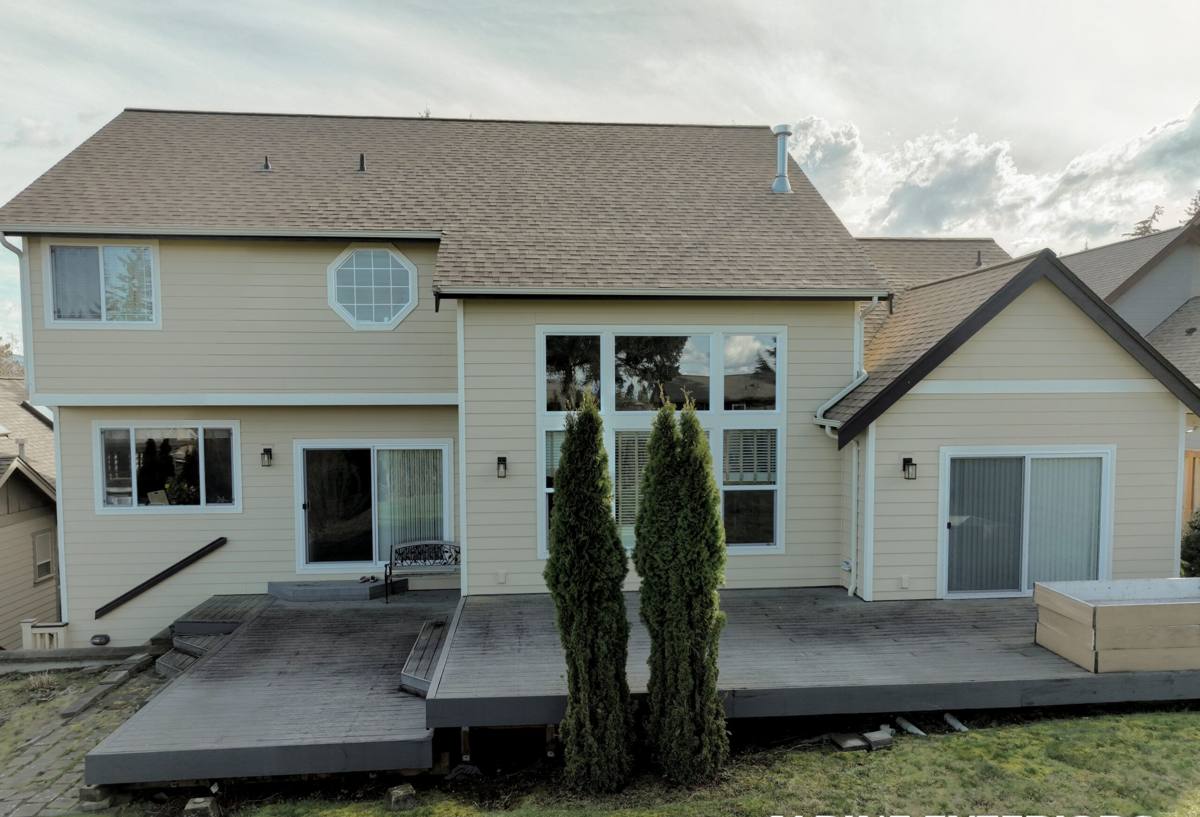
What a Deck Built for This Climate Actually Needs
Drainage first, decoration second
Every deck we build starts with where the water goes, not what the boards look like. That means proper slope away from the house on any solid-surface decking, gaps between boards sized for real airflow, and ledger board flashing that actually sheds water instead of trapping it against the siding. A huge share of the deck failures we get called out to look at in this area trace back to a ledger board that was lag-bolted straight to the rim joist with no flashing at all — it looks fine for years, then the sheathing behind it turns to pulp.
Fasteners and hardware that won't quietly fail
Salt-tainted air corrodes exposed steel faster than most homeowners expect, and corrosion doesn't always show on the surface first — it works on the fastener inside the wood. We use stainless or heavy hot-dip galvanized structural hardware (joist hangers, post bases, through-bolts) rated for coastal exposure, and decking screws matched to whatever material we're installing so there's no reaction between dissimilar metals.
Footings that respect what's actually in the ground
Whatcom County soils vary block to block — some lots drain well, others hold water close to the surface most of the winter. We check what we're footing into before pouring, set posts on concrete footings below frost depth with proper drainage around them, and won't build on a footing that's sitting in standing water half the year just because it's faster.
Decking Material Comparison for Bellingham's Climate
There's no single "best" decking material — there's a best fit for your budget, your maintenance appetite, and how much sun or shade the deck actually gets. Here's how the common options hold up under our rain and moss conditions specifically.
| Material | Moss/moisture resistance | Upkeep | Typical lifespan here |
|---|---|---|---|
| Pressure-treated fir/pine | Fair — needs sealing to resist moss and checking | Annual cleaning and re-sealing | 10-15 years |
| Cedar | Good natural resistance, but greys and can host moss if not cleaned | Periodic cleaning, occasional oil/stain | 15-20 years |
| Composite (capped) | Very good — sheds moisture, resists moss with occasional washing | Low — periodic wash-down | 25-30 years |
| PVC decking | Excellent — non-porous surface | Low — occasional wash-down | 25-30+ years |
We install all of these depending on what a homeowner wants, but we're upfront about trade-offs. Uncapped composite from years ago had real moisture-absorption issues in wet climates like this one; modern capped composite and PVC products don't share that problem, but they cost more up front and some homeowners still prefer the look and repairability of real wood. We'll walk through the honest pros and cons for your specific deck rather than push whatever has the best margin.
The Parts of the Job Homeowners Don't See
A deck that looks right on day one and a deck that's still sound in year fifteen usually differ in places you'd never notice on a walkthrough:
- Ledger board flashing installed as a full system — not caulk alone — with proper step flashing tied into the house's water-resistive barrier
- Joist tape or cap flashing on top of every joist to keep water from soaking into end grain and fastener holes
- Post bases set above the decking surface so posts never sit in standing water
- Blocking and hardware sized to the actual span and load, not just "what's always been done"
- Stair stringers and guard posts anchored with hardware rated for the load, not just screwed to a rim board
Skipping any one of these doesn't show up right away. It shows up in year four or five as soft spots near the house, a wobbly guardrail, or a corner post that's started to lean.
Our Process, From Estimate to Final Walkthrough
- Site visit and assessment — we look at drainage, sun/shade exposure, existing structure (if it's a rebuild), and how the deck ties into the house.
- Honest scope and material discussion — we lay out material options and what each means for cost and upkeep, and answer questions before you commit to anything.
- Permitting — most deck projects in Whatcom County need a building permit; we handle that paperwork so it's not on you.
- Demo and framing — old decking and any compromised framing comes out first; we don't build new surface material over questionable structure.
- Flashing, framing, and inspection — this is where the moisture-management details above get built in, before anything gets covered up.
- Decking, railing, and finish work — surface installation, railings, stairs, and any trim or skirting.
- Final walkthrough — we go over the finished deck with you and explain what maintenance it actually needs going forward.
Repair, Rebuild, or New Build — What Drives the Cost
Not every deck problem means starting over. A deck with sound framing but a tired surface may only need new decking and railing. One with rot at the ledger board or posts usually needs a rebuild from the frame up. Here's what typically moves the price in either direction.
| Cost factor | Pushes cost down | Pushes cost up |
|---|---|---|
| Existing structure | Framing is sound, only surface needs replacing | Rot found at ledger, posts, or joists once opened up |
| Decking material | Pressure-treated lumber | PVC or premium composite boards |
| Height and access | Ground-level, easy site access | Elevated decks needing engineered stairs, guardrails, or extra footings |
| Site drainage | Well-draining soil, simple footing work | Poor drainage requiring extra excavation or drainage systems |
| Permitting complexity | Straightforward replacement, same footprint | Expanded footprint or structural changes requiring engineering review |
We won't know which side of that table your project falls on until we've actually looked at it — which is exactly why the first step is a real site visit, not a phone quote.
Maintenance That Actually Matters in This Climate
Whatever material you choose, a little seasonal attention goes a long way toward getting the lifespan you paid for:
- Sweep debris and standing leaves off the deck surface before fall rains set in — trapped organic matter is what feeds moss and holds moisture against the boards
- Rinse or lightly scrub moss growth in shaded areas rather than letting it establish — moss holds moisture directly against the surface year-round once it takes hold
- Check fastener heads and visible hardware once a year for early rust staining, especially near the water or on exposed, wind-facing decks
- Re-seal or re-stain wood decking on the schedule the product actually calls for, not "whenever it looks dry"
- Keep gutters and downspouts near the deck clear so roof runoff isn't dumping extra water onto or under the structure
- Confirm gaps between boards haven't closed up from swelling — closed gaps trap water instead of shedding it
Why Hiring a Crew That Already Works in Cordata Matters
A lot of deck problems in this area aren't the result of bad workmanship in the obvious sense — they're the result of building to a generic standard instead of a Whatcom County one. A crew that's used to building in drier climates may not think twice about skipping full ledger flashing or using standard-grade fasteners, because in their normal conditions it doesn't fail fast enough to notice. Here, it does. Working regularly in and around Cordata and the rest of Bellingham means knowing which details aren't optional — the flashing, the fastener grade, the footing depth — because we've seen what happens on the decks where a previous builder treated them as optional.
It also means understanding the practical side: what Whatcom County's permitting process actually requires, how local soil and drainage tend to behave, and how to schedule outdoor construction around a rainy season that can otherwise stall a project for weeks if you're not planning around it.
Get a Straight Answer on Your Deck
Whether you're dealing with a deck that's showing its age, planning a new build, or just want a second opinion on something another contractor told you, we're happy to take a look. The estimate is free, there's no pressure attached to it, and you'll get a straight answer about what your deck actually needs — not just an upsell. The form below is the easiest way to get started.