 Bellingham
 Why Birchwood Decks Wear Out Faster Than the Brochure Says
Birchwood sits close enough to the water and the marine weather patterns that move through Whatcom County that decks here take a different kind of beating than decks inland. It's not one dramatic event that ruins a deck — it's the slow accumulation of small, repeated exposures. Salt-tinged air corrodes fasteners and hardware from the inside out, long before the wood itself looks bad. Driving rain, especially the sideways kind that comes with fall and winter storms off the Sound, gets pushed into joints, ledger connections, and end grain that a straight-down rain would never reach. And the moss season here isn't a month — it's most of the year, which means any deck surface that doesn't shed water well stays damp for weeks at a stretch.
None of that is a reason to avoid having a deck. It's a reason to build and replace decks with those specific conditions in mind, rather than using a generic build method that works fine in a drier climate but fails quietly here.
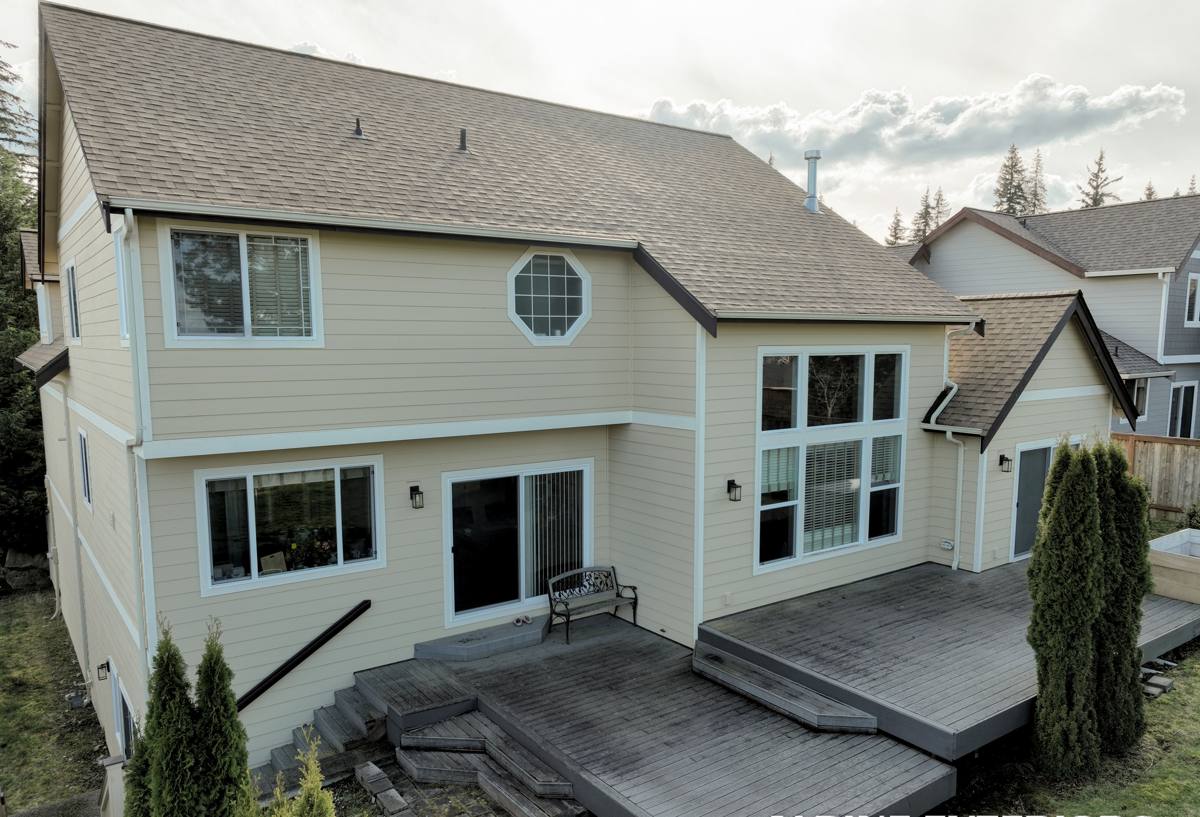
Signs It's Time to Replace, Not Just Repair
Most decks give warning signs well before they become unsafe. The trouble is that surface-level fixes — a new coat of stain, a few swapped boards — can mask a structural problem underneath for a while. Here's what tells us a deck has moved past the point of patching:
- Soft, spongy, or spring-back decking boards, especially near the house or in shaded corners where moss holds moisture
- Rust streaking from fasteners or visible corrosion on joist hangers and post bases
- Any gap, crack, or separation where the ledger board meets the house
- Wobble or movement in the railing when you lean on it
- Posts that feel loose at the base, or footings that look like they're heaving or settling unevenly
- A deck built more than 20-25 years ago with no documented ledger flashing (very common on older Birchwood homes)
- Persistent moss or algae growth that comes back within weeks of cleaning, no matter how well the surface was scrubbed
If it's mostly cosmetic — some graying, a few surface splinters — repair or refinishing is usually the right call. If it's structural, or if the framing has been wet for years, replacement is almost always cheaper in the long run than chasing repairs on a frame that's already compromised.
What a Correct Deck Replacement Actually Involves
A deck replacement is not just swapping old boards for new ones. The parts nobody sees — the ledger connection, the footings, the framing hardware — are what determine whether the next deck lasts 10 years or 30 in this climate.
Ledger Board and Flashing
The ledger is where the deck attaches to the house, and it's the single most common failure point we see on older decks in this area. If it isn't flashed correctly, water gets channeled directly behind the siding and into the rim joist, which can rot both the deck framing and the wall structure behind it before anyone notices. A correct replacement means proper metal flashing integrated with the house's water-resistive barrier, not just caulk over the top — caulk alone doesn't hold up against months of driving rain.
Footings and Frost Depth
Footings need to be sized and set to current code depth, not just poured to match whatever was there before. Undersized or shallow footings are common on older decks and can lead to heaving or settling over time, especially with the freeze-thaw cycles Whatcom County sees in winter.
Framing, Hardware, and Fasteners
In a marine-influenced climate, the grade of hardware matters more than it does elsewhere. We use fasteners and structural connectors rated for the higher corrosion exposure this area sees — mismatched or under-rated hardware is one of the fastest ways a deck's structure fails quietly, well before the decking surface shows any wear.
Choosing Decking Material for This Climate
There's no single "best" decking material — there's a best fit for how much upkeep you want to do and how the deck sits relative to shade, moisture, and moss exposure. Here's an honest comparison for Birchwood conditions:
| Material | Moisture & Moss Behavior | Maintenance | Typical Lifespan Here |
|---|---|---|---|
| Pressure-treated wood | Prone to moss and mildew in shaded, damp spots if not cleaned regularly | Annual cleaning and periodic staining/sealing | 10-15 years with upkeep |
| Cedar | Naturally moisture-resistant but still needs sealing to prevent graying and moss buildup | Sealing every 1-2 years | 15-20 years with upkeep |
| Composite decking | Doesn't rot, but can still grow surface moss/algae in shaded, low-airflow areas — needs occasional washing | Low; occasional washing, no staining | 25-30 years, backed by manufacturer warranty |
| PVC/capped polymer | Best moisture resistance of the group; sheds water and resists moss better than any wood option | Lowest; wash as needed | 25-30+ years, backed by manufacturer warranty |
We'll walk you through the real trade-offs for your specific deck — sun exposure, how much shade it gets, and how much maintenance you actually want to do — rather than steering everyone toward the same product. Cost for a full replacement varies widely depending on size, material, height, and railing style; most Birchwood projects land somewhere between a few thousand dollars for a smaller wood deck and well into five figures for a larger composite or PVC deck with custom railings. We'll give you a firm, itemized number after we've actually looked at the site.
Permits, Guardrails, and Code Basics
Most deck replacement work in Bellingham requires a permit, particularly anything structural or attached to the house — this isn't optional paperwork, it's what confirms the ledger, footings, and framing meet current code. Decks above a certain height above grade also need code-compliant guardrails and, where applicable, stairs with proper rise, run, and handrail requirements. We handle the permit process as part of the job rather than leaving it to the homeowner to sort out, and we build to the current code requirements rather than just replicating whatever was there before — even if the old deck predates those requirements.
Our Process, From Estimate to Final Walkthrough
- On-site assessment — we look at the existing deck's condition, ledger connection, footings, and framing to determine whether repair or full replacement is the right call
- Written estimate — a clear breakdown of materials, scope, and cost, with material options explained honestly rather than upsold
- Permit and planning — we pull the necessary permits and schedule around Bellingham's weather windows where possible
- Demolition and disposal — old decking, framing, and any compromised ledger material removed and hauled off
- Structural rebuild — footings, framing, ledger flashing, and hardware installed to current code
- Decking, railing, and finish work — surface material and railings installed per your chosen option
- Final walkthrough — we inspect the finished deck with you and cover basic care for whatever material you chose
Why a Crew That Already Works Birchwood Matters
A deck built by someone unfamiliar with this area's weather pattern often looks fine on day one and starts showing problems within a few wet seasons — moss taking hold faster than expected, hardware corroding ahead of schedule, a ledger connection that wasn't flashed for the amount of driving rain this area actually gets. Crews who work Birchwood regularly build with that exposure already factored in: the flashing details, the hardware grade, the footing depth, and the material recommendations are all chosen with Whatcom County's marine climate in mind from the start, not adjusted after something fails.
Keeping Your New Deck Looking Right
Whatever material you choose, a little seasonal attention goes a long way toward avoiding the moss and moisture issues that shorten a deck's life here:
- Sweep or blow off leaves and debris regularly, especially in fall — trapped organic matter is what moss feeds on
- Rinse or wash the surface at least once or twice a year, more often in shaded areas
- Check that gaps between boards stay clear so water can drain instead of pooling
- Inspect the ledger connection and flashing annually for any gaps, cracking, or staining
- Re-seal or re-stain wood decking on schedule rather than waiting until it looks worn
- Trim back overhanging branches or vegetation that keeps sections of the deck shaded and damp
If your Birchwood deck is showing its age, we're happy to take a look and give you a straight answer on whether it needs repair or full replacement, along with a free, no-pressure estimate. Use the form below to get started.