 Bellingham
 Window Installation in Lynden Is Its Own Job, Not a Catalog Order
Lynden sits in the Nooksack River valley, a few miles from the Canadian border, and it has its own weather personality within Whatcom County. Winters are damp and grey for long stretches, spring brings wind-driven rain off the Pacific, and the humidity from surrounding farmland and river bottomland keeps moisture around homes longer than in drier parts of the state. That combination is hard on windows, and it's harder on windows that were installed without accounting for it. A window that would perform fine in a dry inland climate can fail early here if the flashing, sealant, and fit aren't done right the first time.
We install windows across Whatcom County, and Lynden gets a good share of our calls every year — everything from older farmhouses with original wood-frame windows to newer builds where a window was installed slightly out of level and has been fighting condensation and drafts ever since. This page is about what correct window installation looks like specifically for Lynden homes, what to watch for, and how we approach the job.
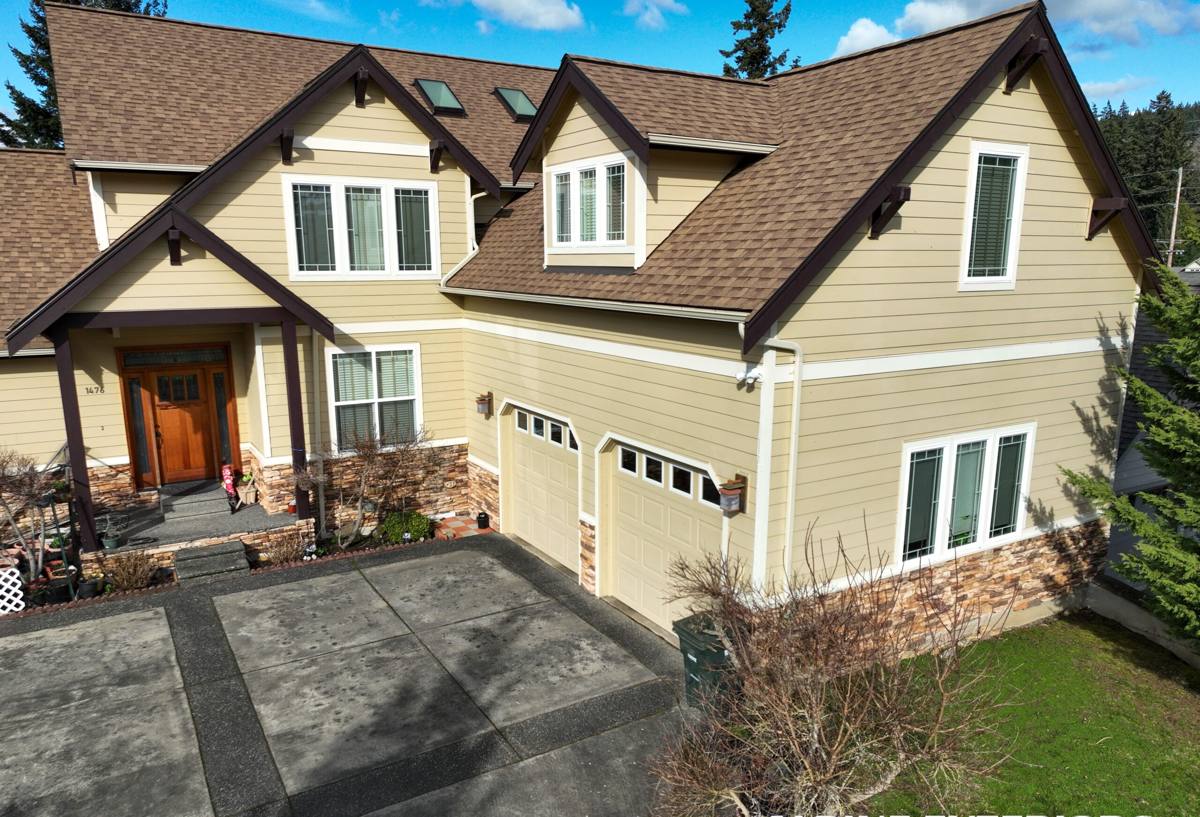
What Whatcom County's Climate Does to Windows Over Time
Driving Rain and Wind-Driven Water
Rain here doesn't just fall straight down. Storms moving through the valley push rain sideways against west- and south-facing walls, and that means water is constantly testing every seam around a window opening. A window that's caulked well but not properly flashed underneath will let water behind the trim eventually — it's a matter of when, not if. Once water gets behind the siding and into the wall cavity around a window, it can sit there for months before you see a stain, a soft spot in the drywall, or a musty smell in that room.
Moss, Mildew, and the Long Wet Season
Whatcom County's wet season runs long, and anywhere moisture collects — window sills, the bottom corners of frames, gaps where caulking has pulled away — moss, algae, and mildew will eventually take hold. On older wood windows this is often the first visible sign of a bigger problem underneath, because moss holds moisture against the wood far longer than open air would. On newer vinyl or fiberglass windows it's usually cosmetic, but persistent black mildew streaking at the bottom corners of a window is worth a closer look, since it can point to a drainage path that isn't working the way it should.
Signs Your Lynden Home Needs New Windows
Not every issue means full replacement, but these are the patterns we see most often on service calls in this area:
- Fogging or a permanent haze between the glass panes — the seal has failed and the insulating gas is gone
- Windows that are difficult to open, painted shut, or feel swollen in wet weather
- Visible gaps between the window frame and the trim, or daylight visible around the edges
- Soft or discolored wood on the sill or lower frame corners
- A noticeable draft near the window even when it's fully closed and latched
- Rising heating bills without any other explanation, especially in rooms with older single-pane or early double-pane windows
- Condensation forming on the inside of the glass regularly through fall and winter
Any one of these on its own isn't necessarily an emergency, but a few of them together on the same window usually means the seal or the surrounding assembly has broken down and repair won't hold for long.
What a Correct Window Installation Actually Involves
The window unit itself matters, but most window failures we get called out for in Lynden weren't caused by a bad window — they were caused by an installation that skipped a step you can't see once the trim is back on.
Flashing and Water Management
Every window opening needs a drainage path so that any water that does get past the exterior finish has somewhere to go besides your wall framing. That means a sloped sill pan at the bottom of the opening, flashing tape or building paper integrated correctly with the house's water-resistive barrier, and a head flashing above the window that sheds water out and away rather than letting it pool. Done in the wrong order, or with materials that don't overlap correctly, this system fails quietly — you won't know until there's damage inside.
Air Sealing and Insulation
The gap between the window frame and the rough opening needs to be sealed and insulated without over-packing it, which can bow the frame and cause the window to bind or operate poorly. Low-expansion foam or backer rod and sealant, applied correctly around the full perimeter, cuts drafts and keeps moist interior air from condensing inside the wall cavity — a real issue in a climate as humid as ours.
Fit, Not Just Fasten
A window has to be set plumb, level, and square, and shimmed so it isn't relying on the fasteners alone to hold its shape. An out-of-square window will bind, won't latch cleanly, and puts uneven stress on the seals — which is often exactly what leads to the early seal failures and fogging we mentioned above. This is the step that separates a window that lasts twenty-plus years from one that starts causing problems in three or four.
Choosing the Right Window Material for This Climate
There's no single "best" window material — the right choice depends on your budget, the style of the home, and how much upkeep you want to take on. Here's how the common options generally hold up in Whatcom County's wet, humid conditions:
| Material | Moisture Performance | Maintenance | Typical Trade-Off |
|---|---|---|---|
| Vinyl | Good — won't rot, doesn't need painting | Low — occasional cleaning | Frame color/style options are more limited than wood |
| Fiberglass | Very good — stable in temperature and moisture swings | Low | Higher upfront cost than vinyl |
| Wood (clad exterior) | Good if the exterior cladding and flashing details are done right | Moderate — interior wood finish upkeep | More installation-sensitive; a poor install shows up faster |
| Solid wood (uncladded) | Requires diligent upkeep in a climate this wet | High — regular painting/sealing | Best suited to homeowners committed to the maintenance schedule |
For most Lynden homes, we recommend vinyl or fiberglass for straightforward energy performance and low maintenance, and clad-wood options when matching a historic or higher-end architectural look matters more than minimizing upkeep. Whatever material you choose, the installation quality matters more to long-term performance than the brand name on the frame.
New Construction vs. Replacement Windows
If you're building an addition or a new structure, the window goes into a fresh rough opening, and we control the flashing and water management from scratch — that's the more straightforward scenario. Replacing an existing window is a different job: we're working with an opening that's already been exposed to Whatcom County weather for years, sometimes decades, and there's often hidden rot, poor original flashing, or settling that needs to be addressed before a new window goes in. We always check the condition of the rough opening and surrounding framing before we install, and we'll tell you honestly if there's more going on than the window itself — patching over a rotten sill with a new window on top just delays a bigger repair.
Our Installation Process
We keep this straightforward and communicate clearly at each step:
- On-site assessment — we look at the existing window, the condition of the opening, and talk through what you want out of the replacement (energy performance, sound reduction, appearance, egress requirements for bedrooms, etc.)
- Measurement and product selection — accurate measurements matter more than people expect; we account for the rough opening condition, not just the visible window size
- Removal — we remove the old window and inspect the framing, sill, and sheathing before anything new goes in
- Repair if needed — any rot, water damage, or compromised framing gets addressed before installation, not covered up
- Installation — sill pan, flashing, shimming to plumb/level/square, air sealing, and fastening per manufacturer specs
- Exterior and interior finish work — trim, caulking, and touch-up so the finished job looks intentional, not patched
- Walkthrough — we operate every window with you before we consider the job done
Why a Crew That Already Works Lynden Matters
Lynden has a wide mix of housing stock — older farmhouses with original wood windows, mid-century homes, and newer construction on the edges of town — and each comes with its own quirks. Older homes often have rough openings that are slightly out of square after decades of settling, which changes how a replacement window needs to be shimmed and sealed. Newer homes sometimes have house-wrap and flashing details that were rushed during a fast build cycle, which we check rather than assume are correct. Knowing the local building patterns, working around Whatcom County's wet-season scheduling, and understanding what Lynden's climate actually does to a window over ten or twenty years all shape how we approach every install — it's not the same playbook you'd use in a drier climate.
Questions to Ask Before You Hire a Window Installer
- Do you inspect and repair the rough opening before installing, or just install over what's there?
- What flashing and sill pan method do you use, and why?
- Is the installation itself warrantied separately from the manufacturer's product warranty?
- Are you licensed and insured to work in Washington State?
- Can you walk me through how water is managed around this specific window opening?
- Do you have experience with homes of similar age and construction to mine in this area?
A contractor who can answer these clearly and specifically — not with a generic sales pitch — is usually the one who'll still be around if something needs attention down the road.
If you're noticing drafts, fogged glass, or moisture issues around your windows, or you're planning ahead for a remodel, we're happy to take a look and give you a straightforward, no-pressure estimate. Use the form below to get started.