 Bellingham
 Fiber Cement Siding Built for South Hill
South Hill sits up above downtown Bellingham with a mix of older character homes and newer infill, most of it catching more wind and rain exposure than homes tucked into flatter, more sheltered parts of town. That elevation and exposure is part of what makes the neighborhood desirable — the views are real — but it also means the siding on a South Hill home is doing more work than siding on a comparable house a mile inland. Salt-tinged air off Bellingham Bay, wind-driven rain that doesn't fall straight down, and a moss season that can run most of the year on shaded and north-facing walls all combine to put steady pressure on whatever material is covering the exterior.
We install James Hardie fiber cement siding exclusively, and on South Hill specifically, we've built our process around the hillside's particular mix of wind exposure, moisture, and older wall assemblies that weren't always built to today's moisture-management standards. This page covers what that means in practice — for the material, for the installation, and for how we run a project on this part of the hill.
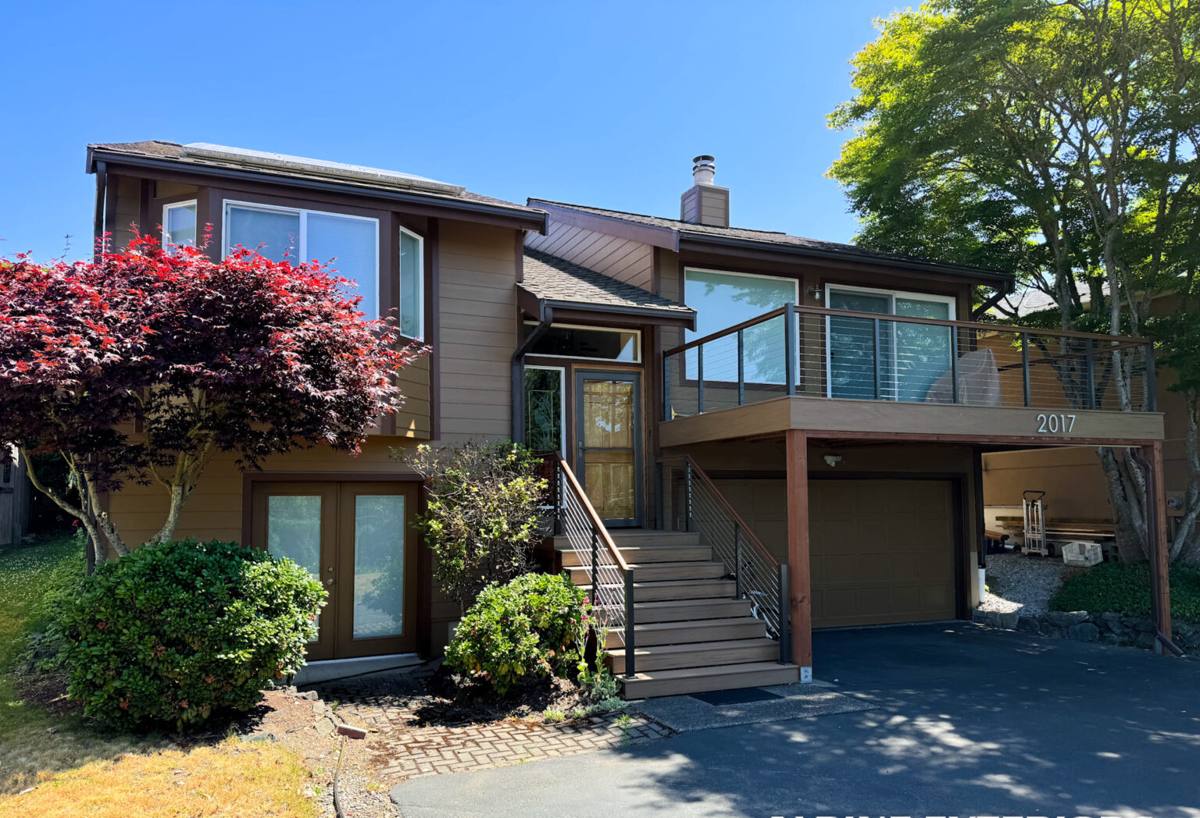
What South Hill's Climate Does to Siding Over Time
Wind and Salt Air at Elevation
Homes higher up on South Hill generally see more direct wind than houses sheltered by trees or lower terrain closer to the water. That wind carries salt-tinged marine air from Bellingham Bay and drives rain sideways into walls rather than letting it run straight off a roofline. Over years, that combination is hard on fasteners, on caulked joints, and on any siding material that depends on a painted surface film to keep water out rather than a material that's inherently water-resistant at its core.
A Long, Damp Moss Season
Whatcom County's marine climate keeps humidity high for much of the year, and shaded or north-facing walls on South Hill's tree-lined streets stay damp longer than sun-exposed ones. That dampness is exactly what moss, algae, and mildew need to take hold. Once organic growth establishes itself on a wall, it holds moisture against the surface even longer, which accelerates whatever damage the material was already prone to.
Older Wall Assemblies
A number of South Hill homes were built well before modern weather-resistive barrier and flashing standards were common practice. That's not a knock on the original construction — it's just a different era of building science. It does mean that when we strip old siding off a South Hill house, we're often finding out for the first time what condition the sheathing and water management underneath are actually in, and planning the reinstall around what we find rather than what we assumed going in.
Why Fiber Cement Fits This Neighborhood
James Hardie fiber cement is a cement, sand, and cellulose fiber composite, not a wood product and not a vinyl product. That composition is the reason it holds up differently than the alternatives in a climate like South Hill's:
- It doesn't rot. Unlike wood or wood-composite siding, fiber cement has no organic wood fiber for moisture to break down over time.
- It's non-combustible. Hardie siding carries a noncombustible material classification, which matters to some homeowners for insurance and wildfire-adjacent building code reasons even in a wet climate like this one.
- The factory finish resists moss better than field-painted wood. Hardie's ColorPlus finish is baked on in a factory, cures harder and more evenly than a site-applied paint job, and gives moss and mildew less texture to grab onto than raw or painted wood grain.
- It's dimensionally stable. Fiber cement doesn't swell and shrink with humidity swings the way wood does, so caulk joints and paint lines hold up longer instead of cracking open every wet-dry cycle.
- The HZ5 product line is engineered for exactly this kind of climate — cold, wet, and humid — with moisture and freeze-thaw performance built into the formulation rather than relying entirely on paint to keep water out.
None of that means fiber cement is maintenance-free. It still needs to be installed correctly, caulked correctly, and kept clear of standing moisture and vegetation contact. But it starts from a material that's working with the climate instead of constantly fighting it.
What a Correct Fiber Cement Installation Involves
Water Management Comes Before Siding
The single most common mistake we find when we open up an older South Hill wall is siding installed directly against inadequate or missing weather-resistive barrier and flashing. Fiber cement is only as good as what's behind it. Before a single course of siding goes up, we confirm the house wrap or building paper is intact and correctly lapped, and that flashing at windows, doors, and any roof-to-wall intersections is directing water out and down, not behind the siding plane.
Clearances and Gaps
Hardie's installation instructions specify minimum clearances — from roof lines, decks, patios, and grade — and a small gap at every butt joint to allow for material movement. Skipping these to save a little trim work is one of the most common shortcuts we see on prior installations, and it's a direct path to trapped moisture at exactly the joints most exposed to South Hill's wind-driven rain.
Fastening
Fiber cement needs to be fastened per Hardie's blind- or face-nailing specifications, with corrosion-resistant fasteners driven to the correct depth — not overdriven, which can crack the board's edge and create a moisture entry point that isn't visible until the damage is already done. In a salt-air environment, fastener material and finish matter more than they would further inland.
Caulking and Sealing
Joints, trim intersections, and penetrations get sealed with a high-quality, paintable exterior sealant rated for the movement and exposure involved — not a bead of whatever caulk happened to be on the truck. This is a small line item that has an outsized effect on how long a wall stays watertight.
Finish
We install Hardie's factory-finished ColorPlus boards wherever the color selection allows it, which eliminates on-site painting for the field of the wall and gives a harder, more uniform, longer-lasting finish than anything applied after installation. Cut edges get factory-matched touch-up product, not generic exterior paint.
Our Process for South Hill Projects
- On-site assessment. We walk the exterior, check existing siding condition, and look specifically at wind exposure, shaded/mossy areas, and any signs of past moisture intrusion around windows, decks, and roof lines.
- Tear-off and sheathing inspection. Once old siding comes off, we inspect the sheathing and existing weather barrier before covering anything back up. This is where older South Hill homes sometimes turn up rot or moisture damage that wasn't visible from outside.
- Repair and water management. Any compromised sheathing gets replaced, and house wrap and flashing get corrected or installed to current standards before new siding goes on.
- Installation to spec. Hardie fiber cement goes up following manufacturer clearance, fastening, and joint requirements — not a generalized "however the last siding was installed" approach.
- Final detailing. Caulking, trim, and touch-up finish work get closed out, and we walk the job with the homeowner before calling it done.
Because we already work this part of Bellingham regularly, we're familiar with the wind patterns, the moss-prone shaded lots, and the older construction quirks that show up on South Hill more than in some of the newer subdivisions further out. That familiarity shortens the assessment phase and reduces surprises mid-project.
Fiber Cement Compared to Other Siding Materials
| Material | Moisture/Rot Resistance | Moss & Algae Resistance | Maintenance | Typical Lifespan |
|---|---|---|---|---|
| James Hardie Fiber Cement | High — non-organic, engineered HZ5 line for wet climates | Good, especially with factory ColorPlus finish | Occasional wash, no repainting for years | Multiple decades with correct install |
| Vinyl Siding | Doesn't rot, but seams and panels can trap moisture behind them | Moderate — smooth surface, but grows moss in shaded, damp spots | Low, but prone to warping, fading, and impact cracking | Variable, often shorter in harsh exposure |
| Cedar / Wood Siding | Lower — organic material, vulnerable to rot without diligent upkeep | Lower — textured wood grain holds moisture and moss well | High — regular sealing, staining, or painting required | Shorter without consistent maintenance |
| Primed Spruce / OSB-based Siding | Lower — engineered wood product sensitive to sustained moisture exposure | Moderate, but edge and seam swelling is a known failure point | Moderate to high, with attention to edge sealing | Shorter if moisture reaches the substrate |
This table reflects general material behavior, not a claim about any specific product's failure rate. We simply made a professional decision, based on how these materials perform in a climate like South Hill's, to install only James Hardie fiber cement.
Cost Factors on a South Hill Project
| Factor | Why It Affects Price |
|---|---|
| Wall height and hillside access | Steeper lots and multi-story walls common on South Hill can require additional staging or lift access |
| Existing siding removal and disposal | Older homes with multiple layers of prior siding take longer to strip than a single-layer tear-off |
| Sheathing or moisture repair | Any rot or moisture damage found once old siding is removed adds material and labor before new siding can go up |
| Siding profile and finish selection | Lap, panel, and shingle-style Hardie products, plus factory color versus site-painted trim, price differently |
| Trim, fascia, and detail work | Homes with more window and roofline detail require more precise cutting and flashing work |
What to Check Before Hiring for This Job
- Ask whether the crew is installing genuine James Hardie product with matching Hardie trim and accessories, not a mixed system
- Confirm they'll inspect and address the sheathing and weather barrier, not just install over whatever is already there
- Ask how they handle clearances at decks, patios, and grade — these are common shortcut points
- Ask about fastener type and corrosion resistance given the salt-air exposure on this part of Bellingham
- Get a clear answer on whether ColorPlus factory finish or site-applied paint will be used, and why
- Ask whether they carry manufacturer certification or training specific to Hardie installation requirements
Why a Crew That Already Works South Hill Matters
Siding installation quality depends heavily on details that are easy to see and easy to skip: clearances, fastener spacing, flashing laps, caulk joints. A crew that already works this part of Bellingham has usually already run into South Hill's specific mix of hillside wind exposure, older wall assemblies, and shaded, moss-prone lots — which means less guesswork and fewer surprises mid-project. It also means we're not learning the neighborhood's quirks on your job; we're applying what we've already seen on others nearby.
If you're weighing a siding replacement on South Hill, we're glad to walk your home, look at what's actually going on with your walls, and give you a straightforward, no-pressure estimate for a correctly installed James Hardie fiber cement system. Use the form below to get started.