 Bellingham
 Why Barkley Roofs Wear Differently Than Roofs Inland
Barkley sits close enough to Bellingham Bay and the Puget Sound shoreline that salt-laden air is a real factor in how roofing materials age here, not just a talking point. Add Whatcom County's long, wet fall-through-spring stretch of driving rain, plus the heavy tree canopy that gives Barkley's streets their shade, and you get a roofing environment that's tougher on materials than a lot of homeowners realize until they're dealing with a leak.
Moss is the most visible symptom. Bellingham's moss season runs long — often eight months or more of the conditions moss needs to take hold: shade, moisture, and mild temperatures that never really dry things out. On a roof, moss isn't just cosmetic. It holds water against the shingle surface, works its way under tabs and flashing edges, and accelerates granule loss on asphalt roofing years before it should be failing.
Driving rain adds a second problem: wind-driven water doesn't just fall straight down, it gets pushed sideways and upward under laps, ridge caps, and flashing that would be fine in a calmer climate. A roof system built for Barkley has to account for that, not just for average rainfall totals.
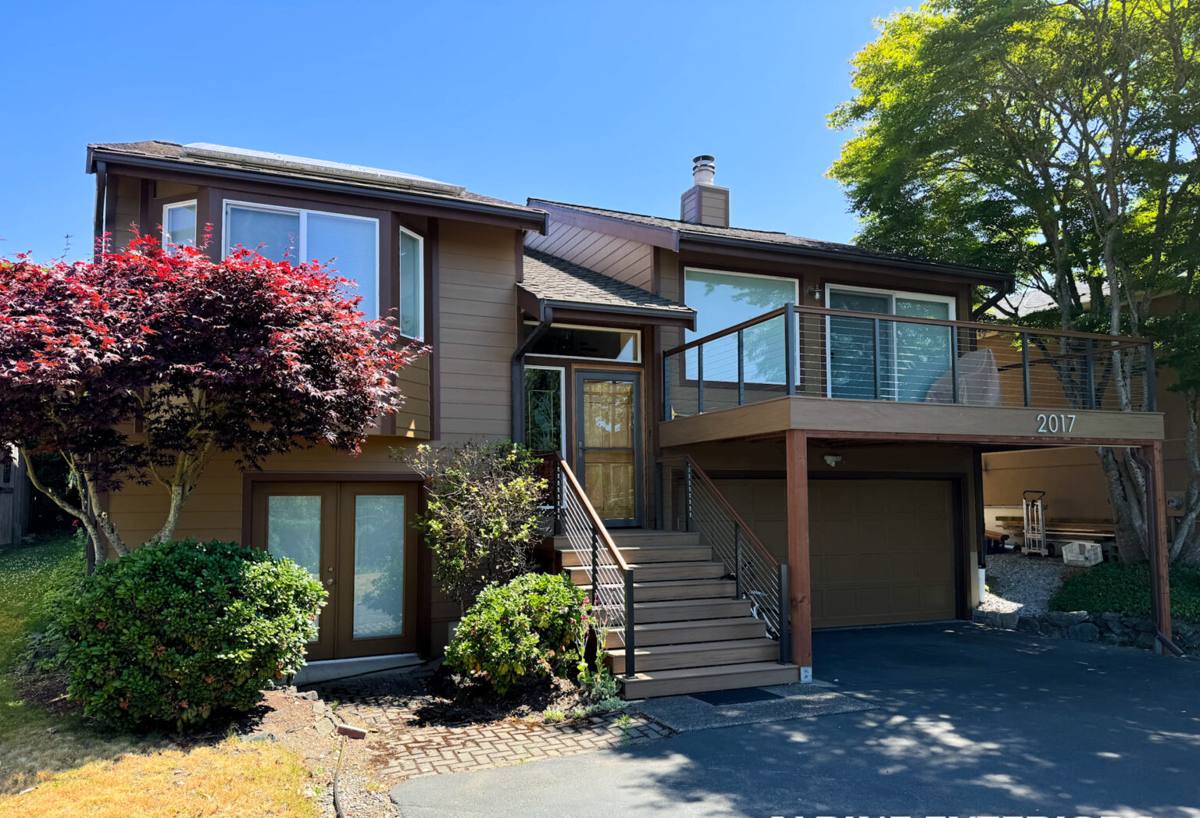
Signs It's Time for Replacement, Not Another Repair
Not every roof problem calls for a full replacement — plenty of Barkley homes just need targeted repair work. But there's a point where patching stops making financial sense. Here's what usually tips a roof from "repair" to "replace" territory:
- Granule loss heavy enough that you're finding grit in gutters and downspouts every time it rains
- Multiple layers of prior repairs, especially around valleys, chimneys, or skylights
- Soft or spongy decking felt underfoot in the attic or during a repair visit
- Moss or moisture staining that keeps coming back in the same spots even after cleaning
- Shingles curling, cracking, or losing their seal on a roof that's already 18-20+ years old
- Daylight visible through the roof deck from inside the attic
If you're only seeing one or two of these, a repair may still be the right call. We'll tell you that directly during an inspection — replacement isn't the answer to every roof problem, and we're not going to sell you one it isn't.
What a Correct Roof Replacement Actually Involves
A roof replacement done right is a system, not a stack of shingles. Each layer has a job, and skipping or cheapening one shows up as a leak two or five years later — often after the visible warranty period has people believing it's covered when it isn't.
Tear-off and deck inspection
Full tear-off to the original decking, not a layover, so we can actually see the condition of the plywood or plank sheathing underneath. Bellingham's moisture load means it's common to find soft or delaminated decking around old flashing points and roof penetrations — that gets replaced, not covered up.
Underlayment and water barrier
Synthetic underlayment across the full roof, with self-adhered ice-and-water shield at the vulnerable spots: eaves, valleys, around chimneys and skylights, and anywhere wind-driven rain has a shot at getting under the shingle line. This layer is what actually keeps a roof dry if wind ever pushes water past the shingles themselves.
Flashing
New flashing at every roof-to-wall transition, chimney, vent pipe, and valley. Reused old flashing is one of the most common causes of "new roof, same old leak" — it's cheaper in the moment and it's a false economy.
Ventilation
Balanced intake and exhaust ventilation so the attic can actually dry out between storms instead of trapping moisture against the underside of the new deck. This matters as much for moss and mold control as anything on the outside of the roof.
Choosing a Roofing Material for Barkley's Climate
There's no single "best" roofing material — the right choice depends on your home's style, your budget, and how much long-term maintenance you're willing to take on. Here's how the common options actually compare for a shaded, damp, salt-air environment like Barkley:
| Material | How it handles moss & moisture | Maintenance | Typical lifespan here |
|---|---|---|---|
| Architectural asphalt shingle | Good with proper ventilation and zinc/copper strips; algae-resistant granules help | Low — periodic moss removal recommended | 20-30 years |
| Standing seam metal | Excellent — sheds moss and moisture with almost nothing for it to grip | Very low | 40-50+ years |
| Cedar shake | Requires diligent upkeep in shaded, damp settings; moss and rot risk is real without regular treatment | High — regular cleaning and treatment | Varies widely with maintenance |
| Composition/3-tab shingle | Fair — thinner profile means less resistance to prolonged moisture exposure | Low-moderate | 15-20 years |
We install cedar shake when a homeowner wants that look and understands the upkeep commitment, but on shaded Barkley lots we're upfront that it's the highest-maintenance option in this specific climate — moisture retention and moss growth are simply harder to manage on wood shakes under a tree canopy than on architectural asphalt or metal. That's a trade-off, not a knock on the material.
Our Roof Replacement Process
- Inspection and honest assessment. We walk the roof and the attic, not just a ground-level look, and tell you plainly whether you need replacement or repair.
- Written estimate. Material options, scope, and price laid out clearly — no vague allowances that turn into change orders mid-project.
- Permitting. We pull the required permit and handle inspections so the job is documented and code-compliant, which matters at resale.
- Tear-off and deck repair. Full removal, deck inspection, and replacement of any compromised sheathing before anything new goes down.
- Underlayment, flashing, and ventilation install. The unglamorous layers that actually determine whether the roof stays dry for its full lifespan.
- Final roofing material installation. Installed to manufacturer specification, which is what keeps the material warranty valid.
- Cleanup and final walkthrough. Magnetic sweep for nails, debris removal, and a walkthrough so you know what was done and what to expect going forward.
The Part You Don't See: Ventilation and Long-Term Moisture Control
A new roof surface can still fail early if the attic underneath it can't breathe. In a climate like Bellingham's, trapped attic moisture condenses on the underside of the decking, encourages mold and rot from the inside, and shortens the life of the roofing material from underneath — independent of anything happening on the outside surface. Balanced ventilation, correctly sized intake vents at the eaves and exhaust at the ridge, is one of the cheapest parts of a roof replacement and one of the most commonly shortcut. We size it to the attic, not to a generic rule of thumb.
What Roof Replacement Typically Costs
Every roof is different, so a real number only comes from an on-site measurement. But the main cost drivers are consistent, and it helps to know what's actually moving the price before you're staring at a quote:
| Cost factor | Why it matters |
|---|---|
| Roof size and complexity | More valleys, dormers, and penetrations mean more labor and flashing detail work |
| Deck condition | Rotted or soft sheathing found during tear-off adds material and labor beyond the base estimate |
| Material choice | Architectural asphalt, metal, and cedar shake carry very different material and labor costs |
| Pitch and access | Steep roofs or limited access require more safety equipment and time |
| Tear-off layers | Removing multiple existing layers takes longer than a single-layer tear-off |
We give a firm written number after inspection, not a phone estimate — a roof is too big a purchase to price without actually seeing the deck and the details.
Why a Crew That Already Works Barkley Matters
Roofing crews who work Barkley regularly already know the practical details that save time and avoid surprises: how tree cover and shaded exposure affect where moss builds up first, what Whatcom County's permitting and inspection process requires, and how to work around the mature landscaping and closer lot spacing that's common in this part of Bellingham. If your home falls within an area governed by architectural guidelines or a homeowners association, we're used to working within that kind of review process and can help you get the paperwork right the first time instead of guessing.
Local experience also means we're not learning on your roof. We know what a healthy Barkley roof looks like at year five versus year fifteen, and that shapes the recommendations we make — including telling you when a repair is genuinely the better call.
After Your Roof Replacement: A Simple Maintenance Checklist
A new roof still needs basic upkeep to hit its full lifespan in this climate. This is the short list we give every Barkley homeowner after installation:
- Clean gutters and downspouts at least twice a year, more often under heavy tree cover
- Have moss growth removed gently before it spreads — don't pressure wash shingles
- Trim overhanging branches back from the roofline to reduce shade and debris buildup
- Check attic ventilation isn't blocked by insulation or storage after any attic work
- Schedule a professional inspection every couple of years, especially after major windstorms
A roof replacement is one of the bigger investments you'll make in your home, and it's worth getting a straight answer about what your roof actually needs before committing to anything. If you're weighing a repair against a full replacement in Barkley, we're happy to take a look and give you an honest read — reach out below for a free, no-pressure estimate.