 Bellingham
 Siding Repair Built for Sehome's Older Homes and Wet Climate
Sehome is one of Bellingham's more established residential pockets, close enough to downtown and Western Washington University that many of its homes have decades of exposure behind them. That means layers of paint, old siding materials, and repairs made by whoever was available at the time. When we get a call for siding repair in Sehome, we're rarely looking at a single clean problem. We're looking at a house that has been through forty or fifty Whatcom County winters, and the siding is telling that story whether the homeowner has noticed yet or not.
Bellingham's climate is not gentle on exterior materials. Salt air drifting in off Bellingham Bay, long stretches of driving rain through fall and winter, and a moss and algae season that can run eight months out of the year all combine to attack siding in ways that drier climates simply don't experience. Sehome's mix of hillside lots and mature tree canopy adds shade and slow-drying conditions on top of that, which is exactly the environment where siding problems get worse instead of better if they're left alone.
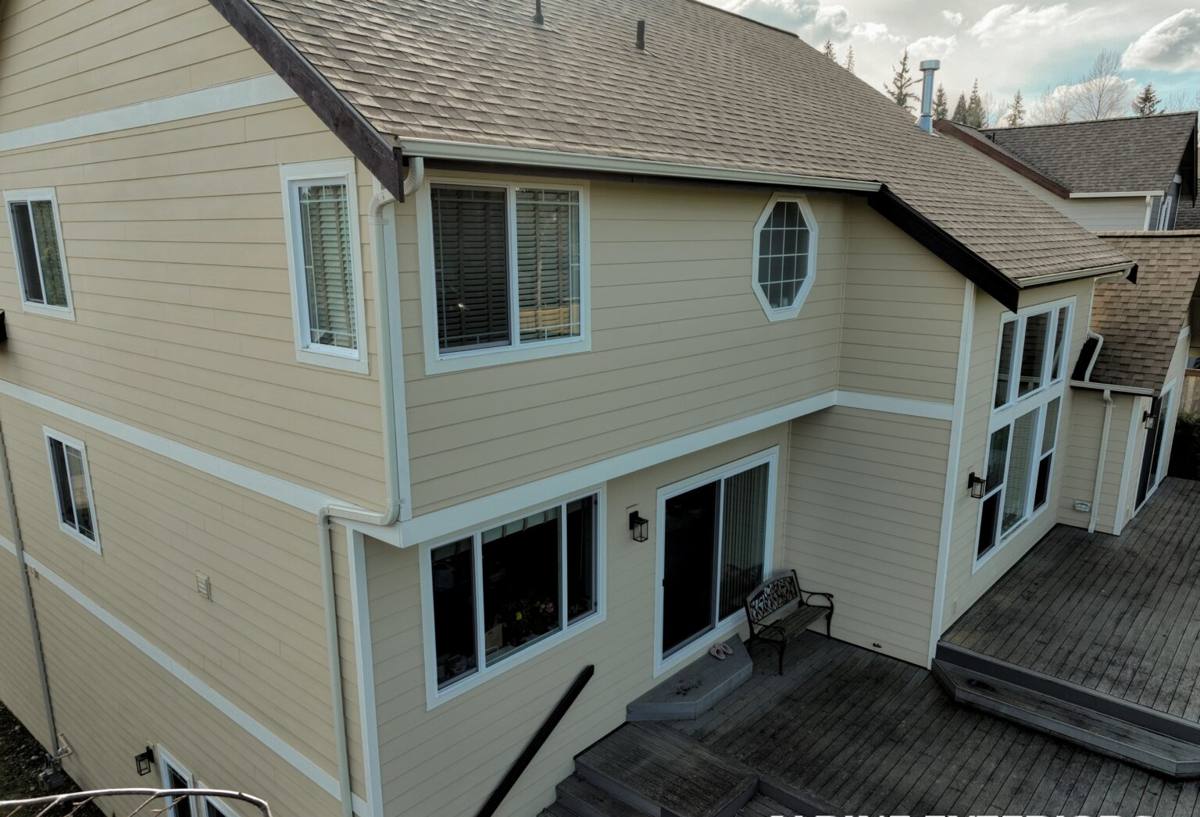
What Actually Damages Siding in This Neighborhood
Before we talk about repair, it's worth understanding what we're repairing against. A few conditions show up again and again on Sehome homes:
- Persistent moisture exposure — Bellingham gets a lot of rain, and a lot of it comes in sideways during winter storms. Siding on the west and south-facing walls of many Sehome homes takes the brunt of it.
- Shade and slow drying — mature trees and hillside orientation common in this neighborhood mean some wall sections rarely get direct sun, so moisture sits longer than it would on a more exposed lot.
- Moss and algae growth — Whatcom County's mild, damp climate is close to ideal for moss. Once it establishes on siding, it holds moisture against the surface and accelerates whatever's underneath it.
- Salt-influenced air — proximity to the bay means airborne salt is a slow, steady contributor to corrosion on fasteners, flashing, and any exposed metal trim.
- Age and material mismatch — older homes in Sehome were sided with whatever was standard at the time, and many have seen partial repairs or additions using a different product than the original, which creates its own set of problems.
Why "It's Just Cosmetic" Is Rarely True
Homeowners often call us about a spot that looks discolored or a board that seems slightly warped, expecting a cosmetic fix. In a wet climate like ours, siding damage is almost never purely cosmetic. Discoloration usually means moisture is getting past the surface. Warping means the material has already absorbed water and is losing its shape. By the time damage is visible from the ground, there's a reasonable chance the sheathing or framing behind it has some moisture exposure too. That's not meant to alarm anyone — most of what we find is manageable — but it's why we recommend a proper inspection rather than a patch-and-hope approach.
Common Repair Scenarios We See in Sehome
Water-Damaged or Rotted Sections
This is the most frequent call. Wood-based siding — cedar, primed spruce, or older composite products — that has been exposed to Bellingham's rain cycles for years without diligent repainting will eventually soften, delaminate, or rot at the edges. We typically find this first at butt joints, around window and door trim, and at the bottom courses near grade, where splash-back keeps the material wet longer.
Failed Caulking and Open Joints
Caulk has a service life, and in this climate it's shorter than most manufacturers' marketing suggests. Once joints open up, wind-driven rain finds its way behind the siding. This is a fast, affordable fix when caught early and a much bigger one when it isn't.
Impact and Storm Damage
Falling branches are a real factor in a tree-heavy neighborhood like Sehome, and winter windstorms off the bay can do real damage to loose or aging siding. Impact damage is usually straightforward to isolate and repair, but it's a good opportunity to check the surrounding panels for pre-existing wear.
Moss and Algae Staining
Not every moss issue requires replacement, but persistent growth that's been left untreated for a long time can degrade the surface underneath it, especially on wood products. We assess whether it's a cleaning issue or a sign of deeper material breakdown.
Flashing and Trim Failures
A lot of "siding" problems are actually flashing problems — around windows, at roof-to-wall intersections, and at trim boards. Repairing the siding without correcting the flashing underneath just resets the clock on the same failure.
How a Correct Siding Repair Actually Works
A repair that holds up in Bellingham's climate isn't just about swapping a damaged board for a new one. It requires the same attention to water management that a full installation does, just at a smaller scale. Here's what that looks like in practice:
- Assess beyond the visible damage. We pull back siding around the damaged area to check the house wrap, sheathing, and framing for moisture intrusion before deciding on scope.
- Identify the root cause. Damaged siding is a symptom. We look for the actual water path — failed flashing, poor caulking, grade issues, gutter overflow — so the same spot doesn't fail again.
- Address any water-damaged sheathing or framing. If moisture has gotten past the siding, that needs to be dried out or replaced before new material goes back on.
- Correct the water management details. Flashing, house wrap laps, and drainage gaps get fixed as part of the repair, not left as-is.
- Match or upgrade the material. We source matching product where reasonable, or recommend a clean transition to Hardie fiber cement where matching isn't practical or where the existing material is the reason the damage happened in the first place.
- Finish to last. Fastening, caulking, and paint or factory finish are done to the same standard as new installation work, not shortcuts specific to "just a repair."
Repair vs. Replacement: How We Help You Decide
Not every siding problem in Sehome needs a full re-side, and we're not going to tell you it does. But there's a point where patching a home riddled with age-related failures stops making financial sense. Here's the general framework we use:
| Factor | Leans Toward Repair | Leans Toward Replacement |
|---|---|---|
| Extent of damage | Isolated to one or two wall sections | Recurring issues across multiple elevations |
| Age of existing siding | Under 15-20 years, sound elsewhere | Original siding is decades old |
| Underlying material | Still structurally sound where undamaged | Widespread softness, delamination, or rot |
| Cause of damage | One-time event (impact, isolated caulk failure) | Chronic moisture pattern tied to the material itself |
| Match availability | Compatible material can be sourced or blended | Original product discontinued or mismatched already |
When replacement makes more sense, our recommendation is James Hardie fiber cement. It's non-combustible, engineered for Pacific Northwest moisture conditions in its HZ5 product line, and finished with ColorPlus factory coating that isn't relying on field-applied paint to hold up against Bellingham's rain and salt air. We don't install vinyl, LP SmartSide, or untreated wood siding, so when a repair conversation turns into a replacement conversation, Hardie is what we're putting on the wall.
What a Sehome Homeowner Should Check Before Calling
A quick visual check can help you describe the problem accurately and gives us a head start on the assessment. It's not a substitute for a professional look, especially at heights or hard-to-see areas, but it helps.
- Soft spots when pressed gently with a hand, especially near the bottom of walls or below windows
- Visible gaps, cracking, or peeling at board joints and seams
- Discoloration or staining that doesn't wash off, particularly dark streaking
- Bubbling or peeling paint, which often signals moisture trying to escape from behind the siding
- Heavy moss or algae buildup, especially on shaded walls
- Any soft or spongy trim around windows and doors
- Gaps where caulking has shrunk, cracked, or pulled away from the siding
Why It Matters to Hire a Crew That Already Works in This Area
Siding repair is very location-specific work. A crew that mostly works in drier parts of the state may not think twice about a repair detail that's a real liability in Whatcom County's rain patterns. Working regularly in Bellingham neighborhoods like Sehome means we already know which wall orientations take the worst weather, how moss behaves on different materials locally, and what water management details actually hold up here versus what looks fine on paper. That local pattern recognition is often the difference between a repair that lasts and one that reopens the same problem in two winters.
It also means faster, more accurate estimates. We're not guessing at how Bellingham's climate affects a given repair — we're applying what we've already seen on homes with similar age, orientation, and exposure in this part of the city.
What to Expect From Our Process
When you reach out about a siding repair in Sehome, the process is straightforward. We start with a visual and, where needed, a probing inspection of the affected area to understand what's happening behind the surface, not just what's visible from the sidewalk. From there, we walk you through what we found, what's causing it, and what your realistic options are — repair, partial replacement, or full re-side — along with honest reasoning for the recommendation. There's no pressure to go bigger than the problem calls for, and no pretending a bigger problem is smaller than it is.
If you're seeing signs of siding trouble on a Sehome home, or you just want a second opinion on something you noticed after the last big storm, we're happy to take a look. Reach out for a free, no-pressure estimate using the form below.