 Bellingham
 Why Siding Wears Out Faster in Sunnyland Than in Drier Climates
Sunnyland is a mature, tree-shaded residential neighborhood, and that combination — established tree canopy plus Bellingham's marine climate — is hard on exterior siding. Homes here take on three kinds of punishment that a house fifty miles inland doesn't face nearly as often: salt-laden air rolling in off Bellingham Bay, wind-driven rain that hits siding sideways instead of falling straight down, and a moss and algae season that can run from early fall through late spring.
Salt air accelerates corrosion on fasteners, flashing, and any metal trim components, and it slowly breaks down paint films and caulking faster than dry-climate exposure would. Driving rain off Pacific storm systems doesn't just wet the face of the siding — it works its way behind poorly lapped boards, undersized flashing, and old caulk joints, which is where the real damage happens. And with Whatcom County's long stretch of damp, mild weather, any wall that stays shaded by mature trees or a neighboring structure can hold moisture for days at a time, which is exactly what moss, algae, and mildew need to take hold and spread across a siding surface.
None of this means Sunnyland homes are unusually fragile. It means the siding has to be matched to the climate, installed correctly the first time, and maintained on a realistic schedule — and older siding, especially original wood lap or early-generation vinyl, was rarely installed with this specific set of stresses in mind.
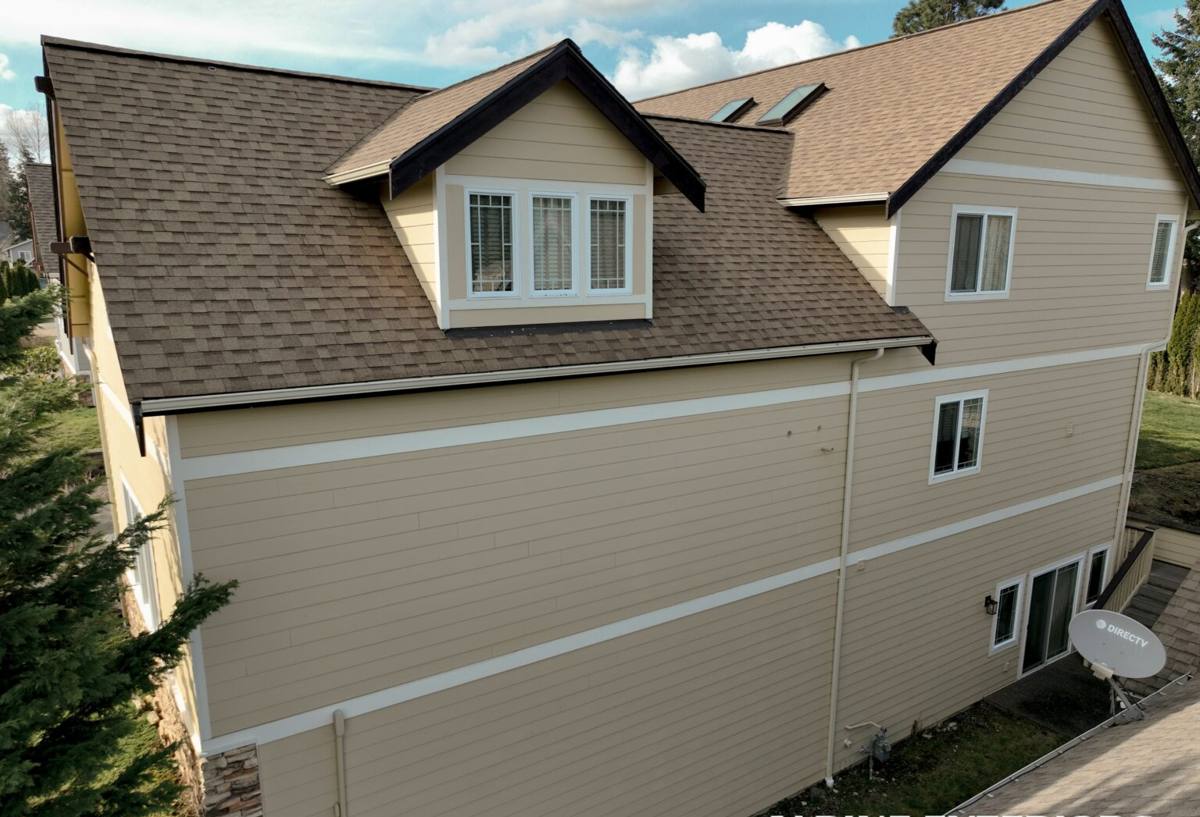
Signs Your Sunnyland Home Needs Replacement, Not Just Repair
A lot of siding problems can be patched. But once you're seeing more than one or two of the items below, patching usually just delays a bigger, more expensive repair later.
- Soft, spongy, or crumbling siding when pressed, especially near the bottom courses or under windows
- Paint that won't hold anymore — repeated peeling or bubbling within a year or two of repainting
- Visible gaps, warping, or cupping in individual boards or panels
- Moss or dark streaking that comes back within weeks of cleaning, particularly on shaded north- and east-facing walls
- Soft trim or sheathing you can find by probing around window and door corners
- A musty smell in an adjoining room, or interior wall staining that suggests moisture is getting past the exterior
- Siding that's original to a home built before the 1990s and has never been fully replaced
What a Correct Siding Replacement Actually Involves
Tear-Off and Inspection
Replacing siding is also the one chance to see what's behind it. Once the old material comes off, we inspect the sheathing for soft spots, check for signs of past water intrusion around windows and penetrations, and confirm the structure underneath is sound before anything new goes up. In a climate like this, skipping that step is how homeowners end up paying to redo the same wall twice.
Weather-Resistive Barrier and Flashing
A continuous, correctly lapped weather-resistive barrier and properly integrated flashing at every window, door, and penetration matter more here than in a dry climate, because the volume and frequency of rain gives water far more opportunities to find a weak point. This is also where a lot of lower-cost siding jobs cut corners — the new siding looks fine on day one, but the water management behind it was never done right.
Installation to Manufacturer Spec
Fastener type and placement, joint treatment, clearances at grade and roofline, and caulking at seams all affect how the siding performs over the next several decades, not just how it looks the week it goes up. Installing to the manufacturer's published specification — not a shortcut version of it — is what keeps the warranty valid and the wall performing as designed.
Why We Install Only James Hardie Fiber Cement
We don't install vinyl, LP SmartSide, Cemplank, Allura, primed spruce, or cedar. That's a deliberate standard, not a lack of options. Each of those products has real strengths, but given what Sunnyland's climate does to a wall over the years, we've concluded James Hardie fiber cement is the material that holds up most consistently with the least ongoing maintenance burden for the homeowner.
| Factor | James Hardie Fiber Cement | Vinyl | LP SmartSide / Wood-Based | Cedar / Primed Spruce |
|---|---|---|---|---|
| Moisture behavior | Engineered to resist swelling and rot; won't absorb water into the substrate | Doesn't rot, but can warp or buckle and traps moisture behind it if flashed poorly | Engineered wood strand core is more moisture-resistant than raw wood but still vulnerable if the surface is breached | Natural wood absorbs and releases moisture constantly, which drives rot over time |
| Moss / algae resistance | Factory finish and dense composition resist staining and are easy to wash | Can host algae/mildew in shaded, damp spots | Similar exposure risk to moss and mildew in shaded areas | Highly prone to moss and mildew in Bellingham's shaded, damp conditions |
| Salt air / coastal exposure | Non-combustible, dimensionally stable, holds finish well near the bay | Can become brittle and discolor faster under UV and salt exposure | Painted surface takes on more of the exposure burden | Salt-laden moisture accelerates checking, cupping, and finish failure |
| Ongoing maintenance | Repainting cycle is much longer with ColorPlus factory finish | Low maintenance but can crack and isn't repairable, only replaceable in sections | Requires disciplined caulk and paint maintenance to protect the wood core | Needs frequent refinishing, sealing, and moss treatment |
| Fire performance | Non-combustible material | Combustible, can melt or deform near heat sources | Combustible wood-based product | Combustible |
| Warranty | Strong transferable manufacturer warranty on the product itself | Varies by manufacturer, often prorated | Varies by manufacturer, often prorated | Typically no manufacturer warranty; performance depends entirely on maintenance |
Every product in that table has a legitimate place in the industry. Vinyl is inexpensive and low-maintenance in the right setting. LP SmartSide has a real following among builders. Cedar has a look some homeowners specifically want. Our position is narrower: for what Bellingham Bay's salt air, driving rain, and moss season do to a wall over twenty or thirty years, James Hardie's engineered fiber cement — with its climate-specific HZ product lines and factory-applied ColorPlus finish — gives homeowners the best combination of durability, appearance retention, and low upkeep. That's why it's the only material we put on a house.
Our Process, Start to Finish
- Walkthrough and assessment — we look at the existing siding, sheathing condition where visible, trim, and any problem areas like shaded walls or spots with a history of moss or moisture
- Written estimate — a clear scope of work covering tear-off, sheathing repair allowances, flashing and weather barrier, the Hardie product and profile selected, and trim work
- Material order and scheduling — James Hardie products are ordered to the home's exact specifications, factory-finished in the selected ColorPlus color
- Tear-off and inspection — old siding removed, sheathing inspected and repaired as needed before anything new is installed
- Weather barrier and flashing installation — the water management layer goes in correctly before the first piece of siding is hung
- Hardie installation to spec — proper fastening, clearances, and joint treatment throughout
- Final walkthrough — we go over the completed job with the homeowner before calling it done
What to Expect After Installation
Correctly installed James Hardie siding is genuinely low-maintenance, but "low-maintenance" doesn't mean "no maintenance," especially in this climate. Plan on an occasional gentle wash to keep shaded walls free of the moss and algae film that builds up during the wetter months, and a periodic look at caulking around windows, doors, and trim joints to catch any separation early. Because Hardie's ColorPlus finish is baked on at the factory rather than field-applied, the repainting interval is dramatically longer than what wood or field-painted products require — but it's not indefinite, and a homeowner who keeps an eye on it gets the longest life out of the material.
Why Hiring a Crew That Already Works in Sunnyland Matters
A siding job goes wrong less often when the crew already understands the specific conditions a house is dealing with — which walls in a shaded, tree-heavy neighborhood are going to stay damp longest, how much clearance to leave at grade given the amount of driving rain this area sees, and what level of flashing detail actually holds up through a Whatcom County winter rather than just looking right on installation day. A crew that treats every job like it's their first Pacific Northwest install is more likely to under-detail the water management, because that's the part of the job that doesn't show up as a problem until a year or two later.
Local familiarity also means fewer surprises around permitting and scheduling — knowing what the City of Bellingham typically expects for a siding replacement permit, and planning work around the wetter months so the house isn't sitting exposed during a storm system.
What Actually Drives the Cost of a Sunnyland Siding Job
Every home is different, so we don't publish blanket pricing — but the real cost drivers are consistent from house to house:
| Factor | Why It Matters |
|---|---|
| Square footage and home shape | More wall area and more corners, gables, and dormers mean more material and more cutting |
| Condition of the sheathing underneath | Rot or damage found during tear-off has to be repaired before new siding goes on |
| Number of stories | Taller walls require more staging, scaffolding, and safety setup |
| Trim and detail complexity | Extensive trim, window casing, and architectural detail add labor time |
| Siding profile and color selection | Different Hardie profiles and factory colors carry different material costs |
The only way to get an accurate number is a walkthrough of the actual house — anyone quoting a firm price without seeing the property first is guessing.
If your Sunnyland home is showing signs of siding trouble, or you're planning ahead before it becomes an emergency, we're happy to walk the property and put together a straightforward, no-pressure estimate using the form below.