 Bellingham
 Fairhaven's Roofs Take a Different Kind of Beating
Fairhaven sits close to Bellingham Bay, and that waterfront exposure shapes what happens to a roof here. Homes near the water catch wind gusts with less to break them up, salt-laden air works into metal flashing and fasteners faster than it does further inland, and the tree cover on many Fairhaven lots means roofs stay damp longer after every storm. None of this is dramatic on its own. It's the combination, repeated over years, that turns small storm damage into a real problem.
Whatcom County gets its share of wind events off the Strait and Bay, and Bellingham's long wet season means a roof rarely gets a full week to dry out completely between storms. Add a solid moss season most winters, and you've got a roof that's under more sustained stress than the "occasional bad weather" picture most homeowners have in their heads.
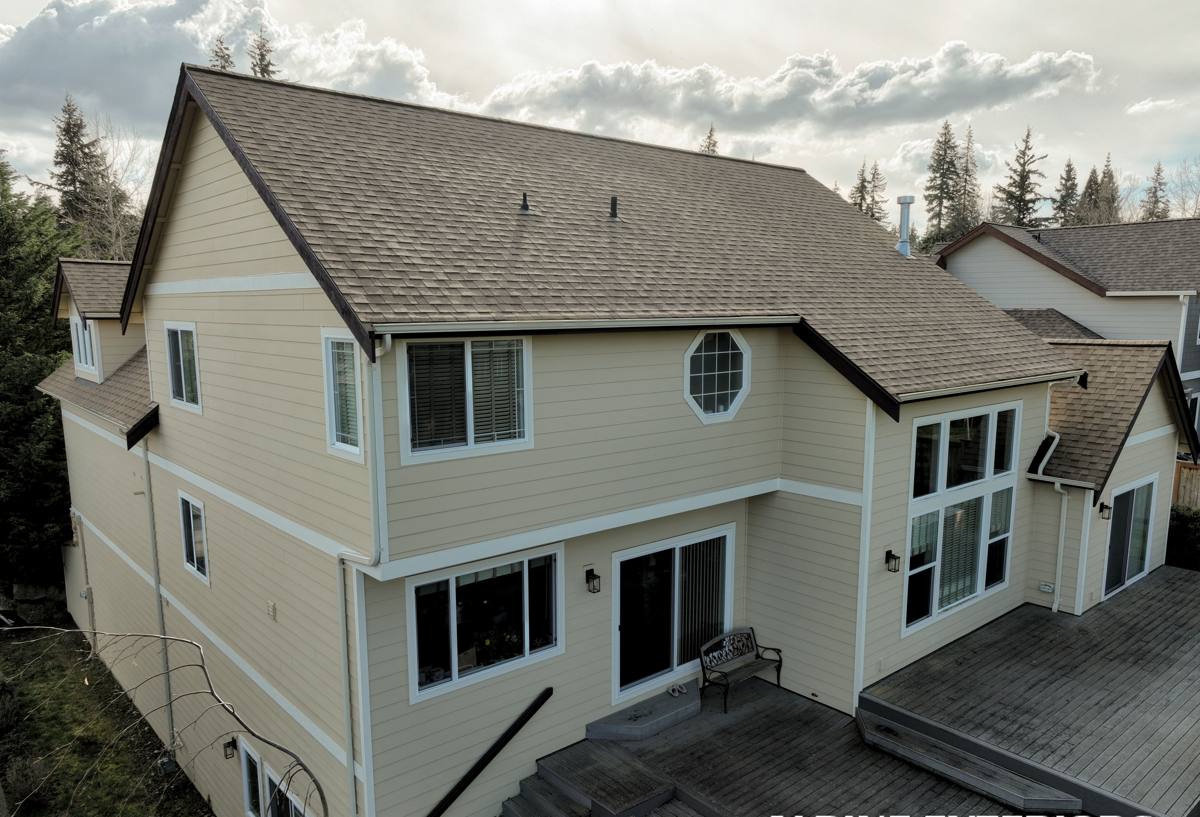
What Storm Damage Actually Looks Like on a Fairhaven Roof
Storm damage isn't always a dramatic hole or a tree branch through the roof deck. Most of what we find after wind and rain events in this area is quieter than that, which is part of why it gets missed.
Wind Damage
Wind rarely tears a roof apart in one obvious event. More often it lifts the edge of a shingle just enough to break the seal, or works a section loose at a ridge or hip where the wind load is highest. The shingle can look fine from the ground and still be unsealed underneath, which means the next rain gets a way in.
Rain and Moisture Intrusion
Driving rain finds any gap in flashing, any nail that's backed out, or any spot where sealant has dried and cracked. On a bay-adjacent property, that moisture doesn't just sit — it interacts with salt residue and organic debris to accelerate corrosion on metal components and rot on wood ones.
Moss and Debris Damage
Moss isn't cosmetic. It holds moisture against the roofing material, lifts shingle edges as it grows, and can work its way under flashing over a season or two. Combined with needle and leaf debris from the tree cover common around Fairhaven, it creates the exact conditions storm water needs to get past the roof's surface layer.
Why Waiting Costs More Here Than Elsewhere
In a drier climate, minor storm damage can sit for a while before it becomes a real issue. That's not really true in Bellingham. Between the rain frequency and the humidity that salt air and tree cover both contribute to, a small breach in the roofing system turns into a wet deck, then insulation damage, then interior staining — often faster than homeowners expect. We regularly see repair jobs that would have been straightforward a month or two earlier turn into deck replacement because water had time to sit.
The other reason to move quickly: most homeowners insurance policies have documentation and timeline expectations tied to storm claims. A roof inspected and photographed soon after a wind or rain event is a much easier claim than one where the damage gets discovered — and questioned — months later.
What a Correct Storm Repair Actually Involves
A proper storm repair is not just "replace the shingles that are obviously missing." Here's what we consider a complete job:
- Full-surface inspection, not just the area reported as damaged — wind and moss damage rarely stay confined to one spot
- Deck inspection where shingles are removed, checking for soft spots, delamination, or existing rot before new material goes down
- Flashing check at every penetration — chimneys, vents, valleys, and roof-to-wall transitions — since this is where most leaks actually originate
- Underlayment assessment, replacing any section that's been wet long enough to lose its water-resistance
- Matching replacement materials as closely as possible in color and profile so the repair doesn't stand out
- Gutter and downspout check, since storm debris and granule loss often show up there first
Skipping any of these steps is how a "repair" ends up needing to be redone within a year or two. The shingles are the visible part of the roof, but the flashing, underlayment, and deck are what actually keep water out.
How We Handle a Storm Damage Call in Fairhaven
1. Inspection and Documentation
We walk the roof (or use a lift/drone where pitch or access makes that safer) and document what we find with photos — condition of shingles, flashing, decking where visible, and gutters. This documentation is useful whether or not you end up filing an insurance claim.
2. A Straight Answer on Scope
We tell you plainly whether this is a repair, a partial re-roof of the affected section, or a case where full replacement makes more sense given the roof's age and condition. We're not incentivized to push you toward the bigger job — a good repair now is often the right call, and we'll say so.
3. The Repair Itself
Work is sequenced to minimize the roof being open to weather — a real consideration in a climate where a dry window can close fast. Materials are matched to what's already on the roof where possible, and every penetration point gets checked, not just the section that failed.
4. Cleanup and Final Walkthrough
Debris and old material removed, gutters cleared of anything knocked loose during the repair, and a final look at the work before we call it done.
Repair or Replace? What Actually Drives That Decision
Homeowners often assume storm damage automatically means a full new roof, or the opposite — that any repair will do. Neither is reliably true. The right call depends on a few concrete factors:
| Factor | Repair Usually Makes Sense | Replacement Usually Makes Sense |
|---|---|---|
| Roof age | Under 12-15 years, or well within expected lifespan for the material | Near or past the material's typical service life |
| Extent of damage | Isolated to one section, slope, or a handful of penetrations | Spread across multiple slopes or recurring in the same areas |
| Deck condition | Solid decking found once shingles are pulled back | Soft, delaminated, or rotted decking in multiple spots |
| Moss/moisture history | First significant moss issue, addressed early | Long-term moss growth with signs of underlying rot |
| Insurance situation | Claim covers isolated storm event damage | Adjuster or inspection reveals broader wear beyond the storm itself |
We'll walk you through where your roof lands on this table honestly — including telling you when a repair is the right, cost-effective answer rather than upselling a replacement you don't need yet.
What to Check After a Storm (Safely, From the Ground)
You don't need to get on the roof to spot warning signs. Here's what's worth a look after any significant wind or rain event:
- Shingle granules collecting in gutters or at downspout outlets
- Shingles that look curled, lifted at the edges, or visibly out of alignment with the rest of the field
- Dented or dislodged roof vents, especially after hail or wind-driven debris
- Gutters pulling away from the fascia or sagging under debris weight
- Visible gaps or lifted metal around the chimney or any roof penetration
- New water stains on interior ceilings or upper-floor walls
- Moss patches that look thicker or darker than before the storm — a sign moisture is sitting longer than usual
Any one of these on its own might be minor. Two or more together are worth a professional look before the next rain event finds the gap.
Why It Matters That We Already Work in Fairhaven
A crew that already works this neighborhood knows what to expect before the ladder goes up — the salt exposure near the water, the moss patterns on shaded, tree-covered lots, and the roof pitches and access challenges common to the area's older housing stock. That's not a small thing when it comes to estimating a job accurately or spotting the second problem hiding behind the first one.
It also matters for response time. Storm damage in Bellingham tends to arrive in waves tied to the same weather systems, and a crew already local to Fairhaven and the surrounding Bellingham area can get eyes on your roof faster than one dispatching from further out — which matters when an open section of roof is sitting under an active weather forecast.
Get a Straight Look at Your Roof
If a recent storm has you wondering whether your roof needs attention, the fastest way to know is to have someone actually look at it. We offer free, no-pressure estimates for Fairhaven homeowners — a clear look at what's actually going on, what it'll take to fix it, and an honest answer on repair versus replacement. Fill out the form below and we'll get back to you.