 Bellingham
 Composite Decking Built for How Barkley Actually Weathers
Barkley is one of Bellingham's newer, more established neighborhoods, and a lot of the homes here were built with outdoor living in mind — decks off the kitchen, elevated platforms over sloped lots, covered spaces for grilling in the rain because, let's be honest, you will grill in the rain. That's exactly why the decking material and the installation details matter more here than a glossy brochure ever suggests. Whatcom County sits right on Bellingham Bay, and Barkley gets the same steady diet of damp air, driving rain off the water, and the long gray stretch from fall through spring when nothing outside truly dries out. A deck built the way it would be built in a drier climate simply doesn't hold up the same way here.
Composite decking has a real advantage over wood in this climate — it doesn't rot, and it won't need refinishing every couple of years. But composite isn't maintenance-free or install-proof, and the mistakes we see most often in this area aren't about the board itself. They're about airflow, drainage, and fastening — the parts of the job nobody sees once the decking is down.
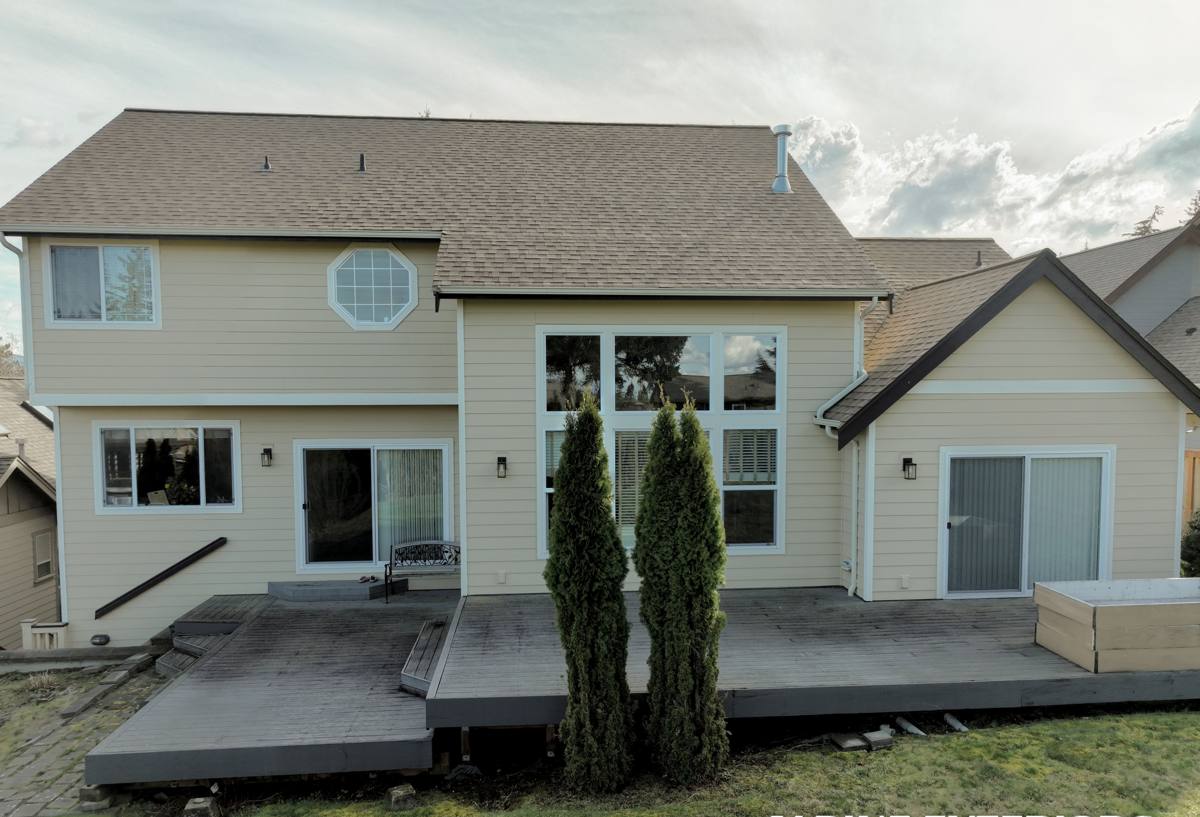
What Salt Air, Rain, and Moss Season Do to a Deck
Salt Air and Metal Fatigue
Proximity to Bellingham Bay means a fine layer of salt in the air, even a few miles inland. Over years, that accelerates corrosion on anything metal — fasteners, brackets, ledger flashing, railing hardware. On a deck, the fasteners are structural. Cheap or mismatched hardware corrodes faster than most homeowners expect, and once a fastener weakens, it's hidden under the board until something moves or squeaks.
Driving Rain and Hidden Moisture
Bellingham doesn't get the heaviest rainfall in Washington, but it gets frequent, wind-driven rain that finds its way sideways under railings, around ledger boards, and into any gap that wasn't properly flashed. Composite boards themselves don't absorb water the way wood does, but the framing underneath — typically still standard lumber — absolutely does. A deck that looks fine on top can be rotting from the joists up if water isn't being shed away from the structure.
Moss Season
Whatcom County's moss season runs long — realistically most of the year in shaded, low-airflow spots. Moss and algae need moisture and shade to establish, and a deck tucked under tree cover or on the north side of a house, common in Barkley's more wooded lots, is exactly that environment. Composite boards with poor surface texture or boards installed without gaps for airflow underneath will grow moss and green algae film faster than most homeowners think possible, and it makes the surface genuinely slick.
What a Correct Composite Deck Installation Actually Involves
The board is maybe a third of what makes a composite deck perform well long-term in this climate. The rest is in details that are invisible once the project is finished:
- Ledger flashing: A properly integrated flashing system where the deck meets the house, so wind-driven rain can't work behind the siding or into the rim joist.
- Joist protection: Joist tape over the framing to keep standing water from wicking into the lumber at every fastener point — the single biggest driver of hidden rot under composite decking.
- Board spacing for airflow: Correct gapping between boards and adequate clearance underneath the deck so air moves, moisture evaporates, and moss has less chance to take hold.
- Hidden fastener systems: Corrosion-resistant, climate-rated fasteners and clips — not whatever came cheapest in bulk — since these are the parts salt air attacks first.
- Proper footing depth: Footings sized and set to local frost depth and soil conditions, especially on Barkley's sloped or fill-graded lots.
- Drainage grading: Ground-level decks graded so water sheds away from the house rather than pooling under the structure.
Skip any one of these, and the composite board on top can look perfect for years while the structure underneath quietly fails.
Choosing the Right Composite Board for This Climate
Not all composite decking behaves the same way in a wet, shaded climate. The biggest distinction is whether the board is fully capped (a polymer shell wrapping the wood-plastic core) or uncapped/partially capped, where more of the core is exposed to moisture.
| Material | Moss & Algae Resistance | Maintenance | Typical Lifespan |
|---|---|---|---|
| Fully capped composite | Best — sealed surface sheds moisture and resists staining | Occasional wash | 25–30+ years |
| Uncapped/mineral composite | Fair — more porous, can absorb surface moisture | Annual cleaning, more attention in shade | 15–25 years |
| Pressure-treated wood | Poor in shade without upkeep | Sealing/staining every 1–2 years | 10–15 years |
| PVC/vinyl decking | Very good, fully sealed | Occasional wash | 25–30+ years |
For most Barkley properties — especially anything with tree cover, a north-facing exposure, or proximity to the water — we lean toward fully capped composite with a textured, grooved surface. The texture matters as much as the cap: a smooth, glossy board sheds water less effectively and shows algae film faster than a board engineered with a slip-resistant, variegated surface.
Our Process for Barkley Projects
1. On-Site Assessment
We walk the site and look at sun exposure, tree cover, slope, and how water currently moves across the yard — all of which affect board choice and framing detail before we ever talk about color or style.
2. Structural Check First
If it's a replacement deck, we inspect the existing ledger, framing, and footings before quoting new decking on top of them. Composite decking on a compromised structure is a short-term fix dressed up as a long-term one, and we won't sell that.
3. Permit and Setback Review
Whatcom County and the City of Bellingham have permitting requirements tied to deck height, size, and proximity to property lines, which we confirm before work starts rather than after an inspection flags it.
4. Build to the Climate, Not the Catalog
Ledger flashing, joist tape, fastener grade, and board spacing get specified for our rain and moss conditions — not generic manufacturer minimums.
5. Walkthrough and Care Guidance
We show the homeowner what routine care actually looks like for their specific board and site conditions, since a shaded lot and a full-sun lot need different maintenance rhythms.
Homeowner Maintenance Checklist
Composite decking is genuinely low-maintenance compared to wood, but "low" isn't "none" — especially in a climate with a real moss season. A simple seasonal routine keeps a well-built deck performing for decades:
- Sweep debris and fallen leaves off the surface regularly, especially in fall — trapped organic material feeds moss and algae growth.
- Rinse the deck and scrub with a soft-bristle brush and mild soap once or twice a year, more often in shaded areas.
- Keep gutters and downspouts near the deck clear so runoff isn't dumping directly onto or under the structure.
- Check railing posts and stair connections annually for any looseness — a sign fasteners may be corroding.
- Keep planters and rugs off the deck for long stretches; they trap moisture against the board surface.
- Trim back overhanging branches where practical to reduce shade and debris load on the deck.
What Drives the Cost
Every composite deck project is different, but the same factors move the price on almost every Barkley job we quote:
| Cost Factor | Why It Matters |
|---|---|
| Board tier (capped vs. uncapped) | Capped boards cost more upfront but resist moisture and moss significantly longer |
| Existing structure condition | Rotted framing or undersized footings need correction before new decking goes down |
| Deck height and access | Elevated decks on sloped Barkley lots require more substructure and railing |
| Railing and stair systems | Composite or metal railing systems vary widely in material and labor cost |
| Permit and inspection requirements | Larger or higher decks may require engineered plans and additional inspections |
We give an honest, itemized estimate up front so there are no surprises once framing is opened up — and if we find a structural issue mid-project, we tell you before we proceed, not after.
Why Hire a Crew That Already Works in Barkley
Building codes, permit review timelines, and typical lot conditions vary by jurisdiction, and a crew that regularly works in Bellingham and Whatcom County already knows what local building officials expect, how Barkley's tree cover and drainage patterns tend to behave, and which fastening and flashing details actually hold up through a full Pacific Northwest wet season rather than just looking good at handoff. That familiarity shows up in fewer surprises during inspection and a deck that's specified correctly for this exact climate the first time.
If you're planning a new composite deck or replacing a tired one in Barkley, we're happy to take a look and give you a straightforward, no-pressure estimate — just fill out the form below.