 Bellingham
 Decking in York: A Different Climate Problem Than Most Composite Ads Admit
Composite decking is marketed as the low-maintenance answer to a wood deck, and in a lot of climates that's a fair pitch. In York, and across Bellingham generally, the pitch needs a footnote. Homes here sit close enough to Bellingham Bay to pick up salt-laden air, get soaked by long stretches of driving rain through fall and winter, and spend months of the year shaded and damp enough for moss to take hold on anything horizontal. A composite deck that's installed the same way you'd install one in a dry inland climate will show problems within a few seasons: green film on the boards, hardware that streaks or corrodes, and a substructure that never really dries out between storms.
None of that means composite decking is a bad choice for York. It's often the right one. It just means the installation details matter more here than they do in a lot of the country, and a deck built to a generic spec sheet isn't automatically a deck built for this climate.
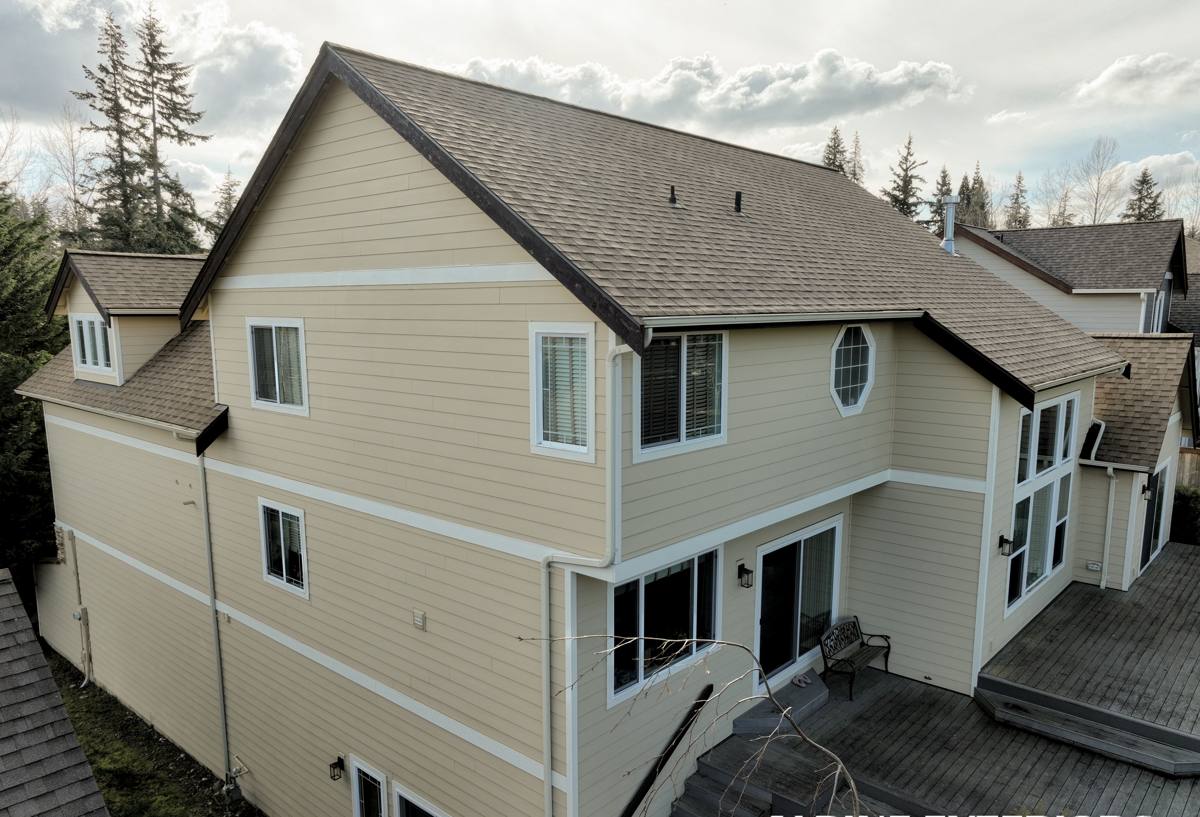
What Whatcom County Weather Actually Does to a Deck
Salt air and moisture together
Proximity to the water means fasteners, flashing, and any exposed metal hardware are working against airborne salt as well as ordinary moisture. Standard coated deck screws and cheap joist hangers corrode faster here than their ratings suggest. It's a slow problem — you won't see it in year one — but it shows up as rust staining on boards and, eventually, as weakened connections.
Driving rain and wind-driven wetting
Bellingham's rain doesn't always fall straight down. Wind off the water pushes it sideways, which means the undersides of boards, the back sides of ledger boards, and any vertical fascia get wetted in ways a "rain falls on top of a deck" assumption doesn't account for. Drainage and ventilation underneath the deck matter as much as what's on top.
Moss season
Shade, moisture, and mild temperatures for months at a time are exactly what moss and algae need. Any decking surface — wood or composite — will grow something green on it eventually if water sits and airflow is poor. The difference is how easy that growth is to remove and how much it damages the material underneath.
Why Composite Makes Sense for This Climate — With Caveats
Composite decking (a blend of wood fiber and plastic, usually with a protective cap layer on today's better products) doesn't absorb water the way solid wood does, doesn't need annual staining or sealing, and won't rot, splinter, or cup from repeated wetting and drying the way an untreated or poorly maintained wood deck will. For a climate that soaks a deck for half the year, that's a real advantage.
The caveat: composite boards can still grow moss and algae on the surface, because that growth feeds on organic debris and moisture sitting on top of the board, not on the board material itself. Composite doesn't rot from that growth the way wood can, but it will look dirty and can get slick if it's ignored. The other caveat is installation-specific: composite boards move with temperature more than solid wood, and they need correct joist spacing, gapping, and fastening or they'll ripple, gap unevenly, or fail at the ends over a few winters of freeze-thaw and soaking cycles.
What a Correct Composite Deck Build Involves
The structure underneath
The composite boards on top are only as good as the framing underneath. For our climate that means:
- Joist spacing tightened to the manufacturer's spec for wet climates — often 12" on center rather than 16", especially for boards installed at an angle or near stair edges
- Joist tape or a moisture barrier on top of every joist, so the composite board's fastener channel isn't sitting directly on bare, repeatedly-wetted wood
- Corrosion-resistant fasteners and hardware rated for coastal or high-moisture exposure, not the cheapest hardware that meets a minimum code rating
- Proper ledger flashing where the deck attaches to the house, since that's the single most common source of hidden rot in any Pacific Northwest deck, composite or not
- Airflow underneath the deck — enough clearance and venting that the substructure can actually dry between rain events instead of staying damp for weeks
The board layout
Manufacturer gapping specs exist for a reason — composite expands and contracts with temperature, and correct gapping keeps that movement from telegraphing into buckled boards or pinched seams. In a climate with big seasonal swings between soaked winter cold and dry summer heat, skipping this step is one of the most common causes of a composite deck looking wavy after a couple of years.
Drainage at grade
A deck built low to the ground, or over a patio or walkway, needs a real plan for where water goes once it comes through or off the decking. In York's rainfall totals, a deck without a drainage plan underneath just becomes a standing-water problem in a different location.
Composite vs. the Alternatives, Honestly
We install composite because for most York homeowners, it's the best balance of upfront cost, appearance, and long-term maintenance for this climate. It isn't the only option, and it isn't right for every budget or every deck. Here's how it stacks up against the two other materials homeowners usually ask about:
| Material | Upkeep in this climate | Upfront cost | Lifespan expectation |
|---|---|---|---|
| Pressure-treated wood | Annual cleaning and re-staining/sealing to fight rot and moss; highest ongoing effort | Lowest | Shortest without diligent upkeep |
| Capped composite | Periodic surface cleaning to remove moss/algae film; no staining or sealing | Mid to upper-mid | Long, backed by manufacturer warranty |
| PVC (all-plastic) | Similar low upkeep to composite; slightly less prone to surface staining | Highest | Long, but less "wood-like" feel underfoot |
We're straightforward with homeowners about wood: it costs less to install, but in a climate that keeps a deck wet for months at a time, the annual maintenance to keep it from rotting or staying mossy adds up in both time and money over the years. That's a trade-off decision for the homeowner to make, not a defect in the material — some people genuinely prefer real wood and are willing to maintain it.
Our Process for a York Composite Deck
1. On-site assessment
We look at the existing structure (if there is one), the grade and drainage around the deck footprint, sun and shade exposure, and how the deck ties into the house. This is where we catch the ledger flashing issues and drainage problems that cause the most damage later.
2. Framing built or corrected for this climate
Whether it's new construction or a rebuild on existing footings, we set joist spacing, moisture barriers, and hardware to a coastal-climate standard, not a bare-minimum code standard.
3. Board selection and layout
We walk homeowners through board options and colors, and lay out the decking pattern to work with the specific deck shape rather than defaulting to the simplest layout.
4. Installation to spec
Correct gapping, fastening, and edge treatment, with attention to stair nosing and rail post attachment — two spots that take the most physical wear and the most water exposure.
5. Walkthrough and care guidance
We show homeowners what routine cleaning actually looks like for their specific board choice, and what to watch for as the deck goes through its first full wet season.
Living with a Composite Deck Through a York Winter
Composite decking is low-maintenance, not no-maintenance. In a climate that grows moss on driveways and roofs, a deck surface needs the same basic attention:
- Sweep debris (leaves, needles, seed pods) off the deck regularly in fall — trapped organic matter under leaves is what feeds moss and algae growth on the surface
- Clean the surface once or twice a year with a soft-bristle brush and a cleaner made for composite decking — pressure washers can be used carefully, but too much pressure or the wrong angle can damage the cap layer on some boards
- Check that gaps between boards stay clear so water keeps draining through instead of pooling
- Keep gutters and downspouts near the deck clear so runoff isn't dumping extra water onto or under the deck surface
- Rinse off salt spray buildup near the water-facing side of the property a bit more often than you would further inland
Why It's Worth Hiring a Crew That Already Works in York
A lot of deck problems we get called to fix aren't caused by bad composite material — they're caused by a build that followed a generic spec instead of accounting for Bellingham's specific combination of rain volume, salt exposure, and shade-driven moss growth. A crew that's already worked on homes in York knows which lots tend to hold water, which sides of a house catch the worst wind-driven rain, and how much shade a given yard actually gets across the seasons — not just on the day of the estimate.
That local knowledge shows up in small decisions: where to add extra ventilation underneath, how tight to run joist spacing on a shaded north-facing deck versus a sun-exposed one, and which hardware upgrades are worth the small extra cost for this specific location. It's the difference between a deck that's technically built to spec and one that's actually built for the house it's attached to.
Questions Worth Asking Before You Commit
Whoever you hire for a composite deck in York, it's worth getting clear answers on a few things before signing anything:
- What joist spacing will they use, and does it match the manufacturer's requirement for this board in a wet climate?
- Will they install a moisture barrier or joist tape over the framing, or just fasten boards directly to bare joists?
- What hardware and fasteners are they using, and are they rated for coastal or high-moisture exposure?
- How is the ledger board flashed where the deck meets the house?
- What's the manufacturer's warranty on the specific board line, and does the installer's workmanship warranty match it?
A contractor who can answer these without hesitation has thought through the climate. One who shrugs and says "composite is composite" probably hasn't.
If you're planning a new deck or replacing an aging one in York, we're happy to take a look and put together a straightforward, no-pressure estimate — just fill out the form below and we'll get in touch.