 Bellingham
 Why Barkley's Climate Is Hard on Siding
Barkley sits inside Bellingham's marine climate zone, and that comes with a specific set of stresses on exterior walls. Even homes a few miles from Bellingham Bay still sit inside the salt-air envelope that rolls in off the water, and Whatcom County's wet season brings months of steady, wind-driven rain rather than the occasional downpour. Add in the tree cover and shaded lots common throughout Barkley's newer and established streets alike, and you get a long moss and mildew season that many other regions never deal with at all. Siding here isn't just cosmetic — it's the first line of defense against moisture intrusion, and the wrong material or a sloppy install shows its weaknesses fast.
Salt Air and Moisture
Salt-laden air accelerates corrosion on fasteners, trim metal, and any siding product with metal or paper-based components. It also holds moisture against exterior surfaces longer than dry inland air does, which matters a lot when you're choosing a siding material and figuring out how it should be fastened and finished.
Driving Rain and Wind-Driven Water
Bellingham's rain doesn't fall straight down — winter storms push it sideways into wall assemblies, testing every seam, joint, and piece of flashing on a house. A siding system is only as good as its weakest water-management detail, and that's where a lot of installations quietly fail years before anyone notices.
Moss, Mildew, and Shade
Shaded, tree-covered lots stay damp longer after every rain event, which is exactly the environment moss and mildew need to take hold. Siding that can't shed water quickly or that traps moisture against its surface will show green and black staining sooner, and in the worst cases that moisture works its way into the substrate underneath.
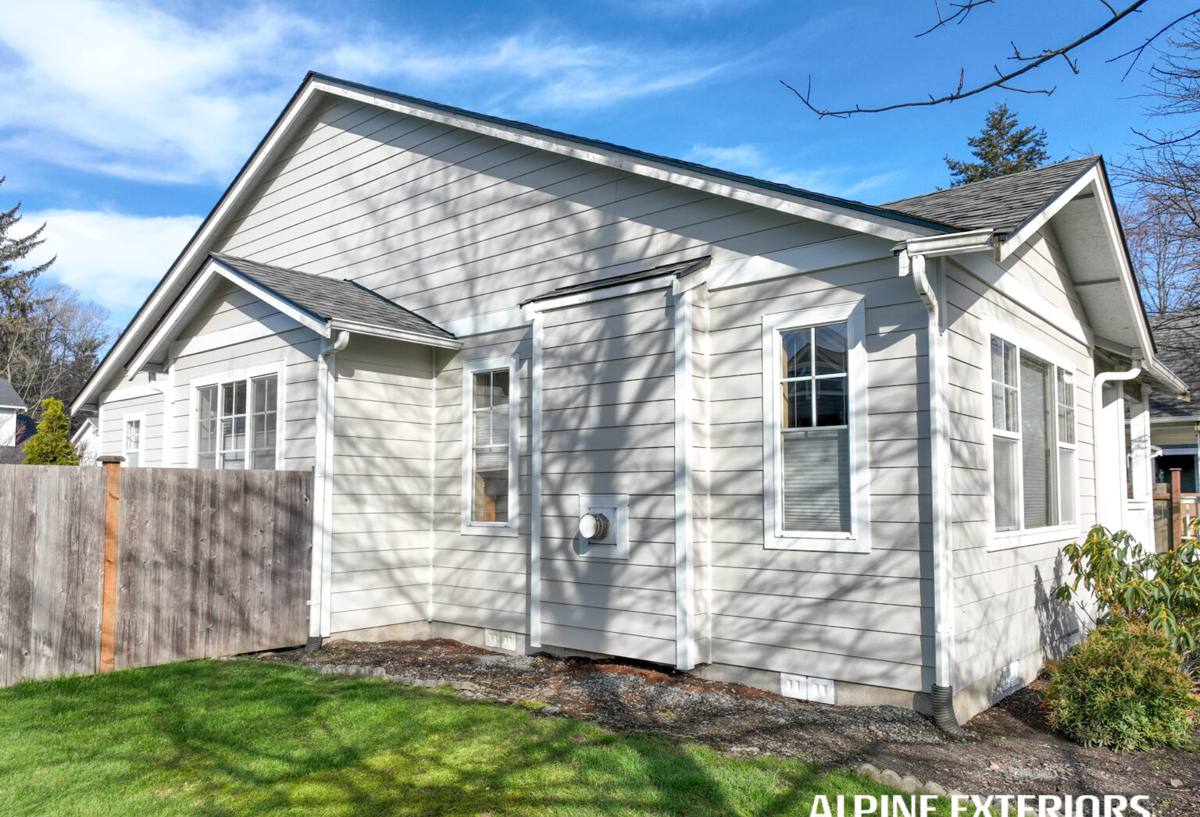
Why We Install Only James Hardie Fiber Cement
We made a deliberate decision as a company to install James Hardie fiber cement siding exclusively — not vinyl, not LP SmartSide, not Cemplank or Allura fiber cement, not primed spruce, and not cedar. That's not marketing; it's a professional standard built around what actually holds up in a climate like Bellingham's, and we think homeowners deserve an honest explanation of why.
Vinyl Siding
Vinyl is inexpensive and low-maintenance in mild, dry climates, but it's a thin plastic product that expands, contracts, and can warp with temperature swings, and it relies almost entirely on the water-resistive barrier behind it rather than the siding itself to keep moisture out. In a region with sustained wind-driven rain, that's a weaker layer of protection than we're willing to put our name behind.
LP SmartSide and Other Engineered Wood
Engineered wood siding has improved a lot over the decades, but it's still a wood-strand product with a manufactured coating, and any coating failure or unsealed cut edge gives moisture a path into the substrate. Once that happens, swelling and delamination follow — a slow failure mode that's expensive to catch early in a wet climate like ours.
Cedar and Primed Spruce
Real wood siding can look great, but it demands a maintenance schedule — recoating, caulking, and inspection — that most homeowners underestimate, and Bellingham's rain and shade make that schedule tighter, not looser. Skip a cycle or two and you're often looking at rot repair instead of routine upkeep.
Other Fiber Cement Brands
Cemplank and Allura are legitimate fiber cement products, but we've standardized on James Hardie for its ColorPlus factory finish, its climate-specific HZ10 formulation for high-moisture regions like the Pacific Northwest, and its warranty structure. Standardizing on one manufacturer also means our crews install it the same correct way, every time, instead of relearning specs for each brand.
What a Correct Fiber Cement Installation Looks Like
Fiber cement siding is only as good as the installation behind it. The material itself is non-combustible and dimensionally stable, but the details — clearances, flashing, fastening, and joint treatment — are what actually determine whether a house stays dry through a Bellingham winter.
Moisture Management Details
Correct installation means proper ground clearance so siding never sits in contact with soil or hardscaping, correctly lapped and sealed flashing at every window, door, and roof intersection, and a drainage plane behind the siding that lets any incidental moisture escape rather than pool. These are the details driving rain finds first, and they're the ones most often shortcut by crews unfamiliar with the product.
Fastening and Joint Treatment
James Hardie specifies fastener type, spacing, and placement for a reason — get it wrong and you invite cracking or reduced wind resistance. Butt joints need to be treated correctly, whether sealed and painted per manufacturer detail or shielded with trim, and factory-cut or field-cut edges need proper sealing before they're closed up behind trim, because an unsealed cut edge is a moisture entry point regardless of how good the rest of the job looks.
Working With ColorPlus Finishes
ColorPlus prefinished panels come with a factory-applied, baked-on finish that's more consistent and more resistant to fading than field-applied paint, but it also means field cuts need touch-up with the matched ColorPlus edge coating rather than a can of exterior paint from the hardware store. Getting this step right protects the finish warranty and keeps the color uniform.
James Hardie Product Lines We Use in Barkley
James Hardie makes several siding profiles, and the right mix depends on the home's style and exposure. On most Barkley homes we're working with a combination of the following:
- HardiePlank lap siding — the standard horizontal lap profile, available in several textures and exposures, and the most common choice for full re-sides.
- HardiePanel vertical siding — used for board-and-batten style facades or accent sections, common on more contemporary Barkley builds.
- HardieShingle siding — a shingle-profile product for homes wanting a shingle-style look without the maintenance burden of real wood shakes.
- HardieTrim boards — matched trim for corners, window and door surrounds, and fascia, so the whole exterior envelope is fiber cement rather than mixing in wood trim that ages differently.
All of these are engineered under James Hardie's HZ10 climate designation, which is formulated specifically for regions with sustained high moisture exposure — Bellingham and the rest of western Washington fall squarely into that category.
Our Process, Start to Finish
We keep the process straightforward and communicate at each stage, because siding work touches every side of a house and homeowners deserve to know what's happening and why.
Assessment and Estimate
We walk the exterior, check the condition of the existing siding, sheathing, and trim, and note anything — soft spots, existing moisture damage, poor flashing — that needs to be addressed before new siding goes on, not covered up underneath it.
Prep and Removal
Old siding comes off, the sheathing gets inspected and repaired as needed, and the water-resistive barrier and flashing details get installed or corrected before a single piece of Hardie siding goes up. This is the stage that determines how the house performs for the next several decades, so we don't rush it.
Installation
Siding, trim, and flashing go on to James Hardie's fastening and clearance specifications, with attention to every joint, corner, and penetration.
Final Walkthrough
We walk the finished exterior with the homeowner, check caulking and touch-up work, and make sure everything meets spec before calling the job done.
What Fiber Cement Siding Costs in Barkley
Every home is different, so we don't quote a number without seeing the house, but the same factors drive cost on most Barkley projects. This isn't a price list — it's what actually moves the estimate up or down.
| Factor | Why It Matters |
|---|---|
| Home size and wall complexity | More square footage and more corners, dormers, and rooflines mean more material and more labor-intensive detail work. |
| Existing siding removal | Tear-off and disposal of old siding adds labor, and the type of siding coming off affects how much care that removal takes. |
| Sheathing and moisture damage | Rot or water damage found once old siding is off needs repair before new siding goes on — this is the most common source of change orders. |
| Trim, window, and door count | Each opening needs flashing and trim work, so homes with more windows and architectural detail take more time per square foot. |
| Siding profile chosen | Lap, panel, and shingle profiles differ in material and labor cost, and mixing profiles for architectural accents adds detail work. |
| Site access | Slope, tight lot lines, and landscaping close to the house affect scaffolding and staging time. |
Maintenance in a Marine Climate
One reason we recommend fiber cement over the alternatives is how little ongoing maintenance it demands compared to wood or engineered wood siding, but "low maintenance" isn't "no maintenance," especially in Whatcom County's climate. An annual rinse to clear moss spores, pollen, and grime off the surface keeps the ColorPlus finish looking sharp, and it's worth a walk-around each fall to check caulking at trim joints and around penetrations before the wet season sets in. Because the material itself is dimensionally stable and doesn't absorb water the way wood does, it resists the swelling, cracking, and rot that drive most siding replacement calls we get from homes with other materials.
Why a Bellingham-Based Crew Matters
Siding work in a climate like ours isn't the same job as siding work in a dry inland region, and a crew that already works Barkley and the rest of Bellingham knows that firsthand — how to sequence a job around our rain windows, how much clearance local moisture conditions actually call for, and what the City of Bellingham's permitting and inspection process expects. That local track record is worth checking before you hire anyone.
- Ask how many James Hardie installations they've completed locally, not just fiber cement in general.
- Confirm they're a factory-trained or certified James Hardie installer, not just a crew that occasionally orders the product.
- Ask specifically how they handle flashing at windows, doors, and roof-wall intersections — this is where most water problems start.
- Get the fastening and clearance specs they plan to follow in writing, not just a verbal assurance.
- Check that they carry proper licensing and insurance for exterior work in Washington State.
- Ask what happens if they find sheathing damage once the old siding is off, and how that's handled in the contract.
If you're weighing a re-side in Barkley, we're happy to take a look and give you a straightforward, no-pressure estimate — no obligation, just an honest read on what your home needs.