 Bellingham
 Edgemoor's Waterfront Setting Puts Real Demands on Siding
Edgemoor sits close to Bellingham Bay, and that proximity to the water is exactly what makes siding decisions here different from a job three miles inland. Homes in this part of Whatcom County take on a combination most siding products were never engineered for: salt-laden air drifting off the bay, wind-driven rain that hits walls sideways instead of falling straight down, and a long, damp moss season that keeps north- and west-facing walls wet for weeks at a stretch. Any one of those factors is manageable. Together, over years, they expose weak siding choices fast.
Salt air is corrosive to fasteners and finishes, and it accelerates the breakdown of coatings that aren't formulated to resist it. Driving rain doesn't just wet the surface of a wall — it tests every seam, joint, and piece of flashing behind the siding, finding the one spot where water intrusion can start. And moss doesn't just look bad; it holds moisture against the wall surface long after a storm has passed, which is a problem for any siding material that isn't dimensionally stable when wet. Replacing siding in Edgemoor isn't just a cosmetic upgrade — it's an opportunity to correct a wall assembly that may have been fighting these conditions for decades with the wrong tools.
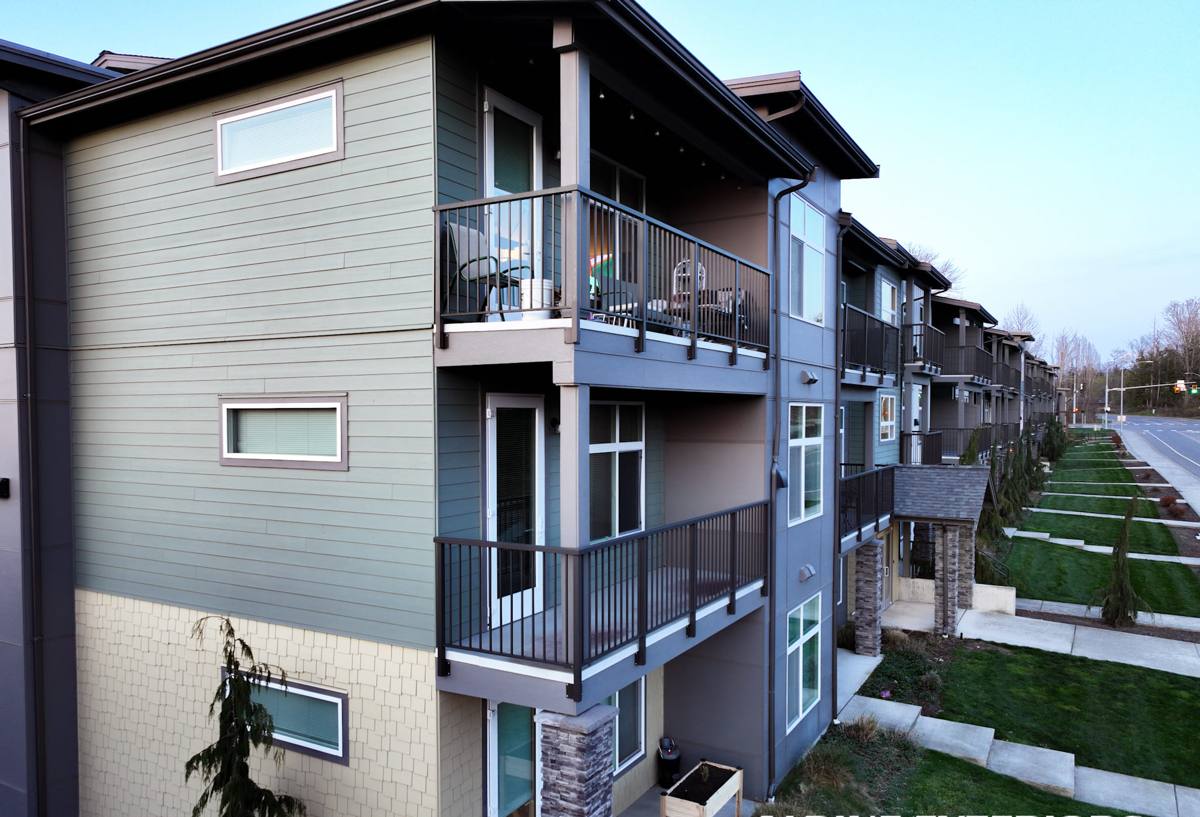
Signs an Edgemoor Home Needs Siding Replacement, Not Just Repair
Homeowners often ask whether a problem area can be patched instead of the whole elevation replaced. Sometimes it can. But in a coastal climate like Bellingham Bay's, visible damage is usually a sign that the problem has been developing beneath the surface for a while. Here's what tends to indicate replacement is the right call rather than a spot repair:
- Soft or spongy spots when you press on the siding, especially near the bottom of walls or under windows
- Paint that keeps failing in the same spots within a year or two of repainting
- Persistent moss or algae growth that returns quickly after cleaning, particularly on shaded or bay-facing walls
- Visible gaps, warping, or buckling in panels, which often points to moisture trapped behind the siding
- Rising energy bills with no other explanation, which can mean the wall assembly is no longer sealing properly
- Interior signs — musty smells, peeling interior paint, or staining near exterior walls
- Siding that's simply past its practical service life for the material it's made from
If you're seeing one or two of these, a repair might buy time. If you're seeing several, or the siding is original to an older home, replacement is almost always the more cost-effective path — repeated repairs on failing siding rarely add up to less than doing the job right once.
What a Correct Siding Replacement Actually Involves
It Starts Underneath the Siding, Not With It
The siding material gets all the attention, but in a climate that delivers driving rain off the bay, the water-resistive barrier and flashing details behind the siding matter just as much — arguably more. A proper replacement means removing the old siding down to the sheathing, inspecting for hidden rot or moisture damage, repairing anything compromised, and installing a correctly lapped weather-resistive barrier with properly integrated flashing at every window, door, and penetration. Skipping this step and simply re-cladding over old problems is one of the most common shortcuts in the industry, and it's the reason siding that looks fine for a year or two can fail from the inside out.
Fastening and Clearances Matter More Near the Water
Fiber cement siding has specific fastening patterns, nailing zones, and clearance requirements — gaps from grade, decks, roofing, and trim — that are engineered to keep water moving away from the wall. In a salt-air environment, fastener selection matters too; the wrong fasteners corrode faster and can streak or stain the siding over time. None of this is optional if you want the siding to perform for its full expected life.
Why We Install Only James Hardie Fiber Cement Siding
We standardized on James Hardie fiber cement siding for every home we side, including in Edgemoor, and we don't install vinyl, LP SmartSide, or other engineered wood or fiber cement alternatives. That's a deliberate professional decision, not a sales position, and it's worth explaining honestly.
Fiber cement is a mix of cement, sand, and cellulose fibers, which makes it dimensionally stable — it doesn't expand, contract, warp, or absorb water the way wood-based products can. That matters a great deal in a climate with a long wet season and persistent humidity. It's also non-combustible, which is an increasingly relevant consideration for homes in Western Washington. James Hardie makes climate-engineered product lines (their "HZ" designations) specifically formulated for different regional exposure conditions, and their ColorPlus finish is a factory-baked, multi-coat finish designed to resist fading and hold up to UV and moisture exposure better than field-applied paint. It's backed by a strong transferable warranty when installed by a certified, spec-following crew.
None of this means other products don't have a place in the market — vinyl is inexpensive and low-maintenance in mild conditions, and engineered wood siding has genuine fans for its look and workability. But for a wall that has to shed driving rain, resist salt air corrosion, and stand up to years of moss and moisture exposure, we've found fiber cement's stability and non-combustibility are worth the difference in material cost. It's what we'd put on our own homes in this climate, so it's what we install.
Material Comparison for Coastal, Wet-Climate Conditions
| Factor | James Hardie Fiber Cement | Vinyl | Engineered Wood (e.g., LP SmartSide) |
|---|---|---|---|
| Moisture stability | Dimensionally stable, doesn't absorb and swell | Doesn't absorb water, but can warp or crack in temperature swings | Wood-based core is more sensitive to sustained moisture exposure |
| Combustibility | Non-combustible | Combustible, can melt or deform near heat | Combustible |
| Finish durability | Factory-baked ColorPlus finish, resists fading | Color is through-body but can fade and chalk over time | Requires field-applied or factory primer plus paint maintenance |
| Salt air / coastal exposure | Engineered HZ lines suited to regional exposure | Generally tolerant, but fasteners and trim can corrode | More maintenance-sensitive in salt air and high humidity |
| Typical warranty structure | Long-term, transferable when installed to spec | Varies by manufacturer, often prorated | Varies by manufacturer, moisture-related claims often scrutinized |
Our Siding Replacement Process
- On-site assessment — We walk the exterior, check for hidden moisture damage, and evaluate the current wall assembly before quoting anything.
- Detailed proposal — You get a clear scope of work: what's being removed, what's being repaired underneath, and exactly which Hardie product and color you're getting.
- Tear-off and inspection — Old siding comes off, sheathing is inspected, and any rot or damage is repaired before anything new goes on.
- Weather barrier and flashing — A properly lapped weather-resistive barrier and correctly integrated flashing go in at every window, door, and penetration.
- Installation to manufacturer spec — Fastening patterns, nailing zones, and clearances are followed exactly, not approximated.
- Final walkthrough — We review the finished job with you before calling it done.
Why Hiring a Crew That Already Works Edgemoor Matters
Siding installation isn't one-size-fits-all, and a crew that regularly works Bellingham's waterfront neighborhoods brings something a general contractor from further inland won't have: a working sense of how bay-facing exposure, prevailing wind direction, and seasonal moss growth actually behave on homes in this specific setting. That shows up in small decisions — where to pay extra attention to flashing, which elevations tend to take the worst of the driving rain, how much clearance to leave near grade and landscaping that stays damp longer near the water.
There's also a practical side: familiarity with Bellingham and Whatcom County permitting requirements, an understanding of the older housing stock common in established neighborhoods like Edgemoor, and the ability to give you a realistic timeline that accounts for the region's weather windows rather than a generic estimate. Siding replacement is a job you want done once, correctly — not revisited in five years because it was installed by someone unfamiliar with what this climate does to a wall.
Protecting Your Investment After Installation
One advantage of fiber cement siding installed to spec is how little ongoing maintenance it asks for compared to wood-based alternatives — no repainting cycle every few years, no caulking that has to be babied. That said, a few habits go a long way in Edgemoor's climate specifically:
- Rinse siding periodically to keep salt residue and organic growth from building up, especially on bay-facing walls
- Keep gutters clear so water isn't sheeting down the siding face during heavy rain
- Trim back vegetation and landscaping that keeps a wall section shaded and damp
- Have caulking and trim joints checked periodically, even with low-maintenance siding — these are still the first line of defense against water intrusion
None of this is labor-intensive, but skipping it entirely shortens the life of even a well-installed system.
Get a Straightforward Estimate
If your Edgemoor home's siding is showing its age, or you'd just like an honest read on whether repair or full replacement makes sense, we're happy to take a look. The estimate is free, there's no pressure, and you'll get a clear explanation of what we find and why we'd recommend the approach we do. Use the form below to get started.